By The Free Press | Created at 2026-09-17 10:13:57 | Updated at 2026-10-07 19:51:08
2 weeks ago
By The Free Press | Created at 2026-09-17 10:13:57 | Updated at 2026-10-07 19:51:08
2 weeks ago
Produced by ElevenLabs using AI narration
It’s Thursday, September 17. This is The Front Page, your daily window into the world of The Free Press—and our take on the world at large. Today: Douglas Murray asks, why do we allow terrorists to die of old age? The American nonprofits backing Hamas. A conversation with Dara Horn and Coleman Hughes. And much more.
But first: inside the unlikely coalition warning that AI may kill us all.
Last week, an AI researcher named Jacob Coxon made headlines around the world after saying that he had resigned from Anthropic because he believes AI might cause human extinction—and his co-workers do, too. Unlike the rest of us, potentially, the story just won’t die.
The Pro-Human Assembly, a conference held Tuesday in Washington, D.C., about the existential dangers of artificial intelligence, couldn’t have come at a better time—or with a more eclectic coalition.
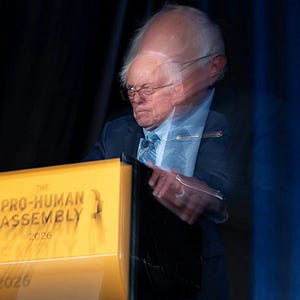
The Archbishop of San Francisco was there. So was Steve Bannon, screaming about the Chinese. Bernie Sanders did a quasi-dramatic reading of messages posted to an online forum by rogue AI agents. Ashley Judd paraphrased a graphic Andrea Dworkin quote for reasons that remain a mystery to me still.
It was odd. People in the AI industry have talked openly about the possibility of this technology causing human extinction for years, but it hits differently in the wake of the Hugging Face incident. If you don’t know what that is, all the more reason to read my dispatch today.
As the doomers see it, the best-case scenario is a future in which humans are basically kept as pets: well cared for, but with zero autonomy. The worst-case scenario, obviously, is the everyone dies thing.
What should be done? I heard lots of ideas but no easy answers. There are currently zero federal regulations on AI, which is sort of strange even to think about. After all, we regulate microwaves, and the people running the microwave industry have never once refused to rule out the possibility that their products will end all human life on Earth.
What I saw in D.C. left me even more convinced that you would be hard-pressed to find anyone who believes nothing should be done. You know, except for President Trump.
— River Page

On Monday, New England Patriots owner Robert Kraft and a group of other NFL owners banned Macklemore from performing at their stadiums after the rapper delivered a “Free Palestine” speech while opening for Ed Sheeran. Kraft cited the rapper’s “broader history of antisemitic rhetoric and imagery.” Once multiple venues refused to host shows with Macklemore on the lineup, the tour’s promoter officially dropped him.
Today, Josh Kaplan says that the move was counterproductive, arguing that though well-intentioned, Kraft’s decision turned an irrelevant footnote into a martyr. “You cannot cancel people into liking you,” Josh writes. Read his column on what a better response to Macklemore would have looked like.
This raises the question: What actually works against antisemitism? On the latest episode of Conversations with Coleman, recorded in front of a live audience in New York, Dara Horn joins Coleman Hughes to talk about her new book The Final Solution to the Jewish Question. She argues that antisemitism is a script that has repeated itself across countries and ideologies, and that most people don’t understand that well enough to fight it. Don’t miss their conversation.

Douglas Murray • U.S. Politics

Twenty-five years after the September 11 attacks, the men who planned them have still not faced trial. Khalid Sheikh Mohammed and most of the accused have been locked up in Guantanamo Bay since 2002. Judges have retired, and plea deals have collapsed. Today, Douglas Murray examines how this happened and argues that a justice system that allows terrorists to die of old age in an interminable pretrial process is one that has failed. Read his latest column on what that failure says about our unpreparedness for the era we are now living in.
The Editors • U.S. Politics

A newly declassified CIA brief from 1998 found that Osama bin Laden used nonprofit shell organizations—including U.S.-based Islamic groups—to fund his terror plots. Today, a similar story is unfolding as multiple organizations on American soil present themselves as nonprofits, taking advantage of tax-exempt status while seeking to advance the ideological mission of terrorist groups like Hamas. Read our editorial on the latest evidence of this dangerous trend—and why there’s no excuse for making the same mistake the CIA revealed 28 years ago.
For decades, the Middle East has shaped American foreign policy and loomed large in the public consciousness. Few understand its influence on our politics better than Simon Sebag Montefiore, who argues that America’s quagmires in the Middle East stem from a deep misunderstanding of the region—on both the left and the right. Join him October 1 as he sits down with Bari Weiss live in New York City to kick off his U.S. book tour for The Cauldron: The Making of the Modern Middle East.
MORE FROM THE FREE PRESS
THE NEWS

The Federal Reserve raised interest rates by a quarter point, its first hike since 2023, signaling that another increase could follow as the central bank tries to bring inflation under control. President Donald Trump fired back by demanding that rates be cut sharply, though he stopped short of criticizing Fed Chair Kevin Warsh by name.
The Houthis fired drones and missiles at Saudi Arabia on Wednesday, including a major oil port on the Red Sea, and Saudi jets struck back with air strikes across Yemen in an escalating front of the Middle East war. (For more on the Houthis, read Zineb Riboua’s column from earlier this week.)
A sweeping Russia and Iran sanctions bill passed the House in a 262–159 vote and is now heading to Trump for his signature. Named after the late senator Lindsey Graham, the legislation would hit countries that purchase large volumes of Russian oil and gas with tariffs of up to 100 percent, and is aimed at cutting off revenue that funds Russia’s war in Ukraine.
European Commission president Ursula von der Leyen proposed making Canada the European Union’s first-ever “associate member,” drawing a standing ovation from European lawmakers. The proposal, framed as a response to a world grown more hostile, faces an uncertain path as EU member states would have to approve it, and one diplomat said that “nobody really knows what it means.”
The House voted unanimously to send billionaire Leon Black a criminal contempt referral after he defied a congressional subpoena to testify and hand over documents related to his connections to Jeffrey Epstein. Black chose to fight the subpoena in court rather than comply.
Charlie Kirk’s family filed a wrongful death notice Wednesday against Utah Valley University, alleging that a series of security failures left him exposed to a rooftop sniper. The notice is a required legal step before the family can sue.
Merriam-Webster added 1,400 words and definitions to its dictionary, including looksmaxxing, vibe coding, and cuffing season. The publisher said the new entries offer “a window into the world today.”