By Literary Hub | Created at 2026-08-04 10:30:47 | Updated at 2026-08-04 19:09:26
10 hours ago
By Literary Hub | Created at 2026-08-04 10:30:47 | Updated at 2026-08-04 19:09:26
10 hours ago
On a crisp March day in 2013, the beginning of the antipodal fall, Sofía Brito walked through a wrought iron fence, up a short flight of stairs, and between the slender salmon columns leading into the University of Chile’s Law School. She knew the building’s monumentalist architecture and its marble interior were designed to awe. Founded in 1842, the University of Chile was the nation’s oldest and most prestigious, and its Law School “a training space in power,” as Sofía put it. Nowhere was this more evident than inside a cream-colored annex with floor-to-ceiling windows, inside of which the black-and-white portraits of sixteen men hung on a wall in resplendent light. They were the sixteen Chilean presidents, out of thirty-three, who’d graduated from the Law School, a chronology of mustaches and beards gazing down at you with the full weight of history.
Article continues after advertisement
Sofía didn’t swoon. She had other gods.
Sofía came from a long and proud line of hard-left militants. Her father was a member of the Revolutionary Left Movement (MIR), a Marxist-Leninist guerrilla group behind some of the most audacious attempts to sabotage the Pinochet dictatorship. Like thousands of other dissidents, he was forced underground after the 1973 coup and eventually spent most of the nearly seventeen-year regime in exile. He and his MIR comrades regaled her with stories of their exploits, and of Chile in the years before the coup. The days of Allende and his Popular Unity Front, when Chile was one of the few countries in the world to pull off a peaceful transition to socialism. When trade unions proudly filed down Santiago’s broad avenues, miners and factory workers holding their helmets aloft, while poets and folk singers plucked guitar strings to hail the dawn of a new era. A brief period of social transformation violently discontinued by a bloody military regime.
It was the high schoolers, more than the university students, who staged the boldest occupations.
For Sofía, who was born in 1994, nostalgia for her country’s recent past fueled her imagination the way fantasy or science fiction did for other children. “I thought about the Popular Unity Front at least once a day,” she said. She decorated her room with posters of MIR guerillas cradling guns. Her Friday-night trilogy was not The Lord of the Rings or Star Wars but The Battle of Chile, a grainy black-and-white documentary about the 1973 coup.
By the time she was twelve, she’d raced through The Communist Manifesto, moved on to Trotsky, and begun participating in her first protests. It was 2006 and Sofía marched down the streets of Santiago along with thousands of other kids, primarily middle and high school students, dressed in white button-down shirts paired with black skirts or pants and blazers, in what the press baptized “the penguin revolution” after the students’ uniforms. They took aim at Chile’s for-profit education model, which had left public schools so neglected, many classrooms felt more like Siberian cells that failed to get students up to speed for university entrance exams.
An alarming 50 percent failed them, meaning that often only students whose families could afford expensive private schools were guaranteed a place. And even then, forking over tuition presented a whole other challenge: At $3,400 a year in a country where the average annual salary was about $8,500, university in Chile was, proportionally, the most expensive in the world. “They are tired of seeing wealthy schools educate those who become the bosses, while their schools train them to become the workers,” Patricio Fernández, a columnist, wrote at the time about the penguins.
Chile had long been hailed as one of the wealthiest countries in Latin America. It was also one of its most unequal. This was a reality etched into Santiago’s very geography. The city’s northeast was a mecca of sleek high-rises made of steel and reflective glass, home to banks and multinationals and districts with names like “Providence,” while the west was home to derelict colonial mansions, webbed with cracks and graffiti, that the wealthy had abandoned decades earlier. Beyond them stretched sprawling suburbs, isolated and underserved, far from hospitals and jobs. Behind it all, the snowcapped peaks of the Andes rose to graze the sky, like an enormous wave on the verge of engulfing the city.
For Sofía, protesting for public education funding was her way of continuing her father’s legacy—the fight to dismantle the inequality ravaging Chile. And as it turned out, the penguin revolution was just the beginning of nearly a decade of sustained student protests.
By 2011, when Sofía was finishing high school, the student movement had matured into a well-oiled political machine. Students from Patagonia to Atacama ran their affairs by committee with the fastidious exactitude of a Soviet politburo. It wasn’t rare to see a grave-looking fifteen-year-old enumerate a precise list of demands on TV with the political acumen of a veteran lawmaker. Leaders of the movement at the university level were profiled by international outlets like The New York Times. Sofía participated in a nationwide coordinating body of secondary school students called the ACES.
By then the students’ protests had evolved into colossal affairs capable of convoking 100,000 teenagers, combining carnival-like swagger, earnest performance art, and anarcho-punk antics. Big brass bands belted out cumbia, flash mobs performed Michael Jackson’s “Thriller,” while skaters in baggy pants and hoodies glided by holding signs reading $1.8 billion—the amount they demanded the government invest in public education each year by, some suggested, taxing large corporations or nationalizing resources. Their message never changed, but the format constantly did in a bid to keep the protest relevant and novel, as well as fun. The students relayed one another to jog around the presidential palace for 1,800 hours—seventy-five days—day and night as onlookers cheered and stray dogs nipped at their heels. They squeezed onto the presidential palace square to make out for 1,800 seconds—thirty minutes—in a muffled field of lip smacking and suppressed giggling. But the more formidable the student protests became, the more excessive the police response.
Almost without fail, armored trucks prowled the streets during protests like fat alligators in a marsh, waiting for the slightest trigger to release battalions of police in olive-green fatigues armed with shields in one hand and nightsticks in the other. The students, who were used to and ready for them, would tie bandannas across their noses and mouths like bandits to protect themselves from the tear gas and kick the pellets back toward the cops with the elegance of midfielders. When the guanacos arrived—water cannons atop militarized vehicles the students named after the cousin of the llama, known for spitting up to six feet—the students raced for cover, craning from their retreats to hurl rocks at the cops.
The police offensives were visually stunning—so patently lopsided in the force deployed against kids with rocks—they primarily served to strengthen most Chileans’ sense of solidarity with the students, and to invest the movement with a heightened sense of mission, best expressed by their coup de grâce: the school occupation.
Students seized the buildings, hauled chairs out of classrooms, and piled them up in unscalable walls worthy of a grand art installation to block their schools’ entrances. They then padlocked doors and proceeded to live and sleep inside the schools for days or weeks—and in some cases, months—until they satisfactorily negotiated the school’s release with the administration or got dragged out by the police.
It was the high schoolers, more than the university students, who staged the boldest occupations. “You have less to lose,” explained Catalina Cabello, a former student activist. Failing a university course after missing too many classes felt more consequential. An extra semester meant added expenses, especially if you weren’t living with your parents and had to cover rent and other living costs.
Occupations were the part Sofía loved the most. There was something magical about transforming a classroom—a space that normally exuded rigidity and hierarchy, where adults lectured at students—into their own headquarters, where they made the rules. They allocated tasks and responsibilities among themselves, from guarding the entrances and drafting lists of demands with which they would negotiate the school’s release to cleaning and cooking. The occupied schools became their own little Marxist utopias. Sofía relished the simple pleasures of huddling together in sleeping bags on classroom floors to ward off the sharp cold of the night, eating the meals they concocted themselves on portable stoves they borrowed from their parents, and sipping tea and cheap instant coffee out of shared flasks. Booze was strictly prohibited. “We drink like Mexicans,” said Carla Iuspa, a former student activist, with rogue pride. She meant exuberantly and excessively. Dry laws were self-imposed to maintain decorum. A bit of weed was generally tolerated.
Among a sea of big political fish, Carmona was a whale.
Of course, student politics were not always high-minded. “A lot of gossip,” Sofía remembered. Hookups, breakups, crushes, and petty arguments—the drama of teendom—peppered the proceedings in ways that could sometimes feel more soap opera than Bolshevik. Still, it was a formative political experience for a whole generation of Chileans.
“You gained the confidence to speak among your peers,” remembered Javiera Manzi, another former student activist. “I’m talking about really young people—fourteen, fifteen, sixteen, seventeen, eighteen years old—who felt this great sense of responsibility for what was at stake, this sense of seeing ourselves as political subjects.”
It was out of love for the student movement that Sofía decided to go to law school after graduating from high school. (In Chile, law school begins in undergrad.) She planned to specialize in labor law in order to defend trade unions, which felt like a natural progression of her current activism. She wanted to understand how power worked at its highest echelons—in politics and business—so that she could fight it. She applied to the University of Chile because it had the best law school in the country, and she had the grades to get in. And because it was a public university, she’d get to attend for free. But she had mixed feelings about it.
Sofía’s first love was music. She’d studied the clarinet for ten years at a prestigious institute and sang in the choir. She had a clear, sweet voice and a knack for writing lyrics to accompany the music she composed. In time, that led her to experiment with poetry. “I realized there was something there,” she said. It was a window into a new form of self-expression, one that connected her to another important Chilean tradition.
Chile is often called “the land of the poets.” For a small nation of fewer than twenty million people—less than half the population of neighboring Argentina and a fraction of that of the United States—it has produced a remarkable number of the world’s most celebrated poets, including two Nobel laureates: Gabriela Mistral in 1945 and Pablo Neruda in 1971. The name also reflects how deeply poetry is woven into Chilean public life. Unlike in many countries, where poetry can be seen as remote or elitist, in Chile it is generally considered a popular art form closely tied to political engagement. In 1972, the year before his death and the military coup that brought Pinochet to power, Neruda—who was revered as much for his verse as for his commitment to communism—filled the national stadium with seventy thousand people, roughly the same number of fans who would fill arenas for Beyoncé concerts decades later.
But in her own life, Sofía felt a certain tension between her commitment to politics and her artistic inclinations, which she’d begun to view as an indulgence. So she cast them aside in order to be useful to the student movement. This was a sacrifice she was willing to make. There was another reason law school did not sit well with her. While the University of Chile as a whole had a reputation as a progressive stronghold, its Law School skewed more conservative, with many students coming from wealthy, right-wing families.
“I thought the next five years were going to be horrible, that I was going to have a bad time, that maybe with some luck I’d make friends, but that everyone who studied law wanted to be president,” Sofía said. The so-called Presidents Building, the one lined with the portraits of the Chilean heads of state who’d graduated from the Law School—said it all. Not only was she embarking on a major in which she saw no discernible beauty, but she’d be doing it surrounded by egomaniacs. Sofía coped by telling herself she’d be like a spy on a recon mission.
Shortly after first walking between the school’s columns in 2013, Sofía stood before the college’s courtyard. She gazed at rich kids “who looked like they’d stepped out of a magazine” clustered together on the right, the sons and daughters of diplomats and ministers putting in their time before Miami vacations. Then she turned her head to the left and found a scrum of students sitting on a flight of stairs under a thin veil of smoke, their backpacks stitched with lefty political patches and slogans. She walked over. For the next two years, Sofía poured her energy into the college’s student politics, taking part in strikes and seizing classrooms. Every fall, she’d walk in, take a deep breath of the blend of cigarette smoke and traffic exhaust drifting in from the street, and think to herself, Smells like an occupation. “Honestly, I hardly went to class,” she said.
But that all changed her third year, in 2015, when she wound up in class with Carlos Carmona.
Like much of the Law School’s staff, Carmona wasn’t just an academic. He had been a prominent political adviser who’d worked closely with government administrations since the country’s return to democracy in 1990. “Presidents didn’t sign anything unless Carmona supported it,” one senator recalled. Ricardo Lagos, Chile’s president between 2000 and 2006, nicknamed Carmona “the Republic” because of the influence he wielded. In 2009, Lagos’s successor, Michelle Bachelet, appointed Carmona to the Constitutional Court, a judicial body with responsibilities similar to those of the Supreme Court but, in some ways, more powerful: It could uphold or strike down laws immediately after they’d been passed but before they were officially enacted, like a kind of constitutional prophylactic. Since 2014, Carmona had served as its president. As such, he presided over sessions, assigned the drafting of rulings, and cast tie-breaking votes in constitutional disputes.
She was now convinced that in order to effect change, you had to work inside institutions, not outside.
Among a sea of big political fish, Carmona was a whale.
At the Law School, he taught a course on administrative law—a breakdown of how the state is organized and how government branches are regulated. This was the first class Sofía took with him.
For a musician and a poet, law could feel jarring with its clinical language. Carmona’s course was no exception. And yet for Sofía, who’d begun wondering if she’d made a giant mistake by majoring in law, it was a revelation. Once you decoded the jargon, administrative law was a window into the world of power she had gone to school to study on her recon mission. And Carmona was the perfect Virgil leading her into its depths. “I flipped out. I felt like, Finally, this is my area,” Sofía said.
Carmona was in his mid-fifties and his formerly jet-black buzz cut was graying, but his plump, full cheeks gave him a youthful demeanor. He was the kind of teacher who went to great lengths to get his students excited about the subject matter. His students invariably described him as approachable and warm, and brilliant. At the end of the semester, he took the students with the highest grades on a field trip to the Constitutional Court. Sofía and her classmates wandered around the stately chamber and took turns sitting in Carmona’s chair.
Carmona typically employed a fleet of teaching assistants (TAs) to help him with his many classes, some years upward of twenty-eight students. Sofía joined their ranks in the second semester of 2015. It was an unpaid but coveted position that opened doors inside academia and beyond. Carmona took them on field trips to the Central Bank and the Ministry of Finance to introduce them to influential people in both politics and business. “We got to know so many institutions from the inside. It was an amazing education into how power moves in this country, how economic and political power are completely intertwined,” Sofía said.
They rode up to the top of the Entel Tower, a torch-shaped telecommunication tower balancing high above the city. Sofía gazed down below, thinking about how power was brokered by men in suits in rooms suspended in the clouds, impervious to the stones student activists threw far below. “Coming from hard-left organizations, it felt like getting doused with a bucket of cold water. Like, This is how this works. In other words, we’re nothing.” And so began a new chapter in her political evolution.
Sofía left the anarchist collective with which she’d been affiliated and joined an official political party, then switched her specialization from labor law to public law. She was now convinced that in order to effect change, you had to work inside institutions, not outside. When she asked Carmona for help with her thesis on housing regulation—part of which touched on administrative law—he handed her the key to his office so that she could help herself to books from his personal library. They began texting regularly about her work. “He was a mine of information, and really generous with his time,” she said.
That was how, in July and August 2017, Sofía found herself inside one of the most powerful chambers in Chile, beside one of its most powerful men.
Carmona was demanding and exacting with his TAs, but he also cared about their well-being. Students remembered him slipping cookies onto their desks when they were having a rough week. On Friday evenings, when the rest of the student body raced out of school to neighboring bars to chug beers and wolf down chorrillanas—a stroke-inducing mountain of fries and sausage topped with a fried egg—Sofía and her fellow TAs holed up in Carmona’s office to discuss the lead-up to the 1973 coup or watch classics like The Godfather and Doctor Zhivago.
Sofía had already worked as a TA to several professors. She had a reputation as a diligent worker. Carmona took a shine to her. After she’d been assisting him as a TA for about a year, in late 2016, he asked her to become his head TA, tasked with organizing the others. It was an attractive offer, but there was one problem: Teaching assistant was an unpaid position, and Sofía needed money. Her thesis grant had just run out, and she was looking for work to support herself. When she explained her situation, Carmona offered her a solution. He would hire her as his personal assistant. She would not only coordinate the other TAs at the University of Chile but also support him in his classes at the several other universities where he taught. And, most important, she would assist him inside the Constitutional Court.
Besides the prestige of working in the Constitutional Court, Sofía had another reason for accepting the position. When she started the job at the beginning of the new academic year, in March 2017, Chile’s Congress was debating a bill that would decriminalize abortion under three circumstances: when the mother’s life was at risk, if the fetus was unviable, or if the pregnancy was the result of rape. The law would bring Chile only up to the legal standard Argentine feminists had been fighting to reform for decades.
But in a country with a blanket ban on abortion—the most restrictive abortion law in South America and one of the strictest in the world—it was tepid but necessary progress. Even if it passed, however, a legal challenge was expected. And that’s exactly what happened: A group of lawmakers argued that the bill violated a constitutional provision protecting “the life of the unborn” and, after Congress approved it in early August 2017, they lobbed it over to the Constitutional Court. It was then down to the court’s ten judges—eight men and two women—to decide whether the law went into force. Carmona would draft the ruling. As his assistant, Sofía would help him.
That was how, in July and August 2017, Sofía found herself inside one of the most powerful chambers in Chile, beside one of its most powerful men. And that was why she knew exactly what she was up against the day she defied him.
__________________________________
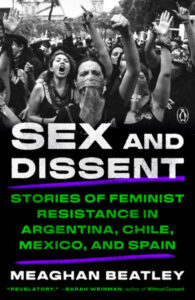
From Sex and Dissent by Meaghan Beatley, published by Penguin Books, an imprint of Penguin Publishing Group, a division of Penguin Random House, LLC. Copyright (C) 2026 by Meaghan Beatley.