By Gatestone Institute | Created at 2026-07-21 09:05:08 | Updated at 2026-08-01 16:01:14
1 week ago
By Gatestone Institute | Created at 2026-07-21 09:05:08 | Updated at 2026-08-01 16:01:14
1 week ago
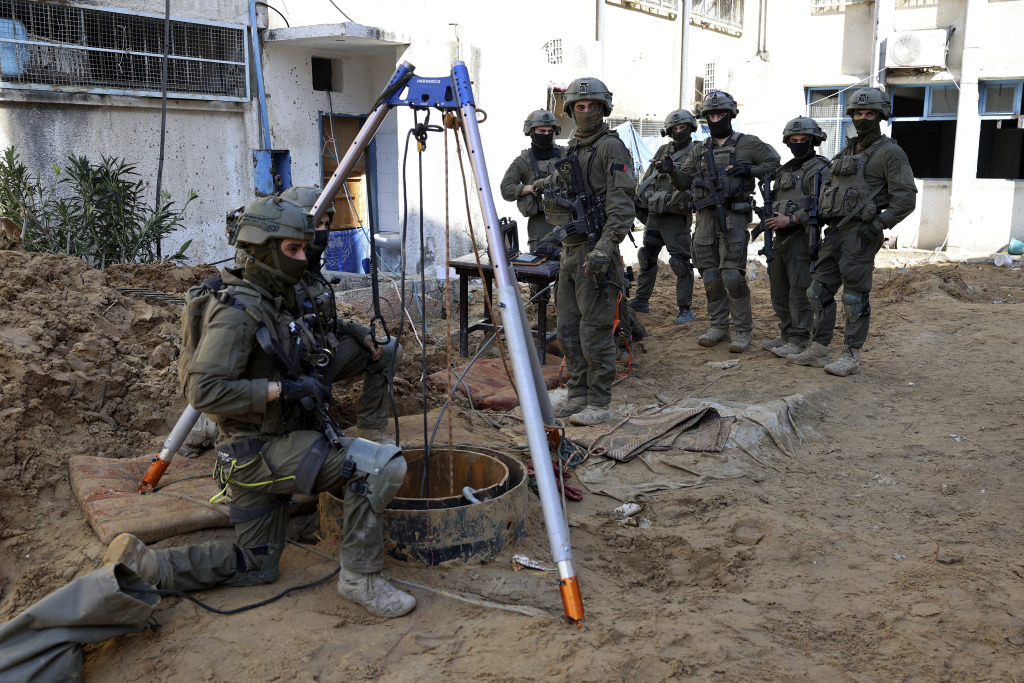 For the United Nations, voting patterns, internal investigations and its own decisions this year no longer support the fiction of neutrality. An UNRWA school in Gaza sat above a Hamas tunnel shaft and three anti-tank positions, and its own principal was on the payroll of both institutions at once -- a fact American investigators, not the UN, brought to light. Pictured: Israeli soldiers inspect the entrance to a Hamas terror tunnel directly outside an UNRWA compound in Gaza City, on February 8, 2024. (Photo by Jack Guez/AFP via Getty Images)
Institutions built to prevent atrocities eventually face the question of what they actually protect. For the United Nations, voting patterns, internal investigations and its own decisions this year no longer support the fiction of neutrality. An UNRWA school in Gaza sat above a Hamas tunnel shaft and three anti-tank positions, and its own principal was on the payroll of both institutions at once -- a fact American investigators, not the UN, brought to light.
The pattern is old: during the Oil-for-Food scandal, a mid-level program director faced US prosecution while the officials who managed the program from above kept their positions. When UN failures surface, line staff absorb the exposure. The people who set the policy rarely do.
The arithmetic alone dismantles the pretense of balance. In 2025 the General Assembly adopted fifteen resolutions targeting Israel, and only eleven addressing the rest of the planet combined -- a tally covering North Korea, Iran, Myanmar, Russia and the United States together. From 2015 through 2024 the total reached 173 resolutions against Israel, against 80 for every other member state on earth combined. The Human Rights Council has run comparable numbers since 2006, adopting 112 resolutions against Israel against 45 against Syria, despite a civil war there that has killed hundreds of thousands. On November 20, 2025, the Assembly's Fourth Committee passed six resolutions condemning Israel while producing not a single text on Sudan, where fighting has killed more than 150,000 people and driven twelve million from their homes. The bloc that commands the Assembly's automatic majority sets these priorities; the scale of actual human suffering has nothing to do with it.
UNRWA supplies the starkest illustration. After October 7, the agency's own internal review found that nine employees may have taken part in the massacre and dismissed them -- a figure American investigators have since made look negligible. The USAID Office of Inspector General, a statutorily independent law enforcement body, has referred 108 current and former UNRWA staff for suspension or debarment over participation in the October 7 attacks or membership in Hamas's al-Qassam Brigades. Among them: deputy school principals serving as Hamas company commanders, a teacher who tracked the assignment of explosive devices for Hamas intelligence, and a school principal whose building sat above a tunnel shaft and three anti-tank positions. One of those referred, Hafez Mousa Mohammed Mousa, coordinated with fellow operatives during the massacre while running an UNRWA school, and became the first person affiliated with a UN humanitarian agency ever debarred by the US government for terrorism. Under mounting pressure, UNRWA itself dismissed 70 staff linked to terrorist organizations in Gaza in the weeks before the referral was published, an admission that followed the release of evidence rather than the agency's own vetting. Groups tracking UNRWA's personnel put the true scale of Hamas penetration considerably higher, closer to 1,500 employees still drawing a UN salary.
The reckoning caught up with the agency in public on July 1, 2026. \The Board of Peace, the body now overseeing Gaza's postwar administration, announced that UNRWA "has no place in the new Gaza" and described continued dependence on the agency as an obstacle to recovery rather than a form of relief. Washington's ambassador for UN reform, Jeff Bartos, told the annual pledging conference the same day that member states funding UNRWA had spent years choosing incitement, terrorism and stagnation over an alternative, and warned that history would remember the choice. Within hours, the Palestinian Authority and the Arab League rejected the announcement,and insisted that UNRWA's mandate cannot be dissolved by an administrative statement. Whatever the outcome of this dispute, an institution long marketed as irreplaceable is being dismantled in real time by the very coalition managing the territory it was built to serve.
This state of affairs is not new behavior wearing new language. The UN's largest financial scandal, the Oil-for-Food program, saw Saddam Hussein extract $1.8 billion in kickbacks with help from more than two thousand companies, while the Volcker inquiry found that weak UN oversight and Security Council paralysis had made the scheme possible. The program's own director was later indicted in the United States for bribery; senior UN officials mostly walked away untouched.
Peacekeeping missions have produced a smaller, steadier version of the same pattern: a procurement task force documented more than $630 million in tainted contracts and two dozen confirmed corruption schemes, only to be shut down in 2008 after member states with implicated nationals refused to renew its mandate.
Sexual exploitation by peacekeepers followed an identical script, with nearly 2,000 allegations accumulated over twelve years and only a fraction of the accused ever serving jail time.
The historical ledger is worse than the bureaucratic one. In 1994 the UN watched more than 800,000 people die in Rwanda over roughly a hundred days while its own commander in the field begged for reinforcement and was refused. A year later it declared Srebrenica a protected zone, then denied the air support its peacekeepers requested as eight thousand men and boys were murdered under the UN flag. In Haiti, UN peacekeepers introduced cholera into a country that had been free of the disease for a century; nearly ten thousand people died before the organization admitted any responsibility --- six years after the outbreak began. The zero-tolerance policies announced afterward changed little about how missions were run or how misconduct was punished.
Rwanda, Srebrenica, Haiti and Gaza share the same organizational reflex: investigate quietly, discipline the lowest-ranking staff available, and leave the people who set policy in place.
Secretary-General António Guterres told the Security Council after October 7 that the Hamas attacks "did not happen in a vacuum," a formulation he has since echoed on UNRWA's failures, careful language built to avoid naming the agency's own culpability.
The United Nations was founded to make atrocity costly for those who commit or enable it. It has instead built a machine that absorbs those costs internally, so long as the people responsible sit inside the institution or represent the states that control its votes.
Even the coalition now running Gaza's transition has concluded that one of the UN's flagship agencies does not belong there. This verdict came from the body tasked with cleaning up what the war left behind -- not from Jerusalem or from Washington's harshest critics of the UN. The record speaks plainly enough on its own. What remains open is how much longer the rest of the world intends to keep paying for it.