By Literary Hub | Created at 2026-08-13 21:50:36 | Updated at 2026-08-14 09:44:02
19 hours ago
By Literary Hub | Created at 2026-08-13 21:50:36 | Updated at 2026-08-14 09:44:02
19 hours ago
“[Journalists] are knocking on the walls of the tank and pleading their case to those who are listening. And yet the world is not moving fast enough or doing nearly enough to stop this genocide. It is their hands upholding all the standards and ideals of humanity, keeping the world from collapsing into something completely dark, oppressive, and barbaric. A world that’s nothing but a jungle. It already is . . . But there’s still goodness here, in this small place, in the ground underneath us, in those who fight the evil spreading through the rest of the world. To me, those are the people and journalists of Gaza.”
–Bisan Owda
*
Since October 7, 2023, Israel has killed at least 268 media workers in Gaza, making the Gaza genocide the deadliest conflict for journalists in history. In many cases, the reputations of these murdered journalists—some of whom were killed alongside their families—were smeared by the IDF within hours of their deaths, their personalities and accomplishments erased. There has long been a need to memorialize these extraordinary people, to tell their stories in a manner that befits the courage and compassion they showed in the line of duty.
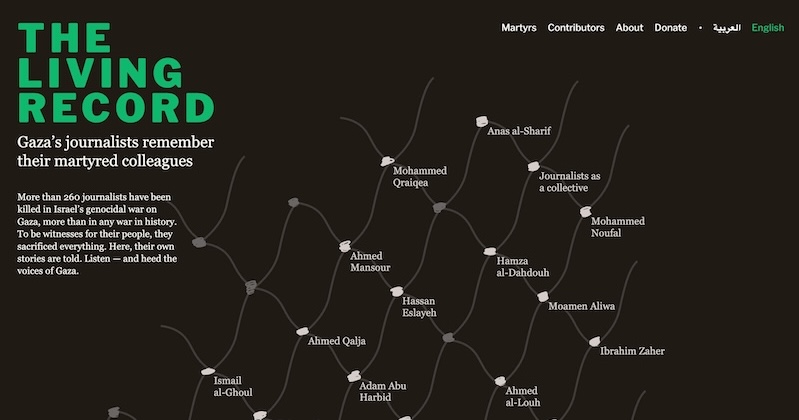
Yesterday, the activist coalition Writers Against the War on Gaza (WAWOG) responded to that need by launching “The Living Record,” an oral archive featuring more than 50 eulogies delivered by journalists across the Gaza Strip to their martyred peers.
In a press release, WAWOG describes the project (which was launched this week to coincide with the one-year anniversary of the killing of Al-Jazeera reporter Anas al-Sharif and five of his colleagues) as a collective memorial, one which “stands as a testament to the moral and political will of Gaza’s heroes, who—despite being marked for death by the Israeli occupation—chose the path of resistance, the path of truth”:
The Living Record is the largest oral archive produced since the genocide began. From Gaza, fifty journalists and media workers give eulogies for their martyred colleagues—many of whom are also their best friends, their brothers, their husbands—including Mariam Abu Dagga, Hamzah Al Dahdouh, Hassan Esleih, Ismail al-Ghoul, Hussam al-Masri, and Hossam Shabat. Visitors can navigate interconnected pages detailing each journalist’s hopes, dreams, and accomplishments alongside testimonies delivered by their colleagues in Gaza. In addition to audio recordings in Arabic, each testimony has transcriptions in both English and Arabic that are synchronized to the audio stream. We hear their voices speaking in Arabic, reading along in either Arabic or English. We see the faces of those they loved so much.
The press release goes on to accuse Western media outlets of complicity in the Gaza genocide through the uncritical publishing of hasbara (Israeli government propaganda) and the use of the passive voice as a way to normalize Israel’s war crimes:
Just as Israel fabricates claims that Gaza’s journalists are Hamas-affiliated to justify their murder, Western media is complicit by not only publishing hasbara but also using passive voice such as “found dead” instead of “murdered” to normalize Israel’s genocide of the Palestinian people. As martyred journalist Hossam Shabat wrote, “[l]anguage is important. Language makes genocide justifiable. A reason why we are still being bombed after 243 days is because of The New York Times and most Western media.”
Visitors to the archive can navigate interconnected pages detailing each journalist’s “hopes, dreams, and accomplishments” alongside testimonies delivered by their colleagues in Gaza.
Following the launch of The Living Record, WAWOG, the Palestinian Youth Movement, and the Palestinian Feminist Collective will host “Keeping the Record Alive,” a tribute to Anas al-Sharif, tomorrow, August 14 at 6:30PM at the Riverside Church in New York. All proceeds from the event will be donated to the Gaza Journalist Fund, which helps journalists in Gaza City evacuate, survive repeated displacement, and keep their families alive.