By Kotaku | Created at 2026-06-17 17:11:31 | Updated at 2026-06-17 21:33:30
4 hours ago
By Kotaku | Created at 2026-06-17 17:11:31 | Updated at 2026-06-17 21:33:30
4 hours ago
I love that picture above so, so much.
That’s Jack Quaid, the actor playing a gelatinous cube named Phranque in the upcoming God of War Laufey. He’s in a mocap studio, wearing a PVC pipe rig in the shape of a cube, with mocap sensors on his head and waist. This image is from a short clip in this video, and while I would never presume to speak for Mr. Quaid, he looks like he’s having a fabulous time:
I love the image of Quaid in the cube suit because it’s silly-looking and whimsical, and it’s the sort of goofy behind-the-scenes nonsense you rarely get to see but which is critical to making the nice, polished-looking video games that Sony Santa Monica is known for. However, I have one point of confusion here that I really would like to clear up:
Why is Jack Quaid in a mocap suit?
I’m not asking why he’s on set, wearing a cube suit. That’s actually pretty obvious to me and I’ve since had several professionals confirm that my instincts are correct—it’s good for actors to be on set together and work off one another as they perform. Deborah Ann Woll, who is playing Faye, is also in this scene and her mocap is essential for Faye’s animation. It only makes sense that she should have someone in approximately the correct size and shape bouncing around the set with her so she can deliver lines effectively and not inadvertently stand in the spot where the cube is going to be at any given point.
No, what baffled me was the mocap suit, and the sensors on his head and waist. Jack Quaid is a human person. A cube is a cube. What use could it possibly be to mocap a human when the final product is an animated cube? I tried asking Sony Santa Monica this directly, but they didn’t get back to me. So instead, I turned to some mocap experts to see if any had guesses as to what was going on here.
I spoke with two actors, an animator, and a mocap technician, all of whom have some experience with this sort of thing. None of them worked on God of War Laufey, so none of them can say definitively why Jack Quaid is in a mocap suit. But they were able to apply their expertise to take some stabs at an explanation.
The general consensus among all the people I spoke to is that the developers are, in fact, capturing footage to animate the cube. That’s because even though it’s a faceless object, the cube still needs to express emotions through movement. Because it’s gelatinous, it can likely twist its respective halves in ways that might look similar to a human hanging its head, looking around, wiggling with excitement, and so forth.
“There’s definitely a case to be made that they could use the head movement as a guide for the gelatinous cube’s twisting and bending, which could help convey human emotions,” said performance capture artist Remco Nijs. “Having trackers on both the head and the waist would allow you to use the waist markers as a reference point for, say, the bottom of the cube, meaning you could transform the entire upper body and head movement into turns and twists. Like if the actor says something sad and looks down, the gelatinous cube could kind of squish down in the front, mimicking the human emotion or if the actor shakes their head in disbelief, the cube could twist in the same way.
“Conveying human emotions without a face is quite challenging; however, considering the cube is ‘gelatinous,’ I think they could convey quite a lot with the squishing and stretching of the cube.”
Nijs shared the following example, though he noted this cube has a face, which makes it a bit easier:
One professional mocap technician who did not wish to be named even had some theories as to why such capture might be critical for a God of War game, specifically. Previous God of War games, they pointed out, had a “no-cut” camera throughout, and they assumed Laufey would be no different. They also took a guess that Phranque the cube might be the equivalent to this game’s Atreus, which would mean he’s in a lot of scenes with Faye. If all that was the case, they said, then knowing where these two characters are in staging is even more important than usual. If a character is in a frame at any point, they said, then you want them to be there not just for the reference of other actors, but so animators can keep track of who’s standing where at any given moment.
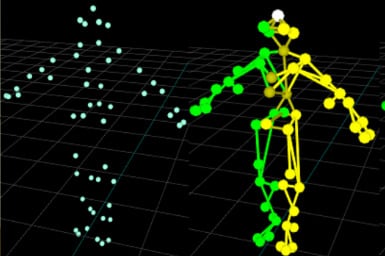
The same technician shared a sample image from a personal project to help me better understand how mocap works. Normally, they say, a mocap actor would have sensors all over their body, resulting in mocap data that looks roughly like what you see on the left in the image below. Animators would then map that data to a rig like the one shown on the right, allowing them to then see how the animation looks when applied to the character in-game and refine it accordingly.
 ©All diagrams created and shared by my anonymous mocap technician source
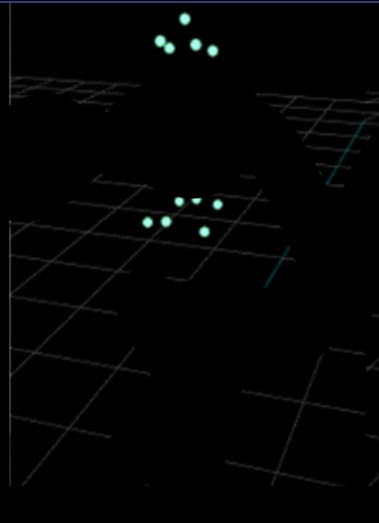
In the photo of Quaid in cube form, he’s wearing markers on just his head and his waist, which means animators are only getting his hip and head movement
 ©All diagrams created and shared by my anonymous mocap technician source
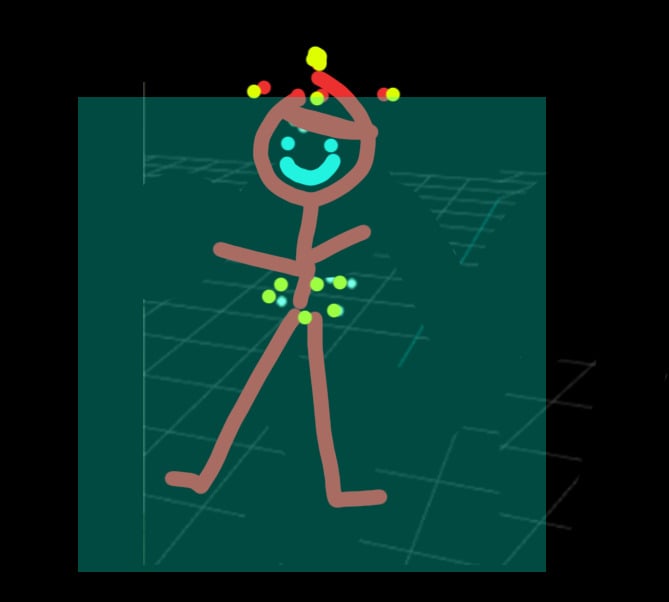
Which they can then apply to the top and mid-sections of the cube to make it react like Quaid does:
 ©All diagrams created and shared by my anonymous mocap technician source
For instance, if Quaid walks by Woll and turns his head to look at her, the animators can more easily make the cube bounce past her and twist as if looking at her.
It’s tough, they concluded, to animate things with no faces. It forces animators to be creative in order to bring them to life. “It looks goofy,” they said, “but a lot of motion capture looks goofy.”
When I consulted Kal van der Meij, a former animator who has worked with performance capture, she referenced Benedict Cumberbatch crawling around the floor as a dragon in clips of the mocap work he did for Smaug in The Hobbit. While Cumberbatch is not a dragon, movement is still part of the full, emotive performance.
“Even as a cube, there can still be a huge amount of expressiveness that can be conveyed via performance capture,” she said. “Jack Quaid would have been cast not just for his voice but for his performance, that unique spirit and soul that only he brings to the character as an actor. That factor would be incredibly important to the project and is why Quaid’s physical performance is recorded as data. If you were to capture the performance of three people playing gelatinous cubes, all three would move differently in identifiable ways.”
And actor Elisa Meléndez added that Quaid might even be able to make larger character choices that animators would ultimately decide to keep, even if they weren’t scripted. “When actors and devs get to playing, we ideally get to make fun choices!” she said. “There’ve been times when, after we’d get what the script calls for, time allowing, we’d do a few different or playful versions that may end up being an even better fit for the scene. If Jack and the team wanted to play with delivering a line with a spin, or if he adds the slightest sassy cock of the hip, or even if Jack made up a fun cube dance while he was hanging out between shots that the devs ended up loving and wanting to keep, all those physical nuances and choices could be captured, and it would add even more personality in collaboration with animators…more shape to the gelatinous. At least, that’s what I’m thinking!
“Just another nod to how voice acting isn’t just voice acting–you gotta get your whole body involved, even if it’s the kind of body that’s a couple of suspended veggies away from being served at a 60s dinner party.”