By Literary Hub | Created at 2026-08-11 18:06:35 | Updated at 2026-08-11 19:15:07
2 hours ago
By Literary Hub | Created at 2026-08-11 18:06:35 | Updated at 2026-08-11 19:15:07
2 hours ago
Have you ever wondered how long those nice people were actually stranded on the Orient Express? Or speculated about the carriage distance from London to Longbourn? Well, dear reader, have I got a tip for you.
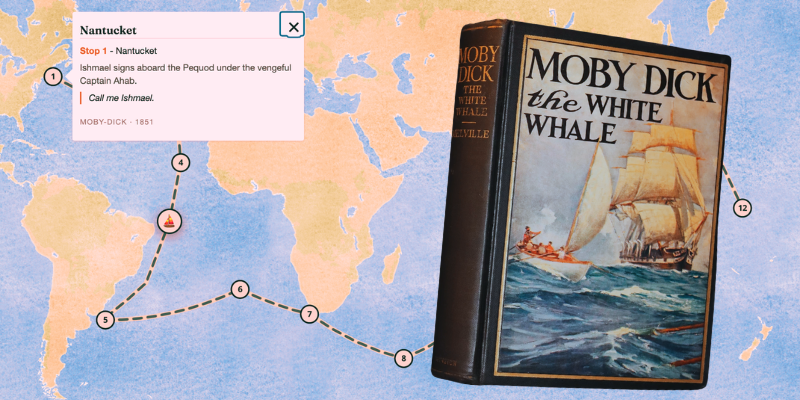
Reading Maps is home to an interactive database where curious readers can explore—if not recreate—famous journeys from literature.
These trips are classified by mode (overland, sea) and type (survival, exile, coming of age). There are road trips represented, like that in Dave Eggers’ Heartbreaking Work of Staggering Genius. But also multi-country emigration tales, as in Yaa Gyasi’s Homegoing.
This project is the brainchild of Aires Loutsaris—UK-based SEO consultant by day, whimsical cartographer by night. Loutsaris has spent the past few years building his free interactive atlas, which includes both intercontinental epics (see: Moby Dick) and local meanders like Mrs. Dalloway.
He and his site developer Fabio Moreira were inspired by a craving for stakes that transcend the page.
“Odysseus crossed a real sea. The Pequod sailed real water. Phileas Fogg’s eighty days ran on real railways,” Loutsaris writes on the site of his inspiration. “However when you read a book, all that geography stays locked in your head. Once you close the cover, it goes with it.”
Enter Reading Maps, a highly bespoke piece of fan service. On the site, readers can request a route from their favorite novel (or film!), and the team will set to work making it real.
Process-wise, the map-making begins in the close read. Loutsaris initially goes into a text with an eye to stations and sequence, then checks his speculative coordinates against existing hi-res maps.
Where a novel’s setting is invented (see: Calvino’s Invisible Cities), he has a system. He anchors a hypothetical locale to “the nearest real location” and makes an editorial note in the key.
But this modern Daedalus is highly open to collaboration. He relies on readers to catch errors and offer sites of expansion—as several did for his map of Hemingway’s Moveable Feast.
Why maps? It’s true that a visual aid can scratch an itch, especially for anyone nostalgic for the illustrations at the front of our favorite epics. But beyond the flair factor, maps can provide a sense of scale that’s sometimes hard to grasp on the page.
How long, after all, is Huck’s Mississippi River? (875 kilometers, it turns out!) And after goofing around with the interactive feature, I can report it does something for my sense of plot architecture, being able to see how many miles separate Cairo and Memphis.
A map can also shed light on different character motivations.
It’s one thing to experience Jonathan Harker’s lengthy coach ride to Dracula’s castle. But seeing how the Count traveled the same journey from the Borgo Pass to Exeter by sea sharpens the contrast between these characters, and hints at the undead man’s indomitability.
For his part, Loutsaris is excited about the big picture ramifications.
“The aggregate view is the interesting part,” he told me, via email. “You can see where the canon clusters—the Mediterranean, the North Atlantic, the Silk Road—and the vast regions fiction has barely touched.” Which is of course all the more case for getting those requests in.
Though Reading Maps does have a slight canonic bias—The Odyssey has been the most requested “by a long shot,” Loutsaris told me—the site’s charm lies in its open door policy. Nothing is too strange or specific to get plotted.
Loutsaris’ own personal favorite map comes from a 1970s maritime adventure: Bernard Moitessier’s The Long Way.
“He was winning the first solo non stop race around the world in 1969 and he kept going instead—past the finish, round the Cape of Good Hope a second time and then on to Tahiti,” the cartographer told me. “On the map you see him simply not turn north. The shape is the whole argument of the book in my opinion.”
Talk about the real thing.