 By The War Zone | Created at 2026-10-12 17:55:54 | Updated at 2026-10-12 19:11:57
1 hour ago
By The War Zone | Created at 2026-10-12 17:55:54 | Updated at 2026-10-12 19:11:57
1 hour ago
General Dynamics Land Systems (GDLS) has offered the first official look at its proposal to replace the U.S. Army’s Bradley Fighting Vehicles, called the Wolf. The Wolf is one of two designs competing to become the Army’s future XM30 Mechanized Infantry Combat Vehicle (MICV). Just earlier today, we published a detailed update on the XM30 competition, including new information about both entrants and the Army’s testing plans, which you can find here.
GDLS is showing the one-eighth-scale model of Wolf, seen at the top of this story and made by a company called KiwiMill, at the Association of the U.S. Army’s (AUSA) main annual convention, at which TWZ is in attendance. Wolf is facing off head-to-head against a version of the Lynx from Germany’s Rheinmetall, supplied via the company’s U.S. subsidiary, American Rheinmetall.
It has already been established that Wolf is a further evolution of the GDLS’ Griffin III design, which was first shown publicly at AUSA back in 2018. Griffin III was derived from the ASCOD 2 infantry fighting vehicle, for which Spain was the launch customer, and which is now entering service in Latvia. The U.S. Army’s now-cancelled M10 Booker ‘light tank’ and the British Army’s much-troubled Ajax are also members of this broader family of armored vehicles.
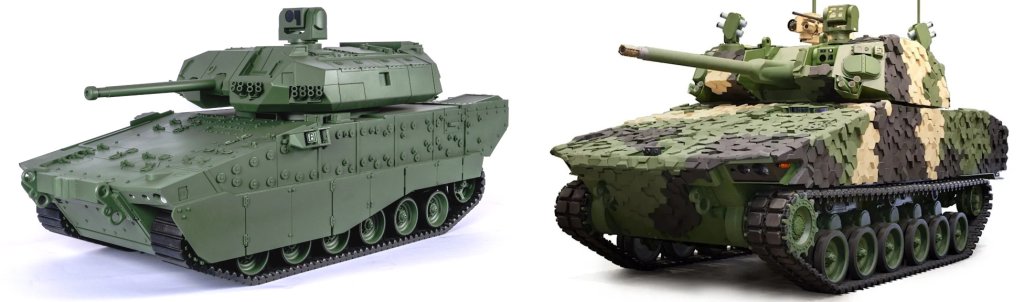 A side-by-side comparison of the model of the Wolf, at left, and the Griffin III demonstrator, at right. GDLS/KiwiMill
 The design of the Wolf, at least based on the model, is substantially different from the earlier Griffin III demonstrator.
Wolf’s turret has a broader, flatter, and overall more streamlined shape, which is in line with its remotely-operated design. There is just a single sensor turret on top, along with space for a forward-looking sensor suite to the left of the main 50mm cannon. What may be apertures for additional sensors or other systems are seen elsewhere along the front and sides of the turret. It also has more launchers for smoke grenades around the front edges compared to the Griffin III.
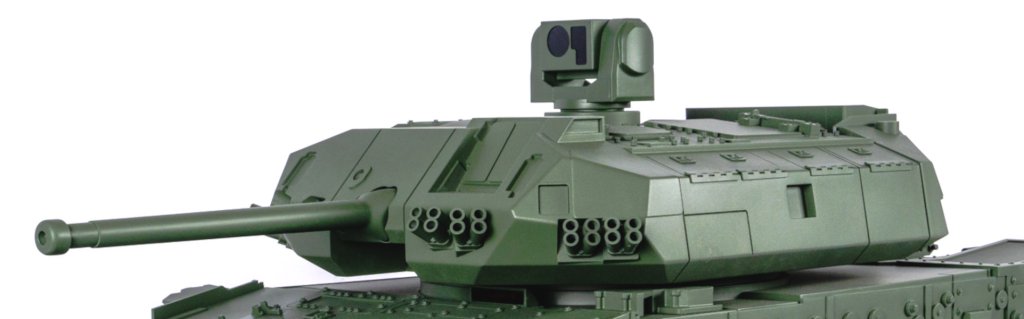 A focused look at the Wolf’s turret as seen on the one-eighth-scale model. GDLS/KiwiMill
 Compared to the Griffin III, the Wolf’s hull has also been much revised, including the elimination of a traditional driver’s hatch in front of the turret ring. The vehicle’s commander (who also acts as the gunner) and driver sit side-by-side deeper inside the hull. Up to six passengers can ride in a compartment further at the rear. For comparison, the Bradley has a crew of three, as well as the ability to carry six passengers.
The Wolf’s hull also features side skirts that were not found on the Griffin III demonstrator. A different style of tracks is also depicted on the model. The picture of the model that GDLS shared shows sensors facing outward from a position on the side of the hull toward the front, as well. This makes sense, as the design features a distributed camera system to offer a full 360-degree view of the outside to personnel riding within, the broad benefits of which you can read more about here.
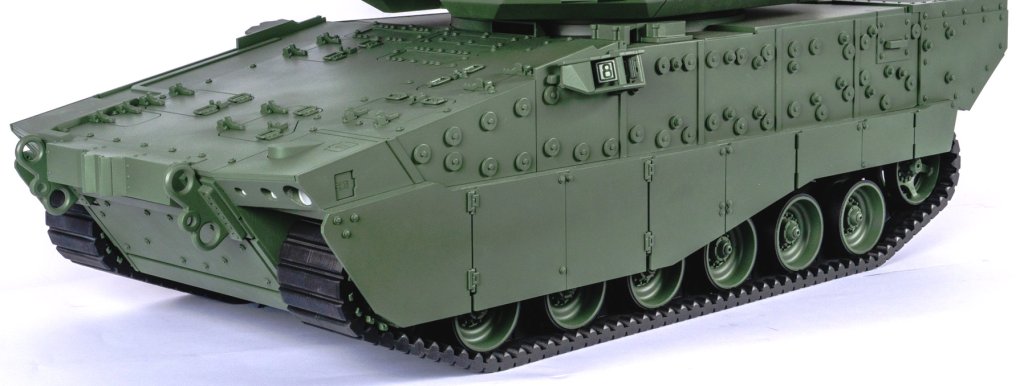 Another look at the hull of the Wolf, as seen on the model. Note the outward-facing sensors positioned toward the front, as well as the lack of any traditional driver’s hatch. GDLS/KiwiMill
 “Because we have a reduced crew from the Bradley [which has a commander and gunner in turret] there has to be greater efficiency in how those soldiers execute their tasks,” Geoffrey Norman, GDLS’ director for U.S. Strategy & Growth, previously noted to TWZ. “The software and menu logic are very intuitive.”
Next-generation fire control, sensor, and networking/communications capabilities, as well as improved active and passive defenses, are key requirements for the XM30 program. Both Wolf and American Rheinmetall Lynx-based designs have built-in launchers for loitering munitions, with GDLS having chosen to integrate AeroVironment’s Switchblade 300 more specifically. What we have seen on the Wolf model so far does not appear to explicitly show this particular feature.
Wolf and Lynx both also feature hybrid-electric propulsion, which will bring various benefits, especially in terms of fuel economy and electrical power generation, compared to the diesel-engined Bradley. When it comes to the boost in on-board electrical power, “the emphasis from the Army has really been about having margin on the vehicle for future [system] requirements – directed energy, counter-UAS systems, or fill-in-the-blank,” GDLS’ Norman has also told us in the past.
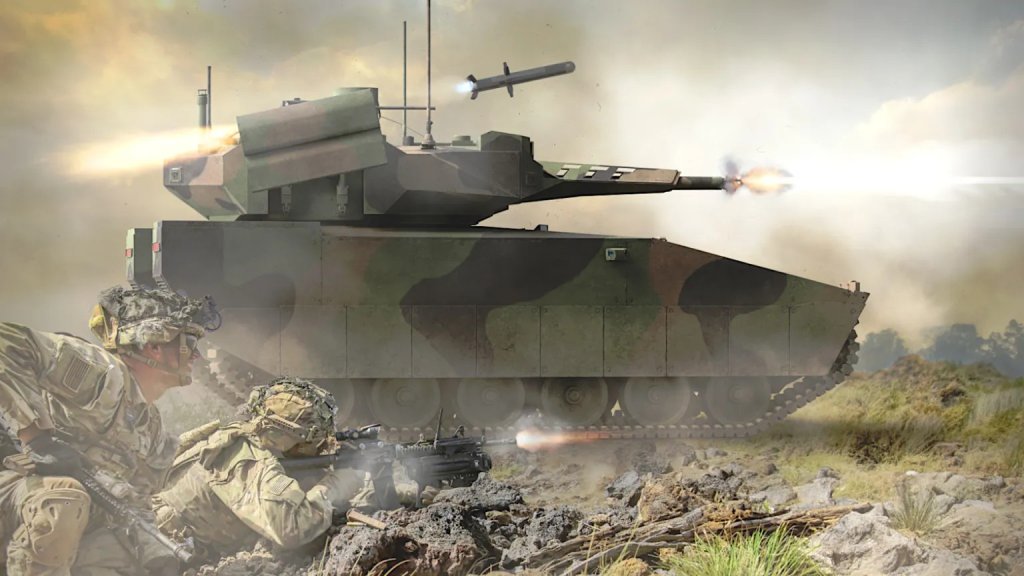 A rendering of the Lynx-based XM30 design. American Rheinmetall
 As it stands now, both GDLS and American Rheinmetall have delivered prototypes of their respective designs to the Army, with initial testing having been conducted at Aberdeen Proving Ground in Maryland. Soldier touchpoints and field evaluations are now set to occur at Fort Hood in Texas between February and March of next year. You can read in more detail about both entrants in the XM30 competition and what is known about their features in our past reporting here.
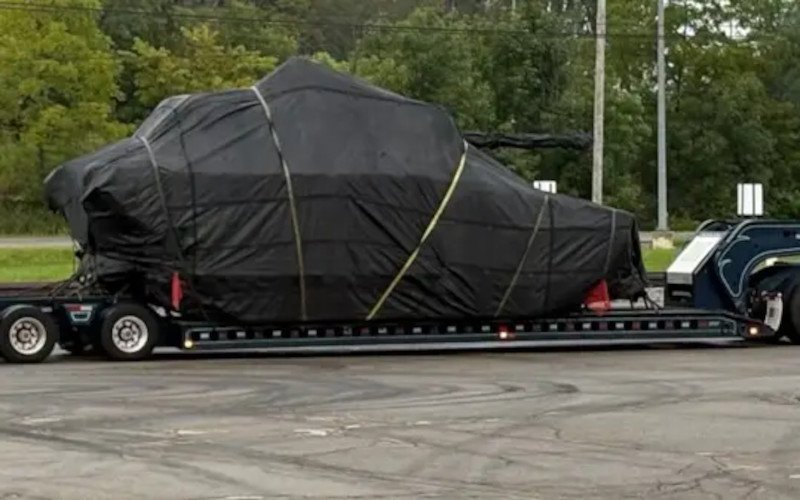 An actual Wolf prototype, seen under wraps, after being delivered to the US Army’s Aberdeen Proving Ground in Maryland around the end of August 2026. GDLS
 In the meantime, we have now gotten clear views of both designs vying to become the Army’s XM30 replacement for the venerable Bradley.
Contact the author: [email protected]