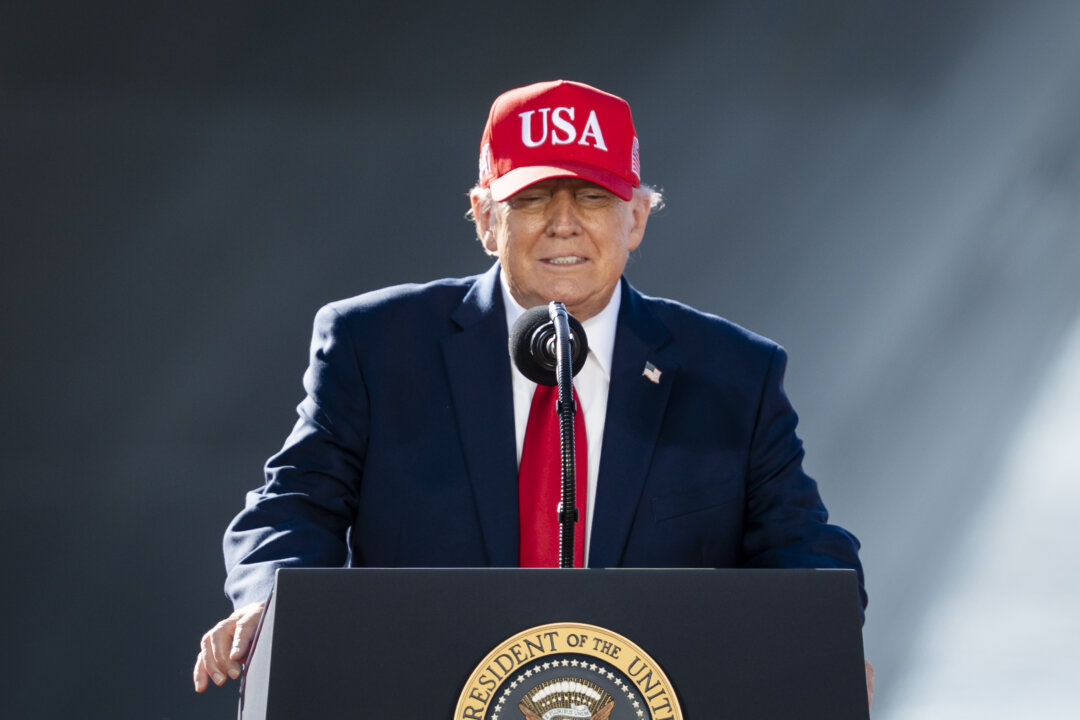
President Donald Trump was defending the costs of the Iran war Monday when he suddenly offered an extraordinary example.
“They can take out a city,” Trump told supporters at a rally in Grand Island, Nebraska. “Let them take out Los Angeles. Let them take out San Diego.”
“This is a very small price to pay,” he added.
Los Angeles and San Diego are California’s two largest cities, major economic centers, and home to more than 5.2 million Americans. Their surrounding counties contain nearly 13 million people. San Diego also hosts one of the nation’s largest concentrations of U.S. military personnel.
The remarks drew immediate backlash from California officials and criticism from several Republicans, while the White House quickly moved to clarify that Trump was describing the danger posed by a nuclear-armed Iran.
The larger issue was not simply what Trump intended, but what language Americans are prepared to accept from a president, or contort themselves to reinterpret after the fact.
What Trump Said
After ranging from the war with Iran and oil prices to immigration, the media, his political opponents, and the midterm elections, Trump told the crowd that Republicans needed a “tremendous victory.” He then abruptly returned to the war and what he described as a “small price to pay”:
And again, remember with the war, just artificial, it’s a little bit high. It’s a small price to pay for keeping the world safe, keeping our country safe. They can take out a city. Let them take out Los Angeles. Let them take out San Diego. This is a very small price to pay and it’s going to be over with very soon. It’s essentially almost over with.
Trump then said the other side had a high “threshold for pain” and predicted:
It’s going to end very soon, and it’ll end one way or the other and your gas and your gasoline and all of the things.
The crowd applauded.
California Furious
California officials erupted.
Governor Gavin Newsom called Trump “deranged and dangerous.” He wrote on X:
After sending the National Guard and Marines to occupy California, Donald Trump is now saying our foreign enemies should “take out” Los Angeles and San Diego.
Newsom later called for invoking the 25th Amendment and called the president “mentally ill.”
Los Angeles Mayor Karen Bass called the comments “irresponsible” and warned that presidential rhetoric “could potentially compromise our safety.”
San Diego Mayor Todd Gloria was equally direct.
“San Diego is not collateral damage,” he wrote. “We are not expendable…. Keep our city out of your reckless war talk.”
Representative Sara Jacobs, whose district includes San Diego, pointed to the people behind the name on the map:
My constituents — including many active duty service members, veterans, and their families — are not acceptable collateral damage in Trump’s stupid war.
Newsom, Bass, Gloria, and Jacobs are Democrats. None is likely to extend Trump much political charity.
That does not make their objection frivolous.
A president does not need to like Los Angeles politics or California’s governor. He can condemn sanctuary policies, crime, taxes, or the state’s failing Democratic leadership.
But Los Angeles and San Diego are American cities. The people living there are Americans.
That should make the political affiliation of their mayors irrelevant when discussing whether an enemy can “take them out.”
Did Republicans Object?
Republicans largely remained silent.
But not all of them.
Jim Desmond, the Republican congressional nominee in California’s competitive 48th District near San Diego, explicitly rejected Trump’s comments. He wrote:
I vehemently disagree with President Trump’s comments. America must stand up to Iran and defend our interests, but the first responsibility of our Commander in Chief is to protect the American people and our homeland.
Desmond, a Navy veteran, went further:
No American city is expendable, and no American family should ever be treated as collateral damage.
Representative Kevin Kiley, an independent who caucuses with Republicans and faces a competitive reelection campaign in Northern California, called Trump’s remark “unhelpful.”
New Jersey state Senator Jon Bramnick, a Republican and longtime Trump critic, called on members of his party to condemn the remarks. He warned that if Republicans failed to speak up, “it will take years to redefine our party.”
Other local Republicans defended Trump.
Representative Darrell Issa, who represents parts of Southern California, did not directly address Trump’s wording. According to the San Diego Union-Tribune:
Where the Obama and Biden Administrations appeased Tehran, paid them billions in bribes and put them on a glide path to having nuclear weapons, President Trump has taken historic and concrete action to eliminate the nuclear threat.
Paula Whitsell, chair of the San Diego County Republican Party, also defended Trump. She accused the “biased media” of taking his remarks “completely out of context.”
White House Says Trump Was Misunderstood
The White House insists Trump never advocated an attack on California.
Communications Director Steven Cheung accused the media of stripping the remarks of their meaning:
The media freakout over President Trump’s comments is not rooted in reality. He was clearly stating U.S. cities would have been threatened if a nuclear Iran hadn’t been stopped.
Cheung added that Iran now has “no nuclear, no navy, no air force, and no money.”
The White House Rapid Response account made the same argument, saying Trump was explaining that the United States was fighting to stop Iran from gaining the ability to destroy Los Angeles or San Diego with a nuclear weapon.
There is some contextual support for that interpretation.
Trump had just described the war’s costs as a “small price to pay” for keeping America safe. He then jumped to the danger of Iran destroying a city.
His speech was characteristically fragmented.
Under the most charitable reading, Trump meant Americans should tolerate temporary economic pain because the alternative could be an Iran capable of threatening an American city.
But that still leaves his actual words.
Trump could have stated, “We cannot allow them to take out Los Angeles or San Diego.”
Instead, he said, “Let them take out” these two cities.
The White House can explain what he intended. It cannot rewrite what he said.
A Dark Conspiracy or “Just Trump”?
The specificity of Trump’s remark quickly fueled darker speculation online.
Some wondered whether he had inadvertently referenced possible Iranian targets, or even hinted at a false-flag operation involving two heavily Democratic cities that have repeatedly clashed with his administration.
There is no public evidence for either theory.
Iran is not believed to have the capability to strike the continental United States with conventional ballistic missiles. Other forms of retaliation remain conceivable, including cyberattacks, terrorist attacks, and sabotage.
A simpler explanation is that Trump got carried away.
That would fit a broader pattern of increasingly provocative rhetoric and frequent, sometimes bizarre, online theatrics. In just a few examples of conduct that would have been career-ending a decade ago, Trump has repeatedly threatened the “annihilation” of Iran, shared an AI generated image portraying himself as a Christ-like figure, and posted an AI video showing himself flying a fighter jet and dumping feces on protesters.
The cultural level and decorum of American politics have been deteriorating for decades, accelerating with partisan media, social media, and the increasingly performative politics of the past 10 years. That may also reflect what parts of the electorate have become willing to tolerate or reward.
But the presidency still carries enormous weight.
A president’s words are heard not only by rally crowds, but by foreign governments, military officials, adversaries, allies, and millions of Americans.
Whatever Trump intended, “let them take out” an American city is not language that should be normalized.


.jpg)