 By The War Zone | Created at 2026-07-29 17:15:51 | Updated at 2026-07-29 18:57:40
1 hour ago
By The War Zone | Created at 2026-07-29 17:15:51 | Updated at 2026-07-29 18:57:40
1 hour ago
The TWZ Newsletter
Weekly insights and analysis on the latest developments in military technology, strategy, and foreign policy.
President Donald Trump on Wednesday vowed to retaliate for Iran’s surprise attack on U.S. forces in Jordan launched Tuesday. His comments came a day after fighting in the region erupted anew after a several-day pause in U.S.-Iranian tit-for-tat actions. After the Iranian barrage, the U.S. and Saudi Arabia hit Iranian-backed militia groups in Iraq. That was in response for previous strikes from Iraq on U.S. and Saudi assets. Meanwhile, the Houthis are reportedly considering imposing a toll on Bab al-Mandeb Strait transits, adding to the region’s heightened tensions.
“We’re going to beat the fucking shit out of them,” Fox News reporter Troy Yingst says the president told him this morning, referring to Iran. “We’ll be hitting them hard. They’re going to get a beating.”
Yingst also said Trump told him that “U.S. forces had just minutes to shoot down these incoming Iranian ballistic missiles. The president says he has reviewed video of the shootdown, and it was U.S. forces conducting this operation to defend that area. He said it was real time; they were calling out coordinates and ensuring that none of this incoming Iranian fire got through.”
“In terms of possible talks with the Iranian regime, the president says ‘we’re going to let them keep talking,'” Yingst added. “…those talks are taking place as we speak behind the scenes.”
"We're going to beat the fuc*ing sh*t out of them," President Trump told Fox News after Iran launched a surprise attack against U.S. forces. "We'll be hitting them hard."
The President says U.S. strikes overnight against Iran-backed militias in Iraq were coordinated with the… pic.twitter.com/AeLbEGFCFi
On Tuesday, the Islamic Revolutionary Guard Corps (IRGC) “launched multiple ballistic missiles from Iran in an attempted surprise attack on U.S. forces based in the Middle East,” U.S. Central Command stated on X. “All Iranian missiles were successfully intercepted. U.S. forces remain vigilant and at a high state of readiness.”
The attack began at 5:45 p.m. ET, according to CENTCOM.
At 5:45 p.m. ET today, Islamic Revolutionary Guard Corps forces launched multiple ballistic missiles from Iran in an attempted surprise attack on U.S. forces based in the Middle East. All Iranian missiles were successfully intercepted. U.S. forces remain vigilant and at a high…
— U.S. Central Command (@CENTCOM) July 28, 2026The official Iranian Press TV media outlet released video it claims showed a missile attack on Muwaffaq Salti Air Base (MSAB) in Jordan. As we have pointed out in the past, the base has been frequently targeted by Iranian missiles and drones. Three U.S. Army soldiers were killed in an attack there on July 17.
Trump also addressed the combined U.S.-Saudi strike on Iraqi militias linked to the Islamic Revolutionary Guard Corps (IRGC). The action appears to marke the first publicly known instance of the U.S. and Saudi Arabia joining forces to carry out attacks in this conflict.
The president “says those strikes were coordinated with the Iraqi government,” Yingst explained. “He called these Iran-backed militias a cancer on the world, and says he is considering additional warnings against Iranian proxies and their link to the Iranian regime.”
Hours before Trump spoke with Yingst, Iraqi militia groups condemned the action.
Harakat al-Nujaba (HaN), an armed group in the Popular Mobilization Forces (PMF), said those would be avenged, Al Jazeera reported. The PMF said at least 20 of its members were killed and 32 wounded in the U.S.-Saudi airstrikes, which took place across Iraq.
In a statement, HaN demanded the expulsion of U.S. forces from the country, saying their continued presence “has become an imminent threat to the country’s security and stability,” the outlet added. The group also called for an end to cooperation with Saudi Arabia and for the deployment of advanced air defense systems and threatened retaliatory attacks against U.S. and Saudi interests.
Prominent Iran-backed Iraqi Shia militia Al-Nujaba says it will not allow the U.S. and Saudi Arabia "to defile Iraqi soil without exacting a heavy price from them," following joint U.S.-Saudi strikes on Iran-backed militias in Iraq overnight. https://t.co/r9euaiH60u
— Ariel Oseran أريئل أوسيران (@ariel_oseran) July 29, 2026Meanwhile, influential Iraqi cleric Muqtada al-Sadr urged the IRGC and allied armed groups to stop launching attacks from Iraq.
“Since this holy land was not a launching point for bombing the Islamic Republic, then our brothers in the Revolutionary Guard must not bomb our independent and holy lands,” al-Sadr posted on X. “Likewise, the rogue militias must not give our brothers in the Gulf Arab states a pretext to target our holy land.”
“Everyone must embrace the spirit of brotherhood and peace and not be drawn into the schemes of the Zionist-American enemy to drag brothers into fighting and conflict,” the cleric added. “While I condemn the targeting of the holy Iraqi lands by all countries and parties, and I condemn the shameless actions of the militias to drag Iraq into a pointless war, I call upon the Iraqi government to establish security, enforce sovereignty, and work diligently for the safety of the Iraqi people and their holy sites, and not to be drawn into the abhorrent sectarian myths.”
CENTCOM on Tuesday said its forces, along with the Saudi Arabian Armed Forces, “conducted precision strikes in Iraq, July 28, against Iran-aligned terrorists that the Islamic Revolutionary Guard Corps (IRGC) directed to attack U.S. forces and Saudi energy infrastructure.”
“U.S. and Saudi fighter aircraft struck multiple terrorist logistics and weapons sites across eastern Iraq in a strong response to over 30 IRGC-directed aerial drone attacks in the last 72 hours. The unwarranted attacks against U.S. forces were not successful,” CENTCOM added. “From February through April 2026, there were more than 600 attempted attacks on U.S. citizens and facilities by Iran-aligned terrorist militias in Iraq. The IRGC and its terrorist proxies must cease these attacks to avoid further U.S. military response.”
A U.S. official told TWZ Tuesday night that the combined U.S.-Saudi attacks came after the Iranian barrage.
“To be clear, the IRGC-directed attacks at our forces and our Saudi partners since over the weekend came without any provocation,” the official added. “This is a clear message that we will not let those attempts go unanswered.”
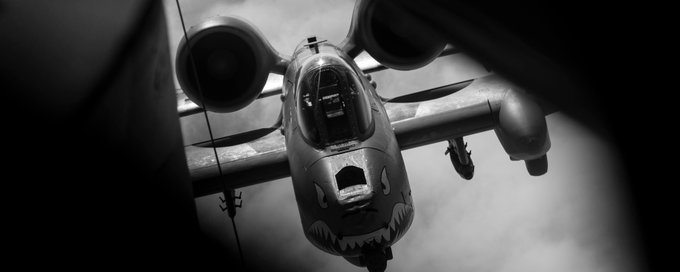 An A-10 Thunderbolt II close attack jet depicted on CENTCOM’s X announcement of joint U.S.-Saudi strikes on IRGC-connected groups in Iraq. (CENTCOM)
 U.S. troops are adding to the danger they face by posting cellphone videos of attacks online, CENTCOM commander Adm. Cooper warned, according to Reuters. The command is also considering having some personnel surrender their phones, the outlet added.
Cooper, in a previously unreported letter, “said Iran was benefiting from being able to see the success or failure of its strikes in near real-time by searching news reports or online posts by journalists referencing ‘reactions, photos, and footage from the cellphones of our troops,’” Reuters stated.
The CENTCOM commander appeared to reference the following video in his letter, Reuters suggested.
“The direct, unavoidable cost of this open-source intelligence could be measured in the lives of American service members and civilian residents in targeted Gulf countries,” Cooper wrote in his July 28 letter, a copy of which was obtained by Reuters.
He called on troops to “redouble our focus on operational security,” without prescribing specific steps in the memo,” the news organization further noted.
“Admiral Cooper’s top priority is the well-being and protection of over 50,000 American service members operating in the Middle East,” CENTCOM spokesman Navy Capt. Tim Hawkins told TWZ in response to our questions about the letter. “His guidance to troops about operational security reinforces this priority.”
Cooper’s letter follows moves by U.S. satellite companies like Vantor and Planet Labs to delay posting imagery from the region out of similar concerns about operational security.
Cooper's memo underscores the mounting tensions between real-time news reporting on the war, often aided by satellite imagery and first-person accounts, and the desire by the U.S. military to restrict any information that could aid Iran as it tries to kill and wound U.S.… https://t.co/0OBN2o1rtg
— Phil Stewart (@phildstewart) July 29, 2026Amid the renewed U.S.-Iran hostilities, the Houthi rebels of Yemen are considering imposing fees on ships transiting the Red Sea, according to Reuters. The move follows the group’s imposition of a blockade on Saudi ships and its firing on Saudi vessels. It mirrors a similar effort Iran is trying to impose on ships transiting the Strait of Hormuz.
“The Houthis were looking into imposing fees on most traffic through the narrow Bab el-Mandeb [BAM] gateway,” Reuters noted, citing sources. The narrow waterway, between Yemen and Djibouti, links the Red Sea to the Gulf of Aden. “No timeframe was given at this stage for implementation,” the sources added.
The Houthis’ media office did not respond to a request for comment.
July 29 (Reuters) – Yemen's Houthi group is considering imposing fees on commercial ships sailing through the southern Red Sea, a week after declaring a naval blockade on Saudi Arabia, regional sources with knowledge of the matter told Reuters.
— Tala Ramadan (@TalaRamadan) July 29, 2026As we have frequently detailed, Houthi actions in the BAM threaten to add far greater pressure on oil exports from the Middle East, already drastically affected by the Iranian closure of the Strait of Hormuz and the resumption of the U.S. blockade on Iranian ports. The Yemeni rebel group has already expanded its target set, hitting oil terminals and infrastructure Saudi Arabia is using to pump supplies to tankers in the Red Sea. The kingdom has diverted millions of barrels of oil per day through pipelines to its Yanbu port on the Red Sea in an effort to minimize the energy shortages due to the hostilities in the Persian Gulf. Even with the BAM closed, oil exports could still head to the West, via the Suez Canal. But if the infrastructure used to convey these energy products is put out of action, the consequences could be even more severe, with far less or even no energy supplies from Saudi Arabia moving out of the Red Sea. The closing of the BAM, and the possible imposition of tolls, also raises the specter of the U.S. having to get as involved as it did during the previous Houthi campaign against shipping that ended last September, which could pull resources away from Iranian-focused operations.
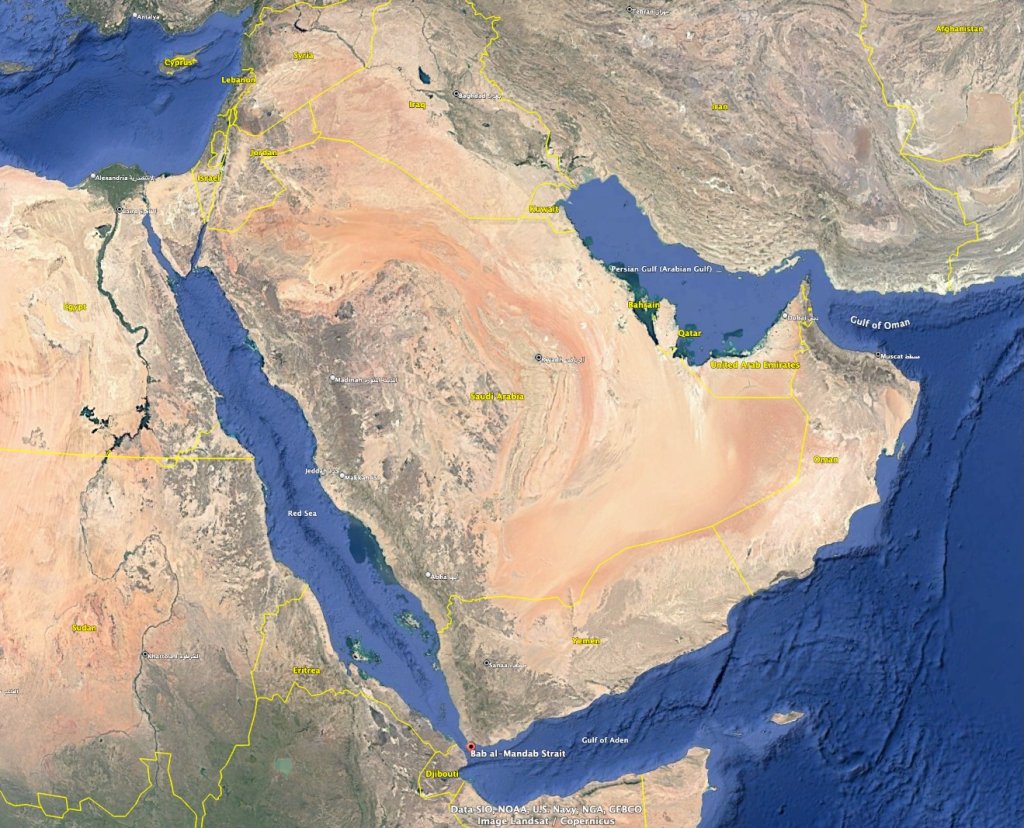 Bab al-Mandeb Strait. (Google Earth)
 Despite the increased risks, transits through both straits are trending upward, according to the Kpler risk management firm.
“Daily monitoring shows stronger transit volumes across the Strait of Hormuz and Bab el-Mandeb, with 12 and 41 confirmed crossings respectively on 28 July,” Kpler noted on X. “Yet higher traffic should not be mistaken for lower risk. Hormuz routing remains concentrated outside traditional traffic separation patterns, while Bab el-Mandeb continues to present elevated operational and compliance challenges through dark transits, sanctioned vessels and shadow fleet movements.”
“With 62 confirmed maritime security incidents recorded by the IMO as of 27 July and geopolitical tensions still unresolved, vessel behavior remains a more meaningful indicator than crossing volumes alone,” Kpler added. “For operators and markets alike, transparency, routing choices and emerging disruptions remain the key signals to watch over the coming days.”
Traffic rises, risks persist
Daily monitoring shows stronger transit volumes across the Strait of Hormuz and Bab el-Mandeb, with 12 and 41 confirmed crossings respectively on 28 July. Yet higher traffic should not be mistaken for lower risk. Hormuz routing remains concentrated… pic.twitter.com/fwUxZyUaf8
In the wake of new fighting in the region and threat of Houthi tolls on the BAM, oil prices are once again trending upward. The per barrel price of Brent Crude has risen to nearly $90, according to OilPrice.com. It had fallen to just over $83 per barrel yesterday when the pause in hostilities was still holding.
As we have previously noted, the U.S. and Iran had stopped firing at each other late last week, leading to a pause after 13 straight days of continuous tit-for-tat operations. U.S. President Donald Trump hadn’t ordered a U.S. strike on Iranian territory since last Thursday. This was ostensibly to give another round of diplomacy a chance. However, lingering concerns over the supply of munitions, especially air defense interceptors, reportedly played a role in Trump’s thinking.
The U.S. has burned through hundreds of Terminal High Altitude Area Defense (THAAD) and Patriot interceptors since a shaky ceasefire went into effect on April 8, according to the Center for Strategic and International Studies (CSIS) latest assessment. CSIS was updating a previous analysis of munitions expenditures during Epic Fury that you can read more about here.
According to CSIS, the U.S. had about 2,300 Patriot interceptors in its inventories before Epic Fury, 1,030 by the time the ceasefire was agreed to and between 759 and 827 as of July 27.
As for THAADs, there were 452 interceptors in the U.S. inventory before Epic Fury, between 232 and 262 on the date of the ceasefire and between 234 and 278 as of July 27.
The report authors noted that “[e]stimated inventories today account for additional interceptor use and new deliveries since the April 8 ceasefire. THAAD deliveries during the ceasefire outpaced estimated use over the same period, resulting in higher inventories today than in April. Patriot calculations include the latest MSE variant and PAC-3s. Several hundred PAC-2s, not represented in the chart, are estimated to remain in the U.S. inventory.”
New estimates of American Patriot PAC-3 and THAAD anti-ballistic missile interceptor stockpiles in American inventory from CSIS.
Roughly a third of pre-war Patriot interceptors are estimated to remain. pic.twitter.com/fa986PkBQM
The lack of sufficient magazine depth is an issue that TWZ has raised frequently for years, and especially in regard to America’s air and missile defenses, in particular. In fact, we laid out in detail these exact concerns and how they would be a major issue in war with Iran just prior to the conflict starting in a feature you can read in full here.
Given Trump’s threat against Iran today, those concerns may be set aside out of a need to respond to the ballistic missile attack. The coming hours should give us a better picture of how all this will develop.
Contact the author: [email protected]