 By The War Zone | Created at 2026-08-14 00:31:05 | Updated at 2026-08-14 01:19:12
1 hour ago
By The War Zone | Created at 2026-08-14 00:31:05 | Updated at 2026-08-14 01:19:12
1 hour ago
The TWZ Newsletter
Weekly insights and analysis on the latest developments in military technology, strategy, and foreign policy.
With one-way attack drones playing an ever larger role in American military operations, U.S. Central Command announced it is creating what it calls “the first multinational attack drone task force.” The move comes as combat between the U.S. and Iran has paused, but tensions in the region remain high, including ongoing attacks on shipping by the Iranian-aligned Houthi rebels of Yemen. The task force is also being launched amid growing concerns about the U.S. magazine depth of high-end standoff weapons — a class of weapon one-way-attack drones aim to take pressure off of.
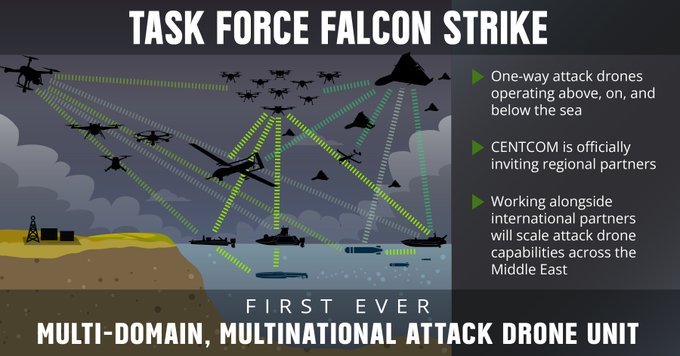
Dubbed Task Force Falcon Strike (TFFS), the command said it will “employ one-way attack drones consisting of unmanned systems from above, on, and below the sea operated by military support staff from the United States and regional partners.”
The CENTCOM announcement offered no further information about which nations will participate, what systems will be used, and whether those joining Task Force Falcon Strike will bring their own equipment. The command declined to provide further details when we asked.
The war against Iran saw the command follow global trends in warfare by deploying air and sea drones in combat for the first time. Other militaries in the Middle East have or are working on acquiring similar capabilities. Israel largely wrote the book on one-way attack munitions, for instance.
 (CENTCOM)
 The establishment of TFFS follows the creation in December of Task Force Scorpion Strike (TFSS). As we were one of the first to report, this was the U.S. military’s first dedicated one-way attack drone squadron and the first operational unit armed with Low-Cost Uncrewed Combat Attack System (LUCAS) kamikaze drones, a design reverse-engineered from the Iranian-designed Shahed-136, in the Middle East.
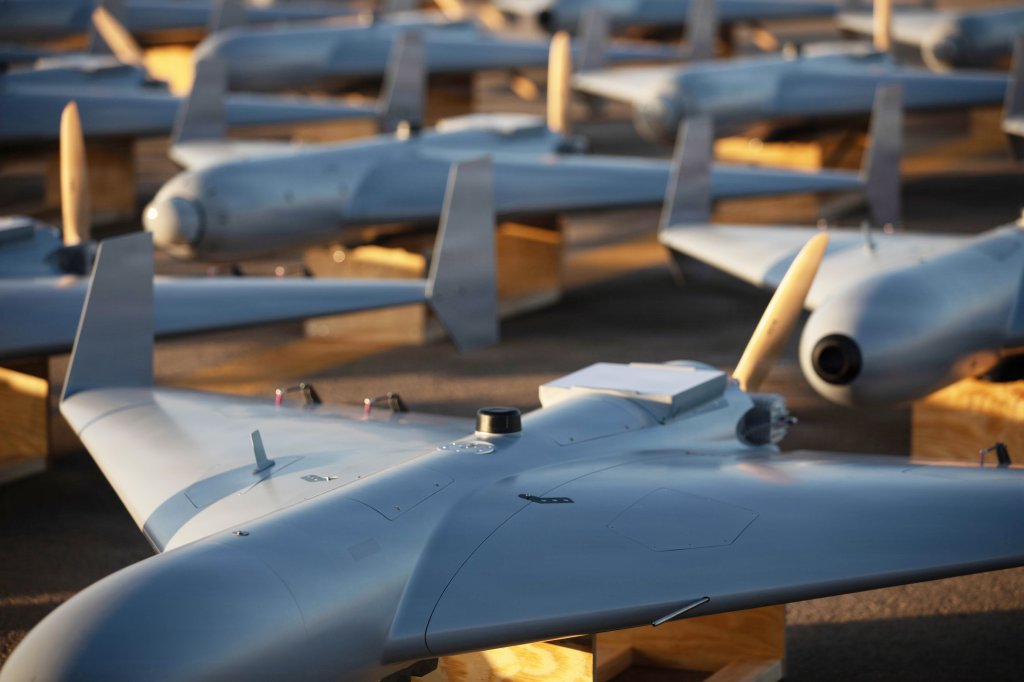 Low-Cost Uncrewed Combat Attack System (LUCAS) drones. (Courtesy Photo)
 Initially, TFSS was created to send a warning to Iran, a U.S. official told us at the time. As we noted earlier in this story, after the launch of Epic Fury on Feb. 28, TFSS marked several operational firsts for America’s use of drones in war.
The first major milestone came on the opening day of the war, when LUCAS drones were used for the first time. The second came in June, when a Saronic Corsair uncrewed surface vessel (USV) rescued the crew of a U.S. Army AH-64 Apache that crashed in the Gulf of Oman after it was downed by Iran. That was the first known instance of a drone boat being used to recover personnel as part of a search and rescue mission.
The third large step forward for U.S. drone warfare came in July, when three Corsairs “hit the port at Bandar Abbas Naval Base” and “successfully struck a submarine and ship maintenance facility in Iran,” the command stated on X that day. It was the first U.S. use of a USV as an attack weapon.
You can see those attacks in the following video produced by CENTCOM.
Yesterday, using multiple one-way attack surface drones, CENTCOM forces successfully struck a submarine and ship maintenance facility in Iran. Three Corsair unmanned surface vessels hit the port at Bandar Abbas Naval Base, marking the first time American forces have employed sea… pic.twitter.com/bOM2kmgRxz
— U.S. Central Command (@CENTCOM) July 13, 2026As we have frequently reported, Ukraine has used USVs to devastating effect on the Russian Black Sea Fleet. The Magura line of drones, among others, has played a key role in this campaign.
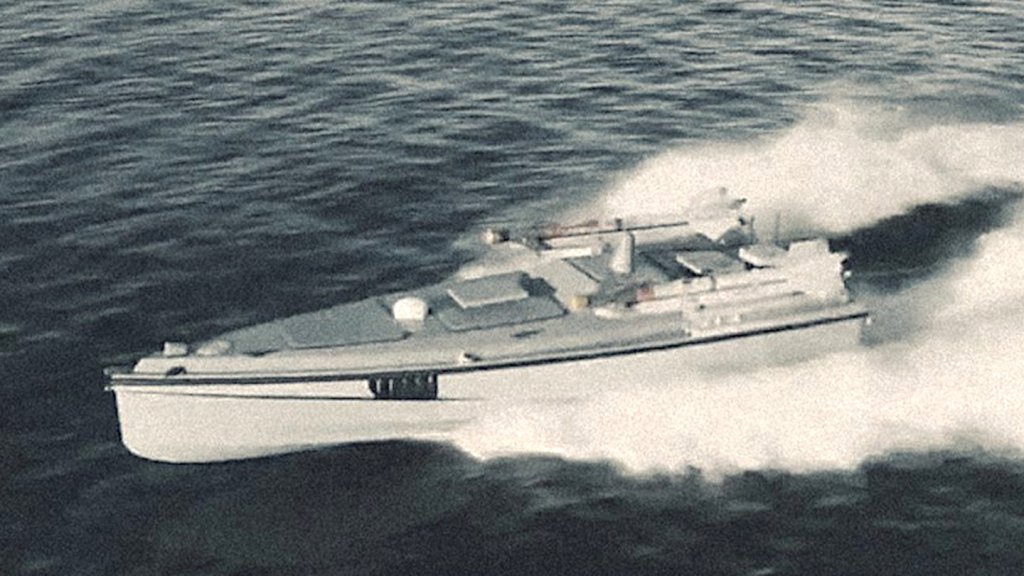 Ukraine Defense Intelligence Directorate’s (GUR) new Magura 7 sea drone. (GUR)
 Notably, the command also said the new task force will also use uncrewed underwater vehicles (UUVs) as attack weapons. If they have been used in combat by the U.S., that has not been publicly acknowledged. The command did announce in April that it was using UUVs to assist in demining the Strait of Hormuz.
In December, Ukraine’s state security service (SBU) said it carried out the first-ever UUV attack on a Russian vessel. The strike was on a Project 636 Varshavyanka class, or Improved Kilo class diesel-electric submarine, in the Black Sea naval stronghold of Novorossiysk.
That attack can be seen in the video below.
“Task Force Falcon Strike will expand on Scorpion Strike’s success given the tremendous innovation happening among our regional allies and partners,” Adm. Brad Cooper, CENTCOM commander, said in a statement. “Integrating and deploying our new capabilities together will help us rapidly realize the new possibilities that are on the horizon.”
“The United States military has a lot of strong partnerships and friends in the region,” Cooper added. “We are collectively stronger when we integrate and deploy new capabilities together.”
CENTCOM said it has started the process of consulting with and officially inviting regional partners.
“As regional partners formally join, Task Force Falcon Strike will scale attack drone capabilities across the Middle East into a unified multi-domain, multinational deterrent,” the command explained.
U.S. Special Operations Command Central (SOCCENT), which launched Scorpion Strike, will lead the new task force’s staff of U.S. and regional representatives.
As we noted earlier in this story, all this comes amid simmering regional tensions.
Although the U.S. and Iran have not fired at each other in a few weeks, the two sides continue to verbally spar over control of the Strait of Hormuz, a standoff that raises concerns about renewed hostilities. President Donald Trump on Wednesday issued a social media post saying the U.S. controls the vital checkpoint and that the ongoing naval blockade of Iranian ports will remain in place.
Trump: ‘The U.S.A. has total control over over the Strait of Hormuz. I THINK WE WILL KEEP IT! Our Naval Blockade is being called, by everyone, “A WALL OF STEEL,” and there is nothing Iran can do about it. They have no Navy, they have no Air Force, their remaining soldiers are… pic.twitter.com/9tecLcW3oW
— Open Source Intel (@Osint613) August 12, 2026For their part, officials in Tehran say the Strait remains “under Iran’s control and management.”
Meanwhile, earlier this week, the Houthis carried out their first deadly attack on shipping in the Red Sea region in more than a year. That came after they promulgated a blockade on Saudi shipping in the Bab al-Mandeb Strait, started attacking Saudi vessels and oil infrastructure, and Saudi-backed troops in Yemen.
As we have frequently noted, these Houthi actions have raised the specter of the U.S. having to get as involved as it did during the previous Houthi campaign against shipping that ended last September.
Six dead in latest (presumed) Houthi attack on a cargo ship in the Red Sea…The Tanzania-flagged Tihamah "was hit by three consecutive ballistic missiles, the Yemeni Ministry of Transport said, in the Bab el Mandeb on Tuesday…Four crewmembers were killed in the attack" and…
— Steve Lookner (@lookner) August 12, 2026Given all that, it is understandable why CENTCOM would want to marshal regional forces to create a new one-way attack drone unit. Especially when concerns are mounting about the expenditure of expensive, high-end, hard-to-replace U.S. munitions during the war on Iran.
Beyond that, the new task force could also create a lucrative regional marketplace for one-way attack drones, including those built at scale in the United States.
There are still many details yet to emerge about Task Force Falcon Strike. We will provide more details when they become available.
Contact the author: [email protected]