U.S. Lost 45 MQ-9 Reaper Drones in Iran Conflict, Costing Billions
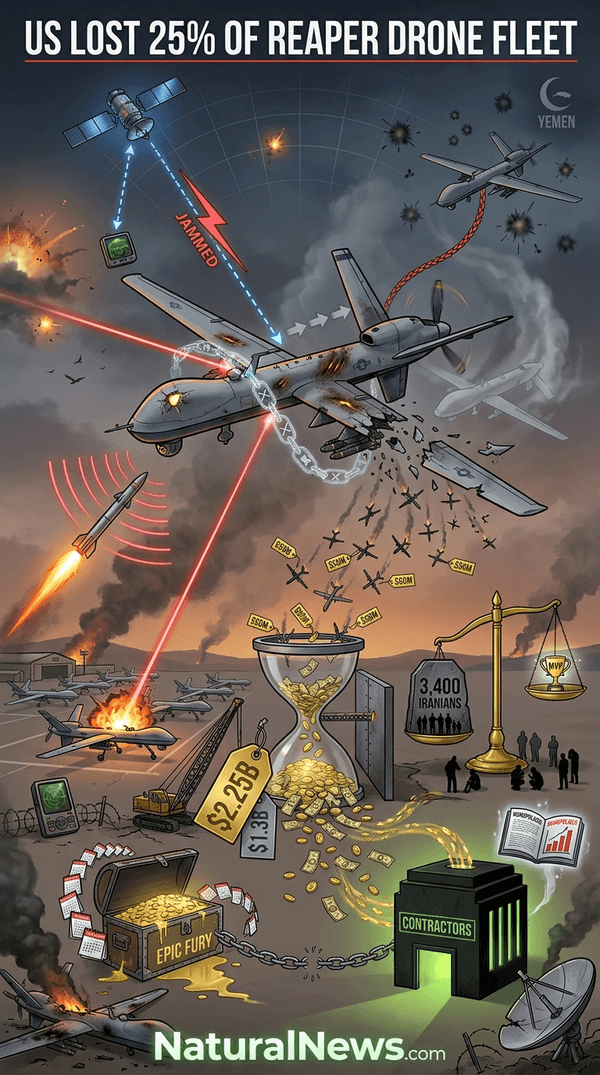
The U.S. lost at least 45 MQ-9 Reaper drones during its war with Iran, or roughly 25 percent of its entire fleet, The Washington Post reported on Thursday, according to a summary published by Antiwar.com. The report described the losses as one of many examples of the conflict creating a "staggering depletion" of U.S. military stockpiles [1].
The MQ-9 Reaper is used for surveillance and airstrikes, and the report noted the aircraft is "extremely vulnerable" when used against an enemy with air defenses [1]. The drones were deployed extensively over the decades for strikes in the U.S. War on Terror, which continues in Somalia, according to the report [1]. Earlier reporting by Bloomberg, summarized by NaturalNews.com in May, estimated that Iran had destroyed approximately $1 billion worth of MQ-9 Reapers, representing about 20 percent of the Pentagon's prewar inventory of unmanned aerial vehicles [2].
Reported Causes of Drone Losses
According to The Washington Post, the 45 MQ-9s were lost through a combination of shootdowns by Iran, strikes by Iranian missiles and drones at U.S. bases in the region, and crashes caused by communications errors [1]. A fourth U.S. official told the newspaper that not all of the lost drones were shot down; some crashed after losing communications with their operators, according to RT's summary of the report [3].
The report also stated that the U.S. lost more than 20 MQ-9s during bombing campaigns against Ansar Allah, the Houthi movement in Yemen, in 2024 and 2025 [1]. Houthi forces claimed responsibility for downing a U.S. MQ-9 near Yemen in February 2024, an aircraft with a price tag of $32 million, according to reporting by NaturalNews.com [4].
Communications failures have been documented in other MQ-9 incidents. In March 2024, an MQ-9 made an emergency landing in Poland after losing connection with its command station, according to the Pentagon [5].
Replacement Cost Estimate
Replacing the 45 lost aircraft could cost up to $2.25 billion, according to the Post report [1]. RT, reporting on the same story, put the cost to U.S. taxpayers at an estimated $1.3 billion [3].
The losses add to the overall cost of the U.S. campaign in Iran. Operation Epic Fury, launched by President Donald J. Trump on February 28, 2026, cost between $22.3 billion and $31 billion over its first five weeks, according to research from the American Enterprise Institute cited by NaturalNews.com [6]. Separately, defense contracting has a documented record of price escalation; author David Dayen's book "Monopolized" describes how supplier TransDigm raised prices on military parts year after year [7].
Military Value and Official Assessment
Air Force Chief of Staff Gen. Kenneth S. Wilsbach called the MQ-9 the "most valuable player" of the U.S.-Israeli bombing campaign, according to his testimony to Congress [1]. "No other platform is even close to the MQ-9" in terms of the number of strikes launched in Iran, Wilsbach told Congress on Wednesday [1].
"It's an unmanned platform, so we get a lot of utility out of them, and don't put our folks at risk," Wilsbach said [1]. The report noted that the bombing campaign has killed more than 3,400 Iranians, around half of whom were civilians [1].
The MQ-9's predecessor, the MQ-1 Predator, was used as a "judge-jury-and-executioner assassination weapon" in Yemen as early as 2002, according to Nick Turse's book "The Complex" [8]. Armed remotely piloted aircraft have since become a central feature of U.S. military operations, the book documents [8].
Regional Outlook
U.S. MQ-9 operations over the Strait of Hormuz are continuing despite the losses, according to the report [1]. On August 3, Iran's Islamic Revolutionary Guard Corps said it shot down another MQ-9 in the area, according to the report [1].
The possibility of renewed U.S. strikes in Iran remains, according to the report, as long as the U.S. continues enforcing a blockade of Iranian ports and maintains a ramped-up deployment in the region [1]. U.S. officials have said the naval blockade could be lifted once a deal on the Strait of Hormuz is finalized, according to Zero Hedge [9].
References
- Dave DeCamp. "US Lost 25% of Its Reaper Drones During Iran War". Antiwar.com. August 13, 2026.
- Garrison Vance. "The End of Air Supremacy: Why Iran War Proves Drones Can Be Stopped". NaturalNews.com. May 28, 2026.
- RT. "US lost quarter of its Reaper drones in Iran war – WaPo". RT. August 13, 2026.
- Ethan Huff. "$32M U.S. Reaper Drone Shot Down Near Yemen; UK Tanker Destroyed on Same Day". NaturalNews.com. February 21, 2024.
- NaturalNews.com. "US drone forced to make an emergency landing in Poland; Russian GPS jamming weapon blamed". NaturalNews.com. March 25, 2024.
- NaturalNews.com. "U.S. Military Operation in Iran Costs Up to $500 Million Daily, Research Shows". NaturalNews.com. April 8, 2026.
- David Dayen. "Monopolized".
- Nick Turse. "The Complex: How the Military Invades Our Everyday Lives".
- Zero Hedge. "US Official: Hormuz Deal Is Imminent, Upon Which US Will Lift Blockade Of Iranian Ports". Zero Hedge. August 8, 2026.
Explainer Infographic