 By The War Zone | Created at 2026-08-13 19:45:57 | Updated at 2026-08-13 20:26:50
46 minutes ago
By The War Zone | Created at 2026-08-13 19:45:57 | Updated at 2026-08-13 20:26:50
46 minutes ago
The TWZ Newsletter
Weekly insights and analysis on the latest developments in military technology, strategy, and foreign policy.
The deputy commander of United States Northern Command (NORTHCOM) and North American Aerospace Defense Command (NORAD) was asked on Thursday if he could defend against an attack by a swarm of drones in the homeland. His reply was blunt and chilling: “No”
We don’t have the sensors, and depending on where that swarm is going to attack, it depends on whether we have any sensors at all, and also on whether we’ve got any effectors to go after that problem,” Army Lt. Gen. Joseph Jarrard stated. He was addressing an audience at the Space and Missile Defense Symposium (SMD) in Huntsville, Alabama, attended by TWZ.
“So we are ill-equipped right now to handle something like that, and obviously we’ve seen it used,” the general added. “We’re seeing it used on a daily basis around the world, and we’ve got to figure out how to mitigate that threat, but we’re not there yet.”

2026 SMD Symposium Day 3
Jarrard’s statements were a sharp admission by a U.S. military leader of a number of interconnected gaps, including the lack of domain awareness over the homeland. It is a topic TWZ has frequently raised over the years, but that U.S. officials would not admit to it or address until after the Chinese spy balloon floated over much of the country in 2023 before being shot down off the Carolinas. He was also raising other concerns we have oft highlighted, like having the right systems in place to take drones down once they are detected and the proper authority to use them when needed.
Though Jarrard didn’t offer any specific examples of potential threat scenarios, the most glaring is Ukraine’s Operation Spiderweb attack on Russian air bases. Drones stored in prepositioned trucks were launched nearby remotely and destroyed a large number of Russian bombers and other critical aviation assets.
You can see a video of one of those attacks below.
Another example of a similar near-field attack was the first-person view (FPV) drone strike on a U.S. Army helicopter in Iraq earlier this year, which you can read more about here.
The following video captures that incident.
An Iranian-backed militia carried out a successful FPV drone strike on Camp Victory in Iraq yesterday, successfully hitting multiple targets.
Seen here, one of the FPV attack munitions hits a parked UH-60 Black Hawk. pic.twitter.com/ngY8td9ONZ
These incidents underscore the very real risk faced by military infrastructure, other critical assets and VIPs in the United States, a point that TWZ has repeatedly raised for a decade. In particular, near-field attacks like Operation Spiderweb pose a huge threat and one would be hard to stop once it began. Compared to a combat theater, there are fewer defenses and far less surveillance, let alone similar alert levels, at sensitive installations all over the U.S. With advances in drone technology and accessibility, attacks coming from within the U.S. could be executed by longer-range drones, as well, which presents additional challenges for preparing defenses.
Speaking at SMD, Jarrard acknowledged many of these concerns and offered some insights into the challenges the command faces and how it is working to address them.
While the authority to use counter-drone systems is still catching up with the technology, Jarrard noted that his commands are working to apply lessons from Operation Noble Eagle (ONE) on the counter-drone effort. Operation Noble Eagle, which came into being following the September 11th attacks, changed America’s air defense posture. It included putting fighters on higher readiness and upping the surveillance over the United States regular air patrols and flights by AWACS surveillance aircraft. In addition, new rules of engagement were put in place and trained for.
“We are integrating some of the TTPs [tactics, techniques and procedures] that we use in that mission to also incorporate with the counter-UAS mission, so some of that is just a natural flow from the ONE mission,” the general proffered at SMD without offering further details. “But the other problem is detection. That is obviously the biggest issue, and so how we are able to detect is one of our biggest concerns right now.”
“We’re using the assets that we have, radars, et cetera, but it’s going to be also involving local law enforcement because it’s not just installations, Army or military installations, but it’s also things like we did [by] interacting with the federal authorities and local law enforcement with respect to the FIFA World Cup,” Jarrard suggested. “We’ve got to be interoperable with the systems that they’re procuring, using, utilizing, and they’ve all got to talk together, and so that’s where we’ve got to get to with respect to the interoperability between not just military systems, but also those that are protecting our cities, cities, critical infrastructure, et cetera, that are off our installations.”

Inside Look at US Drone Security During FIFA World Cup 2026
As we have previously noted, NORTHCOM has taken measures to help base commanders protect against drones one they arrive. One example came earlier this year, after incursions over two installations, including Barksdale Air Force Base in Louisiana, home of B-52 Stratofortress bombers and nuclear weapons storage facilities, and a key part of the airborne leg of America’s nuclear triad. NORTHCOM deployed its new counter-drone fly-away kit, designed to give installation commanders the ability to detect, quantify, and defeat small drones that they cannot defend against on their own.
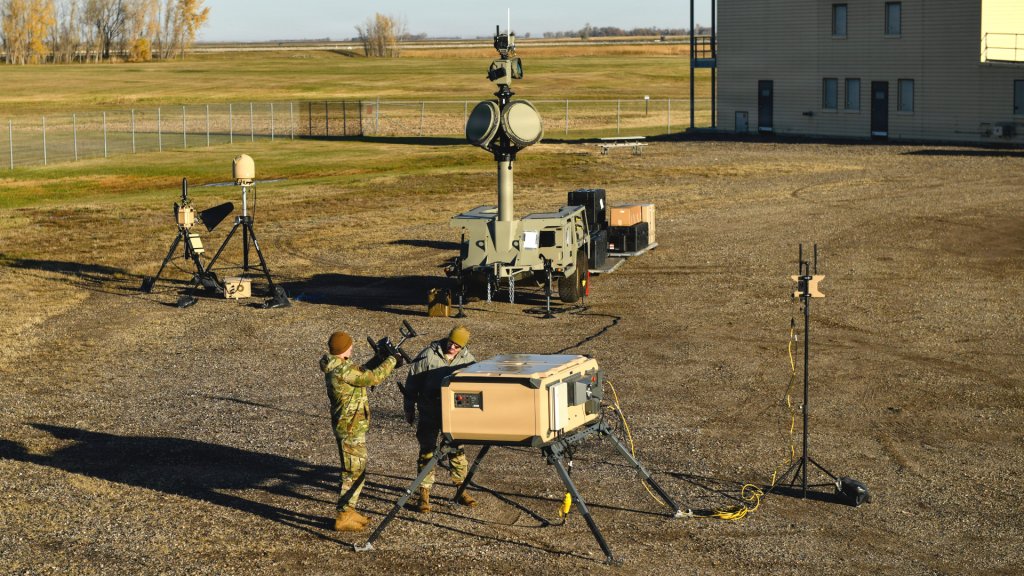 The NORTHCOM fly-away kit. (U.S. military)
 However, given that these systems have to be requested and then delivered, there is a limit to just how much protection they can provide, especially against an attack like Spiderweb that popped up with no warning. The fly-away kits would not arrive until after such an attack occurred, unless there was intelligence that gave some kind of warning. Meanwhile, there is a huge lack of capacity when it comes to installing these systems on a more permanent basis at installations that really need them, let alone critical civilian infrastructure and other high-value targets.
Moreover, for years now, U.S. military officials have often pushed back on the utility and cost-effectiveness of investing more in the physical hardening of bases and other critical facilities, especially shelters to shield aircraft from drones and other threats. However, that is starting to change. In a notable shift in department policy, the Pentagon in February issued new guidance for defending critical infrastructure against drone attacks through the increased use of netting, cables, and other kinds of passive physical defenses.
Jarrard’s comments at SMD, while troubling, were also a refreshing acknowledgment by someone in charge of protecting the U.S. that we remain woefully vulnerable to the kind of attack Ukraine launched against Russia last year. Admitting the problem will hopefully help with putting in place real solutions to it in the not so distant future.
Contact the author: [email protected]