By Euronews | Created at 2026-08-19 15:41:39 | Updated at 2026-08-19 16:09:07
2 hours ago
By Euronews | Created at 2026-08-19 15:41:39 | Updated at 2026-08-19 16:09:07
2 hours ago
The United Arab Emirates has halted all trade, commercial exchange and financial transactions with Iran until further notice, severing economic ties with its neighbour after a fresh round of missiles targeted the country.
 ADVERTISEMENT
ADVERTISEMENT
"In light of regional escalations ... all trade, commercial exchanges, and financial transactions with Iran have been halted until further notice," said Afra Al Hameli, Director of the Strategic Communications Department at the Ministry of Foreign Affairs.
Al Hameli stated that the UAE remained firmly committed to safeguarding the integrity of the international financial system, in line with international law and the highest global standards.
She also rejected allegations about the status of the economic relationship between the two countries and restated the UAE’s commitment to dialogue, cooperation and regional integration.
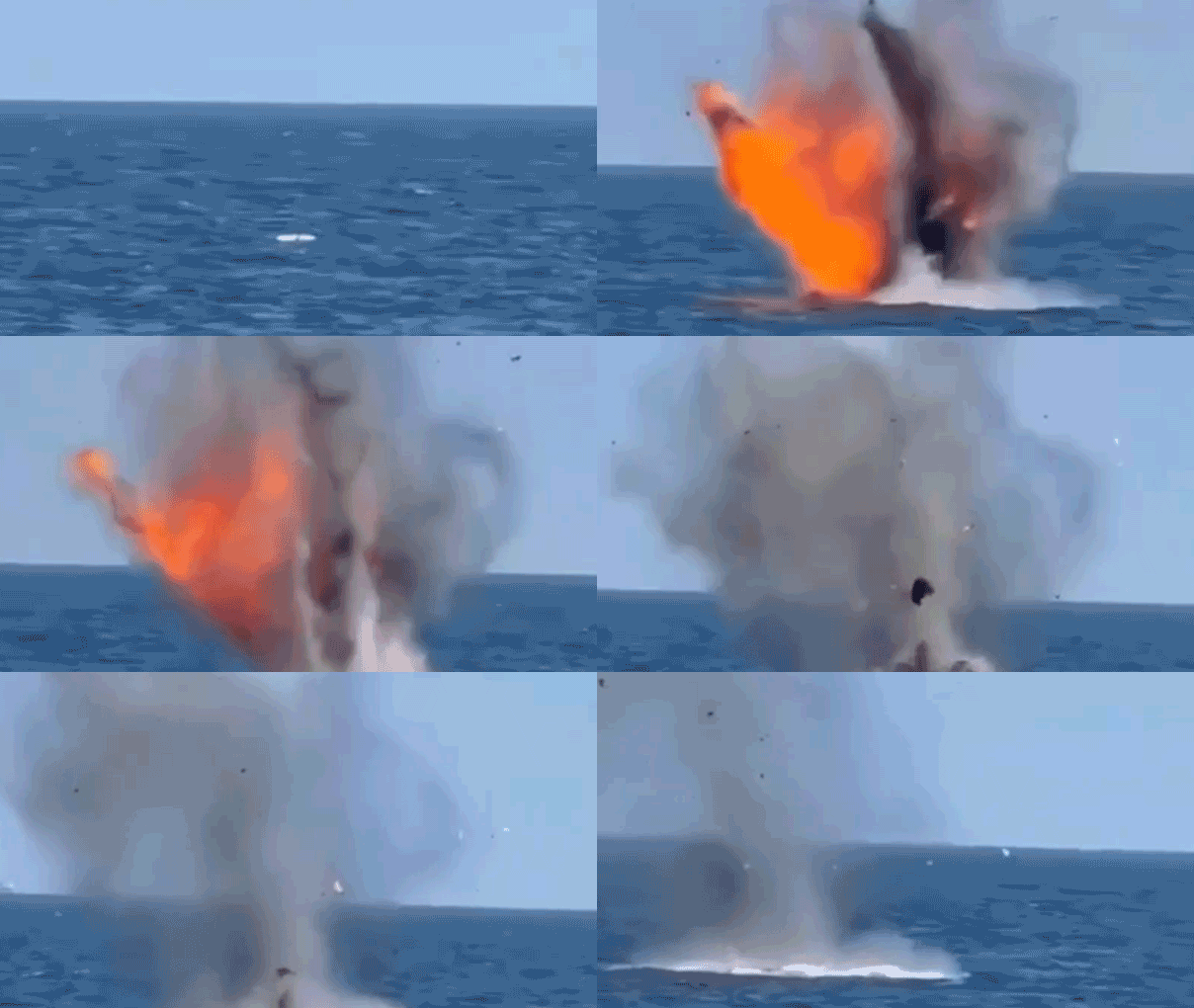
Earlier on Tuesday, Abu Dhabi said Iran fired two ballistic missiles on the country, later clarifying that the salvo had been directed at shipping. Both fell in the sea, one of them inside Emirati territorial waters.
Tehran has denied targeting the UAE. Iranian foreign ministry spokesman Esmail Baghaei "categorically rejected the United Arab Emirates' claim that Iran had launched a missile towards that country".
The war broke out on 28 February with US and Israeli attacks on Iran, which then launched daily missile and drone strikes on targets in neighbouring countries.
What is being switched off?
The UAE, home to a sizable Iranian community, had been a major trading partner for sanctioned Iran, at least before the war.
Tuesday’s announcement is the latest Emirati measure against Tehran, after the ambassador was recalled early in the war and Iran-linked schools and a hospital were closed.
The suspension covers direct dealings. It does not say whether it reaches money routed through third countries.
In June 2025, the US Treasury’s Financial Crimes Enforcement Network told banks that Iranian networks set up front companies in third countries, often exploiting free trade zones that offer favourable conditions for company formation.
It said Iranian actors commonly use general trading companies registered in commercial free zones in the UAE and Hong Kong companies banking in China through non-resident accounts, with trading counterparties mostly in Singapore and Hong Kong.
Hours after the announcement, Iran’s armed forces chief of staff Ali Abdollahi warned Gulf countries against assisting the US, saying "that any assistance or facilitation provided to the aggressor US military amounts to participation in the US military operation", according to the Mehr news agency.
The Gulf is dotted with regular and sometimes permanent US military presence, including in the UAE.
Many Middle Eastern countries have said since the war began that they would not let the US use their territory as a launchpad, yet Abdollahi cast doubt on those assurances.
"It seems unlikely that such a large number of military aircraft, particularly refuelling aircraft, could be present at regional bases without knowledge of host countries," he said, adding that Gulf countries "should know that we are fully aware of the situation".
Media reports have suggested that Saudi Arabia, the UAE, Kuwait and Bahrain have all struck targets inside Iran in retaliation for attacks on the Gulf. The countries have mostly denied it.
Piracy in the strait
Tankers belonging to ADNOC, the Emirati state oil company, have been targeted repeatedly in recent weeks. On 8 August the foreign ministry said a missile had hit an ADNOC carrier crossing the Strait of Hormuz. On 14 August it said two more ADNOC vessels had been targeted as they transited the strait. There were no casualties in either attack.
In both statements, Abu Dhabi called the attacks a "flagrant violation" of the UN Security Council resolution on freedom of navigation and said that "targeting commercial shipping and using the Strait of Hormuz as a tool of economic coercion or blackmail represents acts of piracy by Iran’s Revolutionary Guard Corps".
The ministry demanded that Tehran stop the attacks, commit to an immediate cessation of hostilities and reopen the strait completely and unconditionally.
Iran has blockaded the Strait of Hormuz, through which vessels leaving most UAE ports must pass, and a framework US-Iran deal to reopen the corridor has collapsed.
On Monday Jared Kushner, US President Donald Trump’s envoy and son-in-law, said Washington and Tehran were having "very positive and active conversations". On Tuesday Trump denied it.
"There are no talks or conversations going on, or scheduled, with the Islamic Republic of Iran. The Naval Blockade remains in full force and effect," he wrote on social media, referring to the US counter-blockade of Iranian ports.
Crude moving through the Strait of Hormuz averaged 4.9 million barrels a day in the second quarter of this year, against 21.6 million a day in the final quarter of 2025.
The US Energy Information Administration expects flows to stay severely constrained through August and to recover slowly from September.
It puts Middle East production shut-ins at an average of 5.5 million barrels a day in July and does not expect production and trade patterns to return to their pre-conflict shape before early 2027.
It forecasts Brent at $85 a barrel for the third quarter, $11 above its previous estimate.
![The Lakota Way and Eastern Orthodox Christianity (similarities and a few differences in ‘creation spirituality’ and cosmology) [1]](https://europeantimes.news/wp-content/uploads/2026/08/The-Lakota-Way-and-Eastern-Orthodox-Christianity-cosmology.jpg)