 By GB News (World News) | Created at 2026-08-04 07:16:10 | Updated at 2026-08-04 11:11:16
4 hours ago
By GB News (World News) | Created at 2026-08-04 07:16:10 | Updated at 2026-08-04 11:11:16
4 hours ago
Britain's state pension has climbed two places in a European retirement ranking after years of triple lock increases, shedding its reputation as one of the continent's weakest systems.
The UK now ranks 12th out of 30 European nations in research compiled by Almond Financial after the state pension increased by 4.8 per cent in April, outpacing rises awarded to retirees across much of Europe.
Just three years ago, Britain sat in 14th place, with almost a fifth of pensioners living in poverty.
The triple lock, which guarantees annual increases based on whichever is highest among wage growth, inflation or 2.5 per cent, has helped improve the UK's position.
In recent years, average annual increases have exceeded 6 per cent, outstripping rises awarded in countries including Spain, Italy and France.
When factors such as free NHS healthcare, widespread homeownership and growing private pension coverage are taken into account, British retirees compare more favourably with many European counterparts.
The triple lock was introduced as part of the 2010 coalition agreement after the Conservatives accepted a Liberal Democrat demand during negotiations to form a Government.
Before its introduction, pensioner incomes experienced decades of fluctuating increases after Margaret Thatcher's Government switched annual state pension uprating from earnings to inflation in 1980.
That policy change proved controversial as inflation varied sharply over subsequent decades.
Ms Thatcher was prime minister from 1979 to 1990

GETTY
Pensioners received an 11 per cent increase in 1991, but Gordon Brown's 75p-a-week rise in 2000, equivalent to 1.1 per cent, became one of the defining criticisms of the state pension.
By 2010, around a fifth of pensioners remained below the poverty line.
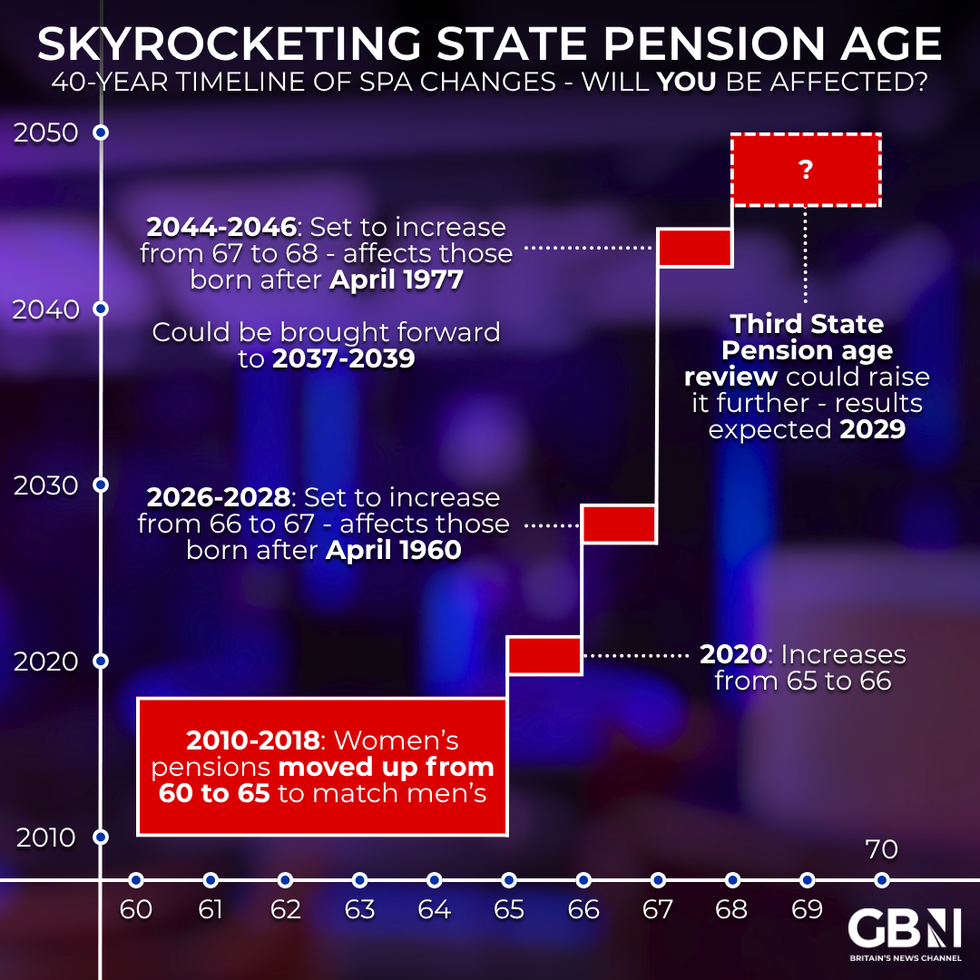
Since the triple lock was introduced in 2012, the old state pension has increased by 71 per cent, while the new state pension, introduced in 2016, has risen by 55 per cent.
The full new state pension now stands at £12,547 a year, around £1,280 more than it would have been under an inflation-only uprating system.
Britain's increase also compares favourably with several major European economies this year.
Spain raised its state pension by 2.7 per cent in line with consumer price inflation. Italy increased payments by 1.4 per cent.
France, which ranks 10th in the European table, awarded pensioners a 0.9 per cent increase.
France has also faced political disagreement over pension reform after attempts to raise the retirement age to 64 sparked widespread protests.
Elsewhere in Europe, Romania has frozen state pension payments for two years as part of EU-backed fiscal reforms.
Slovakia has reduced its annual increase to 95 per cent of wage growth as it seeks to ease pressure on public finances.
Among Scandinavian countries, Denmark matched Britain's 4.8 per cent increase, while Sweden increased pensions by 1.9 per cent and Norway awarded a 4.7 per cent rise using a formula linked to wages and inflation.
Britain's retirement system also benefits from broader structural advantages beyond the state pension.
Automatic enrolment, introduced in 2012, has brought an additional 10 million workers into workplace pension saving.
The Pensions Commission is examining whether contribution rates should increase further.
Major economies including France, Spain and Germany do not operate equivalent automatic enrolment systems, while Lithuania ended its own programme last year.
According to the EU's pensions authority, only one in five workers across the continent belongs to a workplace pension scheme.
Around three quarters of Britons aged over 65 own their home outright, a higher proportion than in many European countries.
Rob Morgan, pensions and retirement expert at Charles Stanley, said: "The UK state pension remains relatively modest by Western European standards, but it's not a like-for-like comparison.
"The UK relies far more heavily on workplace and private pensions, while also providing healthcare free at the point of use through the NHS."
Richard Gibson, senior consultant at Barnett Waddingham, said: "Homeownership is also much less prevalent on the Continent.
"A lot of people rent their homes even into retirement, whereas a lot of UK pensioners have already paid off the mortgage."
The future of the triple lock appears politically secure, with Andy Burnham pledging to maintain the policy and every major party apart from the Greens also backing it.
The Office for Budget Responsibility has projected that the annual cost of the triple lock will reach £15.5billion by 2030.
Mr Gibson added: "Our state pension may be fairly average for the OECD but, combined with the strong history of private provision, it puts UK pensioners in a good place on aggregate."