 By The Epoch Times | Created at 2026-08-03 22:17:00 | Updated at 2026-08-03 23:26:15
1 hour ago
By The Epoch Times | Created at 2026-08-03 22:17:00 | Updated at 2026-08-03 23:26:15
1 hour ago
U.S. and Philippine defense officials challenged Beijing’s maritime lawfare on Monday at a regional security conference in Malaysia, accusing the Chinese regime of using false legal claims and unilateral rules to pressure other countries into surrendering sovereign rights.
Adm. Samuel Paparo, commander of U.S. Pacific Command, said the ruling Chinese Communist Party regularly employs lawfare as a pretext for coercion and uses its public opinion, psychological, and legal warfare to isolate, intimidate, and delegitimize countries and their territorial integrity.
Paparo accused Beijing of declaring laws unilaterally and applying them retroactively—using newly asserted Chinese rules over contested areas to challenge rights that neighboring countries say they already possess under international law.
He said China pressures countries to relinquish lawful sovereign rights and invokes “false claims of legitimacy” to justify coercion.
“That is not ‘Rule of Law,’ that is ‘Rule by Law,’” Paparo said in remarks published by the command.
Philippine Defense Secretary Gilberto Teodoro Jr. called on the Association of Southeast Asian Nations (ASEAN) to stand with the Philippines in upholding the 2016 South China Sea arbitral award, arguing that Philippine maritime rights are a regional interest rather than a bilateral concern.
The officials spoke during U.S. Pacific Command’s 37th annual International Military Law and Operations Conference (MILOPS) in Kuala Lumpur. The gathering brought together more than 200 national security personnel from more than 30 Indo-Pacific nations.
Philippine Rights as an ASEAN Interest
Teodoro said the Philippines’ position as both a Southeast Asian and Pacific island country gives ASEAN a stake in protecting Philippine maritime rights and preserving lawful access between Southeast Asia and the Pacific.
“If ASEAN wants unimpeded access to the Pacific under a regime of UNCLOS and our trust and confidence, it follows ensuring Philippine entitlements as a whole under ASEAN’s interest,” he said, referring to the U.N. Convention on the Law of the Sea.
Teodoro said protecting those rights would benefit ASEAN and the wider international community. Support for the Philippines, he said, would help define the bloc’s solidarity and commitment to international law.
The 2016 tribunal found that Beijing had no legal basis to claim broad historic rights to resources within areas of the South China Sea where those claims exceeded the maritime entitlements allowed under UNCLOS.
The tribunal also addressed the legal status of maritime features and Chinese activities in waters claimed by the Philippines. It did not decide sovereignty over disputed land territory. Beijing rejected the proceedings and said it does not recognize the award.
ASEAN Calls for Unity and Maritime Guardrails
ASEAN Secretary-General Kao Kim Hourn called on the bloc to “speak with one voice” and urged governments to prevent maritime encounters from escalating into wider conflict.
The time between a routine encounter and an incident “can be measured in minutes, not many hours,” Kao said.
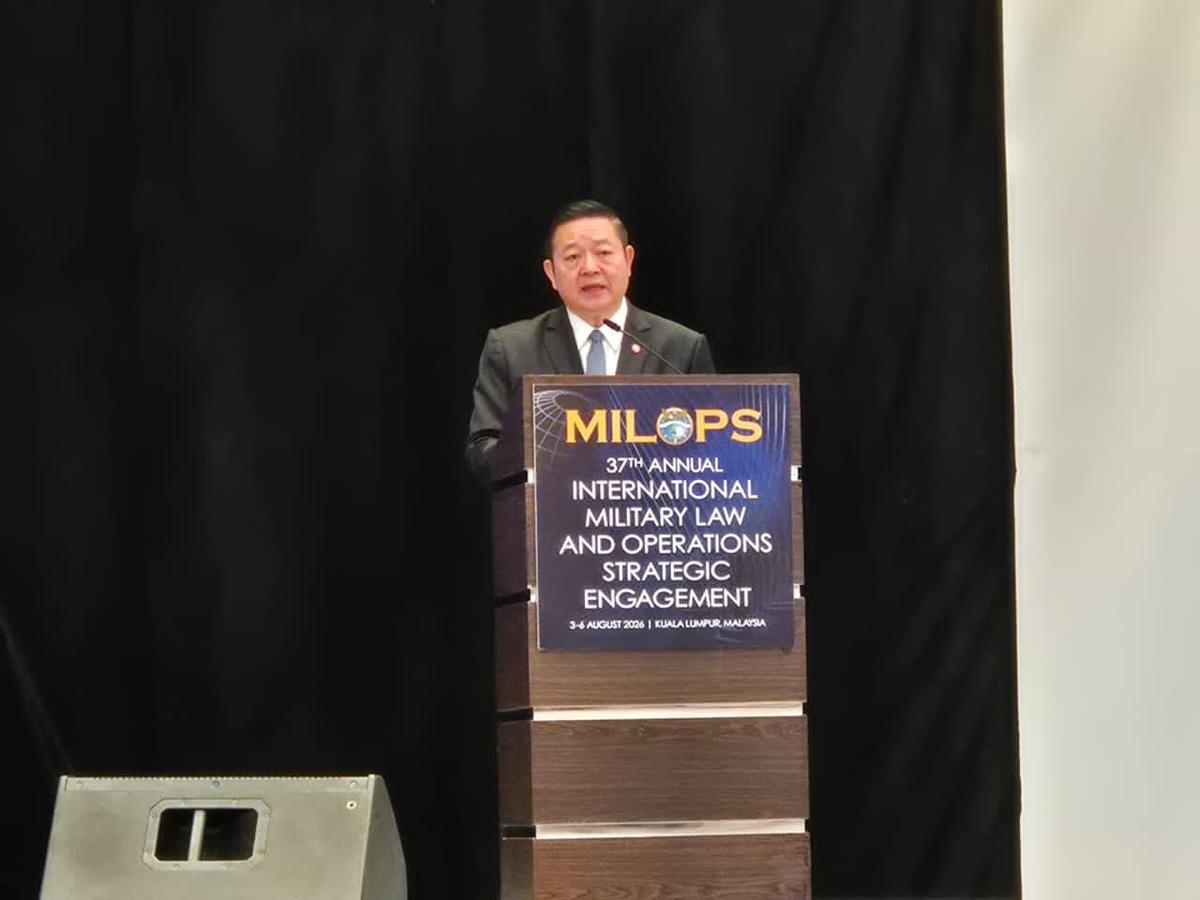
ASEAN Secretary-General Kao Kim Hourn speaks at the 37th annual International Military Law and Operations Conference in Kuala Lumpur, Malaysia, on Aug. 3, 2026. Courtesy of The ASEAN Secretariat
He called for peaceful dispute resolution under international law, including UNCLOS, full implementation of the existing Declaration on the Conduct of Parties in the South China Sea, and the early conclusion of an “effective and substantive” code of conduct consistent with international law.
Washington Targets Artificial Claims
Paparo called for stronger “legal interoperability” among armed forces and civilian ministries, saying deterrence becomes more effective when countries act together.
U.S. Pacific Command’s counter-lawfare initiative monitors competitors’ legal actions, works with partner country legal offices, and publishes legal analysis intended to expose the misuse of law for coercive ends.
Thomas DiNanno, the State Department’s under secretary for arms control and international security, said regional cooperation should strengthen sovereign countries rather than impose outside blocs.
“This week, we see what regional partnership means in practice: not blocs imposed from outside, but sovereign nations improving their ability to protect peace,” he wrote on X.
“We will not be fooled by artificial deadlines, artificial islands, artificial legal entitlements, or arms-control arrangements that create only the appearance of security,” he said. “We are building the strength that makes peace durable.”
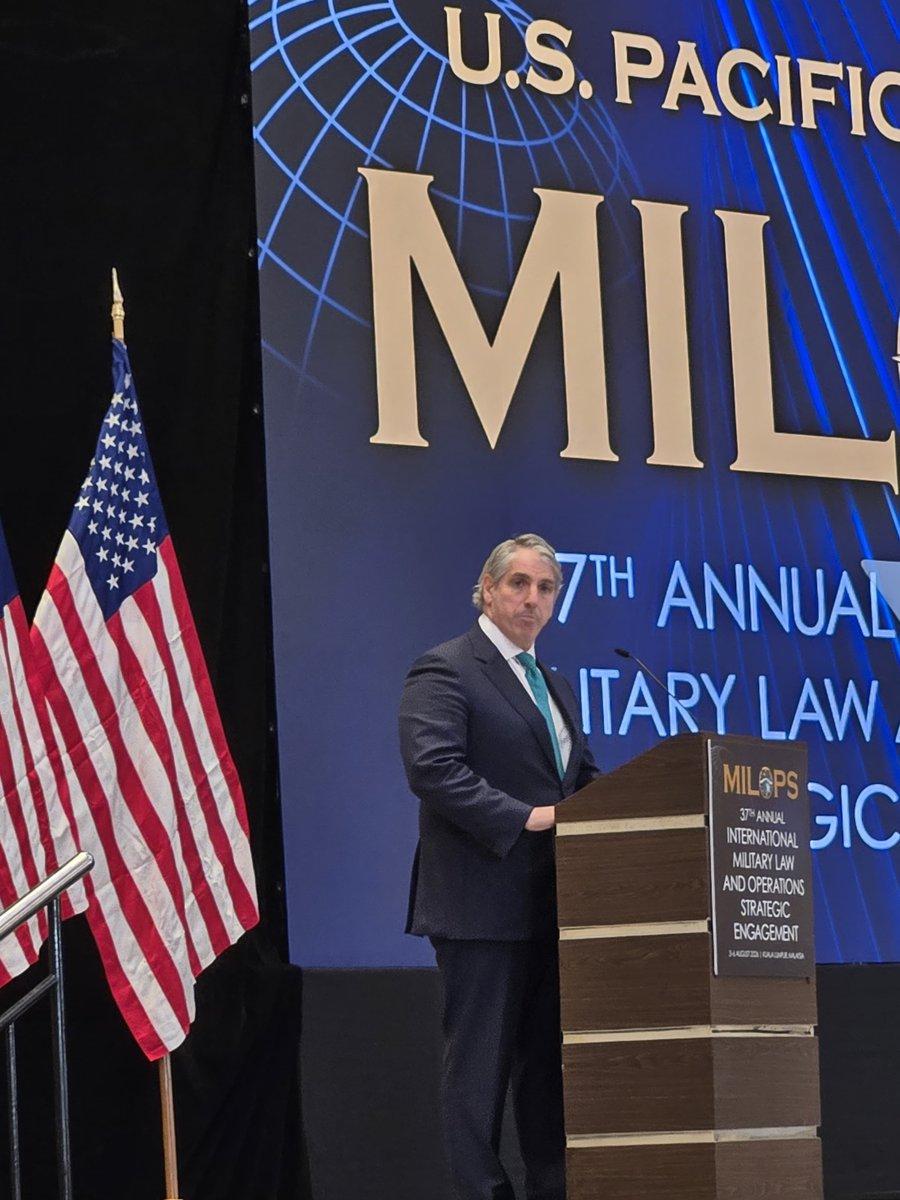
Under Secretary of State for Arms Control and International Security Thomas G. DiNanno speaks at the 37th annual International Military Law and Operations Conference in Kuala Lumpur, Malaysia, on Aug. 3, 2026. Courtesy of Under Secretary of State Thomas G. DiNanno
The U.S. Mission to ASEAN said Washington would continue to support freedom of navigation and the rule of law in the South China Sea, calling ASEAN a critical partner in advancing those principles.
Beijing Issues New Scarborough Shoal Rules
China issued management measures on Aug. 1 for a nature reserve at Scarborough Shoal, which Beijing calls Huangyan Dao. The rules restrict activities including fishing and mining without prior approval.
The shoal is about 120 nautical miles west of the Philippine island of Luzon. China has maintained an effective coast guard presence there since a 2012 standoff with the Philippines.
Collin Koh, a maritime-security researcher at Singapore’s S. Rajaratnam School of International Studies and a speaker at the conference, described the measures as another example of Beijing using domestic rules to provide legal cover for more aggressive “control measures” against Philippine fishermen and government forces.
He said the measures should be considered alongside other Chinese instruments, including Beijing’s coast guard law.
Allies Expand Operations at Sea
The conference followed a five-day maritime cooperative activity conducted by the Armed Forces of the Philippines, Japan Maritime Self-Defense Force, and U.S. Navy inside the Philippine exclusive economic zone from July 21–25.
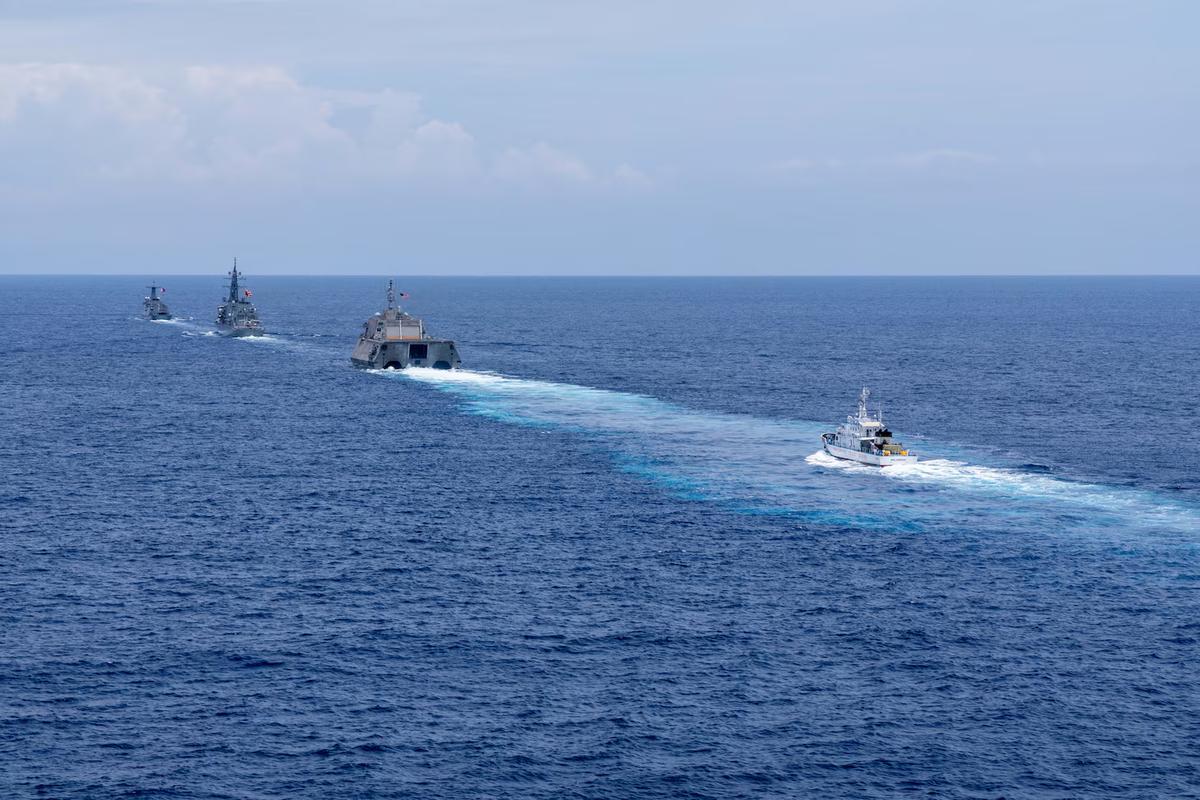
The Armed Forces of the Philippines, Japan Maritime Self-Defense Force, and U.S. Navy conducted a Multilateral Maritime Cooperative Activity within the Philippine Exclusive Economic Zone, July 21–25, 2026. Courtesy of the U.S. 7th Fleet
The activity included anti-submarine warfare training, maritime domain awareness operations, replenishment at sea, vertical replenishment, and coordinated naval maneuvers.
The U.S. 7th Fleet said such activities are conducted consistently with international law and with regard for the safety, navigational rights, and freedoms of all nations. It said the participating countries support freedom of navigation, overflight, and other lawful uses of the sea and international airspace.
“Together with sovereign partners across the Indo-Pacific, we will ensure that no nation can close the commons, dictate the rules, or decide the future of this region alone,” DiNanno said in his post.