 By The Epoch Times | Created at 2026-06-24 20:26:41 | Updated at 2026-06-24 21:40:58
1 hour ago
By The Epoch Times | Created at 2026-06-24 20:26:41 | Updated at 2026-06-24 21:40:58
1 hour ago
The chairman of the Senate Foreign Relations Committee has condemned communist China for engaging in “hostage diplomacy” after Chinese authorities detained an American citizen during an academic trip earlier this month. One expert suggests that Beijing’s move was aimed at securing its strategic interests.
“China’s detention of an American citizen is deeply troubling,” Sen. Jim Risch (R-Idaho) said on X on June 22.
“The Chinese Communist Party must stop its egregious use of hostage diplomacy and its efforts to export repressive practices.”
China’s foreign ministry on June 12 announced the arrest of U.S. citizen U Min Zin on suspicion of conducting espionage in the country that threatened its national security. The ministry didn’t elaborate on the accusation, only saying that it had informed the U.S. side.
The U.S. State Department later confirmed that Min Zin was detained during a trip to Yunnan, a southwestern Chinese province bordering Burma, also known as Myanmar.
Min Zin traveled to Kunming, the provincial capital of Yunnan, on June 3 for a “state-sponsored academic conference where he was invited to speak,” a State Department told The Epoch Times.
“U.S. consular officers have visited him, and the Department of State is engaged with Chinese officials and providing all appropriate consular assistance,” the spokesperson said in an emailed update on June 19.
“The Department of State has no higher priority than the safety and security of Americans.”
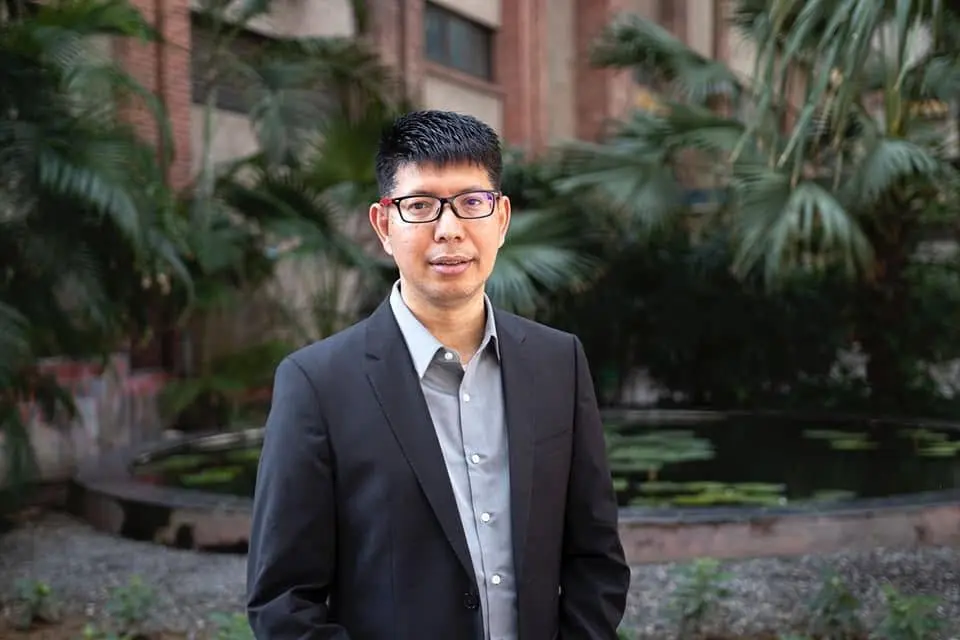
U Min Zin, executive director of the Institute for Strategic and Policy Studies, has been detained in China since early June 2026. Min Zin via Facebook
Beijing’s Strategic Interests
Retired U.S. diplomat Daniel Swift described Beijing’s detention of the American researcher as part of an effort to appease Burma’s military government, aimed at protecting China’s strategic infrastructure from an armed group known as the Arakan Army.
“The US cannot stand by while the Chinese government takes Americans hostage to placate Myanmar’s brutal military dictatorship,” Swift, also a senior research analyst for the Center on Economic and Financial Power at the Foundation for Defense of Democracies, wrote in an article on June 22.
A top trading partner, China has poured billions of dollars into neighboring Burma, particularly in a coastal town at the country’s western tip, called Kyaukphyu.
State-owned companies have constructed pipelines capable of transporting crude and gas from Kyaukphyu to southwestern China. Beijing also secured agreements to build a deep-sea port at Kyaukphyu and a cross-national railway connecting China to the Bay of Bengal, all under the ruling Chinese Communist Party’s (CCP) Belt and Road Initiative.
These corridors offer China an alternative route to receive energy from the Middle East or Africa, reducing its heavy reliance on the Strait of Malacca, a narrow waterway separating Indonesia and Malaysia that CCP authorities have long feared could be blocked in times of conflict.
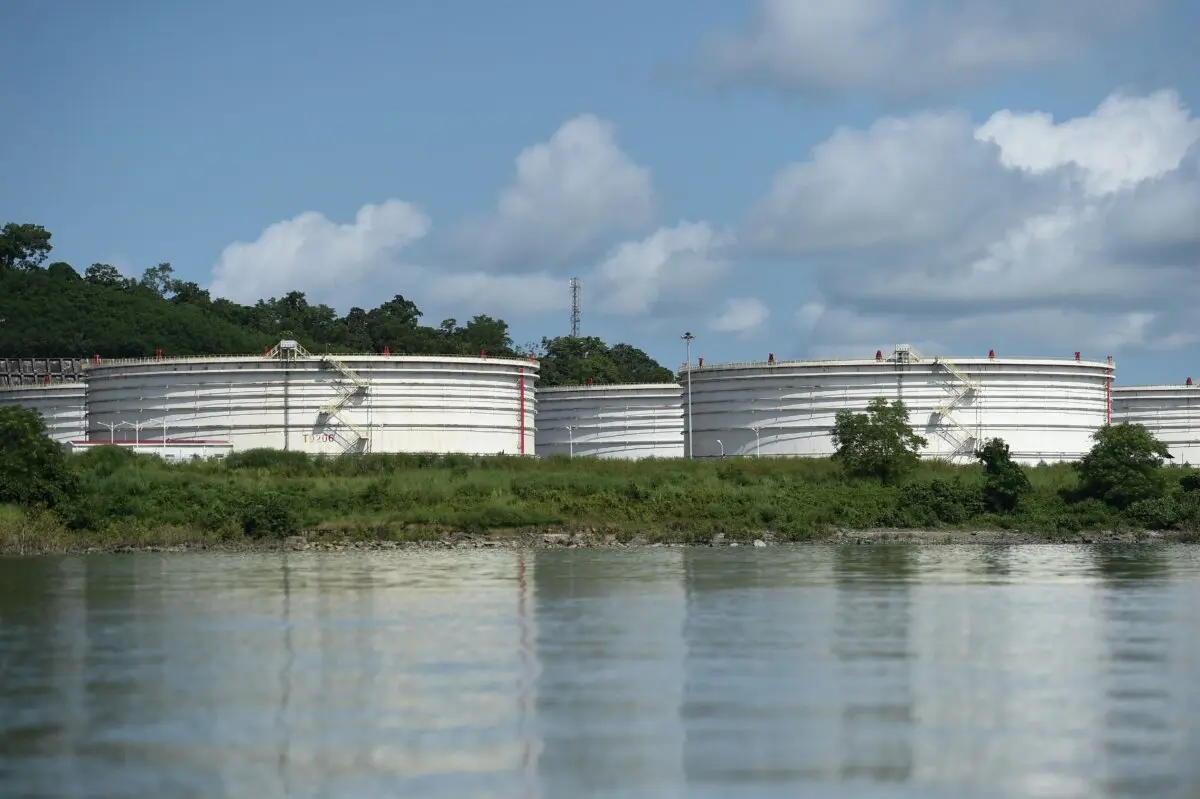
Storage facilities at a Chinese-owned oil refinery plant on Made Island off Kyaukphyu, Rakhine State, in Burma (also known as Myanmar) on Oct. 2, 2019. Ye Aung Thu/AFP via Getty Images
However, as of December 2024, eight Chinese projects have been under partial control of the Arakan Army, including an oil and gas pipeline, a railway project, and the Kyaukphyu deep-sea port, according to a report by the Institute for Strategic and Policy Studies, a research group that Min Zin helped establish.
“Lose Kyaukphyu, and Beijing loses both its energy chokepoint workaround and its most important Indian Ocean foothold,” Swift wrote.
“To keep the junta cooperative, Beijing needed to offer something aside from military support. Enter Min Zin—a student activist in Myanmar’s 1988 pro-democracy crackdown and the founder of a well-respected independent think tank.”
A political researcher, Min Zin has contributed opinion articles to U.S. media, such as Foreign Policy, and given interviews discussing the political landscape and foreign relations of his home country, Burma.
The Southeast Asian nation has been embroiled in a civil war since a 2021 coup led by former army chief Min Aung Hlaing, which ousted the elected government and its civilian leader, Aung San Suu Kyi.
CCP leader Xi Jinping reaffirmed support for the new Burmese government in “safeguarding sovereignty and security,” during a meeting with Min Aung Hlaing in Beijing on June 16.
The Burmese leader pledged to protect the security of Chinese projects in the country, according to a joint statement released by China’s foreign ministry.
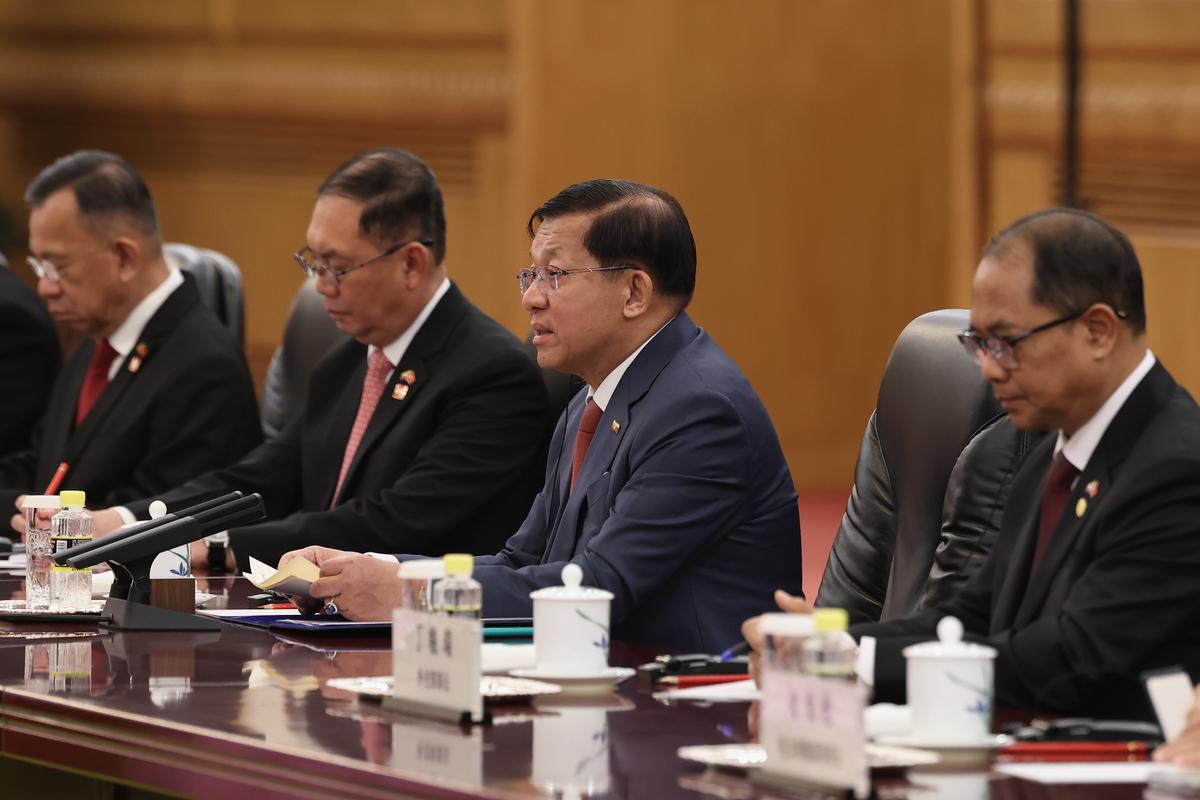
Burmese leader Min Aung Hlaing attends a meeting with Chinese leader Xi Jinping (not pictured) in Beijing on June 16, 2026. Lintao Zhang/Getty Images
Exit Bans
In addition to detention, the CCP has been accused of using exit bans as another form of hostage diplomacy.
The State Department’s travel advisory for China has remained at “Level 2,“ warning Americans to “exercise increased caution” due to Beijing’s “arbitrary enforcement of local laws, including in relation to exit bans.”
Chinese authorities may impose exit bans to compel individuals to cooperate with investigations, pressure the families of their targets to return to China, influence civil disputes’ outcome in favor of Chinese citizens, or “gain bargaining leverage over foreign governments,” according to the advisory.
The Congressional-Executive Commission on China called on the U.S. Embassy in China to demand “full transparency and access” in Min Zin’s case.
“The PRC unjustly detains more Americans than any other country, a reality that puts U.S. citizens at risk and chills academic and business exchanges,” the commission said on X on June 14, using the acronym of the regime’s official name, the People’s Republic of China.
At least 200 Americans are placed under detention, exit bans, or other coercive measures in China, according to an estimate provided to Congress by human rights advocacy groups Dui Hua Foundation and Foley Foundation in 2024.
Swift, of the Foundation for Defense of Democracies, cautioned that Min Zin’s detention should serve as a warning to Americans visiting China.
“Beijing will use anything or anyone as a bargaining chip to keep its supply chains open,” he wrote. “Americans working or traveling in China should take note.”
Frank Fang contributed to this report.