 By The War Zone | Created at 2026-06-25 18:36:17 | Updated at 2026-06-25 20:14:17
1 hour ago
By The War Zone | Created at 2026-06-25 18:36:17 | Updated at 2026-06-25 20:14:17
1 hour ago
The TWZ Newsletter
Weekly insights and analysis on the latest developments in military technology, strategy, and foreign policy.
The U.S. Air Force is set to hold a classified meeting with defense contractors to share its requirements for a new air-to-air missile with a maximum range of at least 1,000 nautical miles. This is roughly 10 times the reach afforded today by the latest versions of the AIM-120 Advanced Medium Range Air-to-Air Missile (AMRAAM). An anti-air missile with this kind of extreme range would be especially well-suited for attacks on critical airborne early warning and control planes, as well as tankers and other high-value aerial assets operating in rear areas. The Air Force is also already interested in an air-to-surface version of this new weapon, which it has dubbed the Air Force Long Range Weapon (AFLRW).
The Air Force Life Cycle Management Center’s (AFLCMC) Armament Directorate (EB) issued a notice yesterday regarding the planned AFLRW industry day gathering. The two-day meeting is currently scheduled to take place at the Guided Weapons Evaluation Facility (GWEF) at Eglin Air Force Base in Florida on August 25 and 26. The Air Force says the event will be held at the Secret classification level and that all attendees have to have appropriate security clearances.
“The AFLRW is aimed at addressing the next generation of Air-Launched Standoff Weapon variants in line with Department of War priorities,” according to the industry day notice. “AFLRW may select multiple vendors for both the Air-to-Air (A/A) and Air-to-Surface (A/S) variants with a focus on A/A solutions for Initial Operational Capability.”
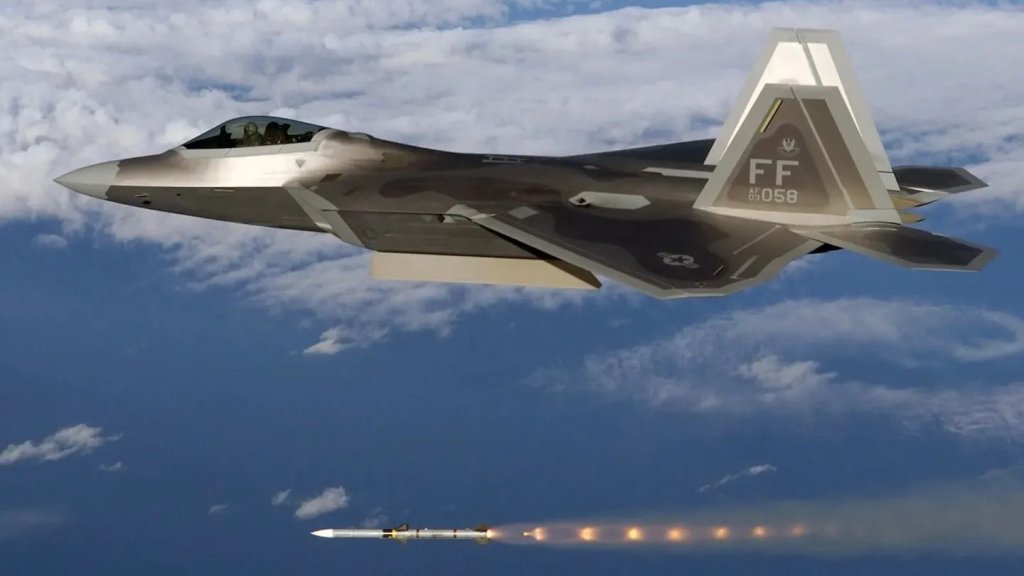 A stock picture of a US Air Force F-22 Raptor firing an AIM-120 AMRAAM. USAF
 “Both [AFLRW] variants will have a threshold minimum range of 1,000 NM [nautical miles] and be capable of striking respective A/A and A/S targets in Defense Planning Scenario 2.1 and 7.1 environments in a responsive manner,” the notice adds. It does not elaborate on what those specific scenarios entail.
The notice also puts particular emphasis on modular components and open-architecture systems, and finding a “Master Integrator” to combine the various elements into a complete missile, or all-up-round.
“Industry should expect a quick-turn Whitepaper Request for Information following the event focused on the 2 solution types above for both variants,” per the notice. “AFLCMC is seeking the next generation of Air-Launched Long-Range Weapon variants that expand the United States’ ability to hit priority air, land, and sea targets far and fast!”
Beyond the range threshold, the notice does not include any other details about requirements the Air Force may have now for the AFLRW. That being said, a desire for an anti-air missile able to hit targets at least 1,000 nautical miles away is very notable by itself.
Though the exact figures are classified, the AIM-120D-3 version of the AMRAAM, the latest model in widespread U.S. service, is generally understood to have a maximum reach of around 100 miles (close to 87 nautical miles). There have been hints that it may be able to fly out further than that, at least against targets in certain envelopes. Longer-range versions of the AIM-120 may now be in development. A known key requirement for the new AIM-260A Joint Advanced Tactical Missile (JATM) has also been extended reach over the AMRAAM. Still, even the JATM, which the U.S. Navy and Air Force are developing together, is not expected to have anywhere near the range required for the AFLRW.
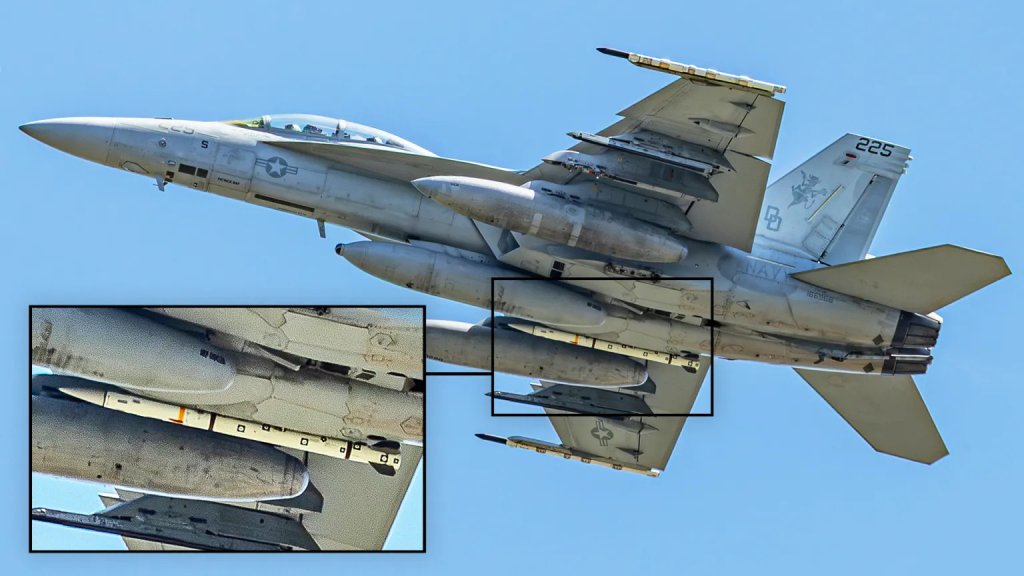 An annotated image showing a US Navy F/A-18F Super Hornet carrying an AIM-260. Jonathan Tweedy/ @flightline_visuals
 It is worth noting here that the Air Force almost adopted a very long-range, high-speed missile designed to engage both air and surface targets during the Cold War. However, the maximum range of that Advanced Strategic Air-Launched Missile (ASALM) was still only expected to be 300 miles (260 nautical miles).
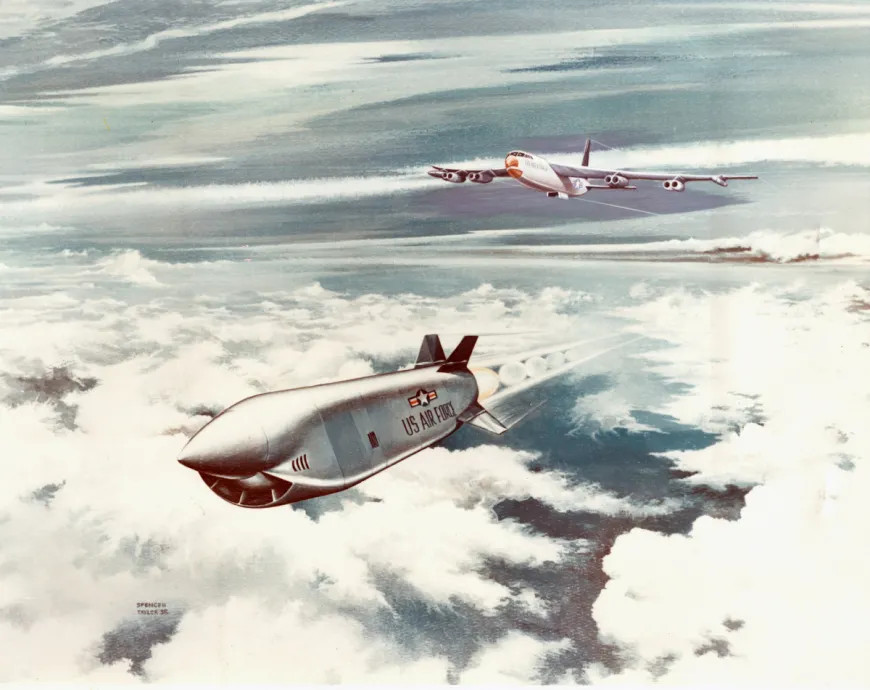 An artist’s depiction of an ASALM after launch from a B-52 bomber. McDonnell Douglas
 Starting in the mid-2000s, the Air Force and the Navy also worked together on a Joint Dual-Role Air Dominance Missile (JDRADM), intended as a single weapon to supplant the AIM-120 and variants of the AGM-88 anti-radiation missile. This evolved into the Next Generation Missile (NGM), which came to a close, at least publicly, in 2013, ostensibly over rising costs. A more secretive Triple Target Terminator (T-3) program, which had initially been conducted in parallel with JDRADM/NGM, continued afterward for at least some period of time. In 2017, a possible successor to T-3, the Long Range Engagement Weapon (LREW), but the fate of that effort is unclear.
In February, the Navy put out its own new call for a long-range anti-radiation missile capable of engaging air and surface targets, dubbed the Advanced Emission Suppression Missile (AESM). However, the service did not say what its desired range for this weapon might be at that time. The Navy has already started fielding an air-launched version of the multi-purpose Standard Missile-6 (SM-6), designated the AIM-174B. TWZ has previously assessed the AIM-174B to likely be in the same range category, broadly speaking, as the Cold War-era ASALM. We have previously explored in detail how the AIM-174B slots into the Navy’s long-range kill chains.

How The Navy's New Very Long-Range AIM-174 Will Pierce China’s Anti-Access Bubble
Nothing approaching a range of 1,000 nautical miles appears to have ever been discussed, at least openly, in relation to any of these programs. Interestingly, the Air Force did publicly talk about the prospect of anti-air missiles with ranges of up to 1,000 miles in a report to Congress in December 2024. However, the report mentioned them as part of a projected threat ecosystem the service envisions taking shape by 2050.
“Counterair weapons with ranges out to over 1,000 miles and supported by space-based sensors will place aircraft, such as tankers, that have traditionally operated with impunity, at risk,” the Air Force’s 2024 report said. This offers a hint at the kinds of capabilities it is looking to add to its own arsenal through the AFLRW effort.
After the Navy put out its AESM contracting notice, TWZ also highlighted the value of such a missile for targeting vital airborne early warning and control assets. This is often referred to as the ‘AWACS killer’ role, which references the E-3 Sentry Airborne Warning and Control System (AWACS) aircraft. As we previously wrote:
“All that being said, the value of an ‘AWACS killer’ missile is clear-cut. AEW&C are critical surveillance and battle management assets. Shooting them down deprives an opponent of those capabilities, inherently reducing their ability to effectively maneuver air assets and share important information, including with other nodes on the ground or at sea, as well as in the air. Knocking out these flying radar stations, which can be especially well-suited to spotting lower flying threats from their high perches, just hampers an enemy’s overall situational awareness.”
“The issue, of course, is that AEW&C planes typically orbit well behind the front edges of a conflict, creating additional challenges for targeting them. This is where something like AESM could come into play. A weapon of this type could engage other aerial targets by zeroing in on the radiofrequency emissions they pump out. This could include electronic warfare aircraft, and potentially other aerial targets. AESM might be able to take on a more general anti-air role with the addition of an active radar and/or imaging infrared seeker, as well as datalinks allowing for the use of networked targeting data. [The AGM-88E] AARGM and [AGM-88G] AARGM-ER both feature an active millimeter-wave radar seeker to enable them to hit fleeing ground targets, but a similar concept could be adapted for air-to-air use.“

AARGM F-18
“For the Navy, as well as other branches of the U.S. military, this is all particularly relevant in the context of a potential future high-end fight with China, which has made major investments in its fleets of AEW&C and electronic warfare planes. The Chinese People’s Liberation Army (PLA) has also been pursuing ever-longer-ranged anti-air missiles, including types that could be used to target American AEW&C platforms, as well as other key support aircraft.”
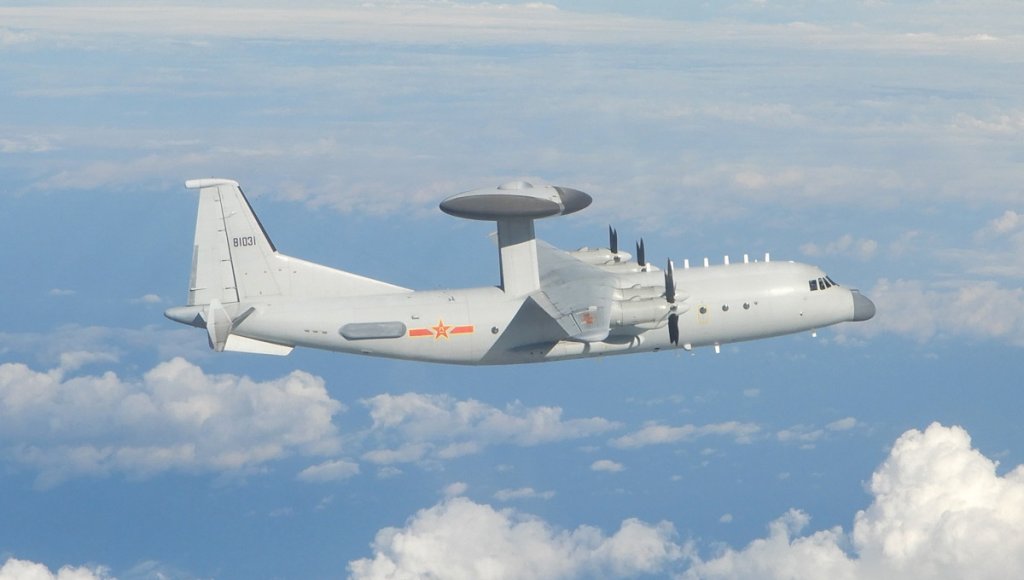 The KJ-500 seen here is just one example of the multitude of different airborne early warning and control aircraft currently in Chinese service. Taiwan Ministry of National Defense
 In that piece, we also touched on the potential for the AIM-174B to help meet U.S. military needs for an ‘AWACS killer’ missile. With the ability to hit targets in the air, as well as down below, out to at least 1,000 nautical miles, AFRLW would be a dramatic step above even the AIM-174B in capability.
The Pacific region offers a host of practical examples to give a better sense of what this kind of reach means. The distance between U.S. bases on the Japanese island of Okinawa and Taiwan is roughly 390 nautical miles. The distance between Andersen Air Force Base on Guam and Taiwan is around 1,500 nautical miles. AFLRW-armed aircraft flying over the East China Sea or the northern end of the South China Sea would conceivably be able to engage targets with hundreds of missiles inside the Chinese mainland, as long as suitable targeting data was available. The AFLRW’s range would be relevant on other potential hotspots globally, as well.
AFLRW would give the Air Force a way to pick off airborne early warning and control aircraft, as well as tankers, bombers, other kinds of surveillance and reconnaissance aircraft, and potentially even unsuspecting tactical jets. The missiles would be able to do so without necessarily alerting them to the fact that they are being targeted at all, at least till it’s too late to escape. Having air-to-air missiles that can go after targets at such great ranges means the need to project tactical airpower and support aircraft far forward and deep into harm’s way for the counter-air mission would be less critical, at least during the first the opening stages of a conflict. By eliminating key force multiplying aircraft with long-range weaponry, conditions would be more better for the survivability of traditional counter-air packages.
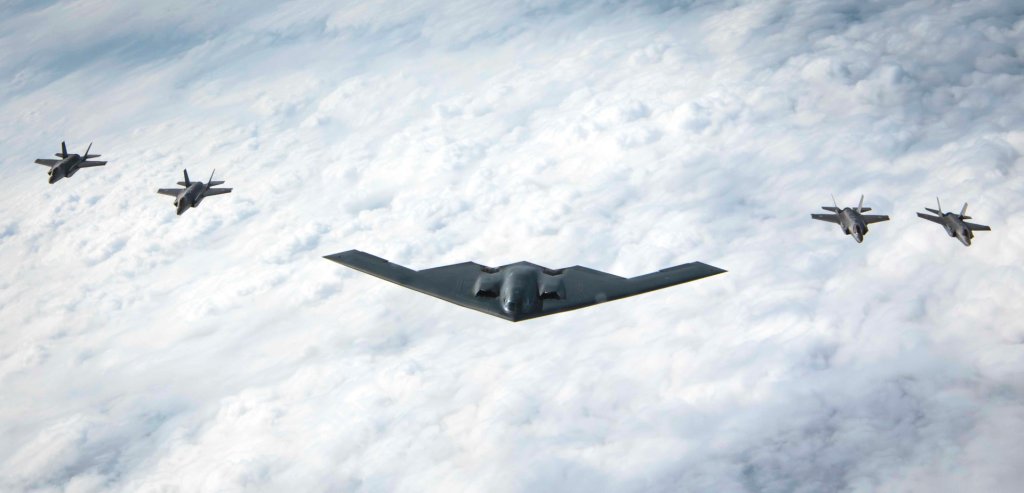 A US Air Force B-2 bomber flies over a part of the Pacific Ocean together with a quartet of Japanese F-35A Joint Strike Fighters. USAF
 On top of offering a new way to hold higher-value targets in rear areas at risk, AFLRW would give Air Force aircraft added flexibility to engage targets closer to the tactical edge, but not necessarily near where they might be flying at any one time. In the aforementioned Pacific scenario, areas of active combat in the air and on the surface could easily be dotted across a broader zone spanning thousands of square miles.
As mentioned, the Air Force also sees anti-air threats being able to reach further and further out. This means stand-off munitions, in general, will need greater reach to help reduce the risk to launch platforms. The AFLRW’s range recommendation is a tacit admission that the U.S. military will face growing challenges piercing adversary anti-access and area denial (A2/AD) bubbles, especially the ones that China has established and is continuing to expand on. It also highlights the increasing risks to friendly airborne early warning and control aircraft, tankers, and other supporting aerial assets needed for sustained air combat operations. Chinese air-to-air missiles are already outreaching their American counterparts, and the U.S. is working to change that now with AIM-174, AIM-260 and other programs.
There are still questions about what it might take to develop a feasible AFLRW with at least a 1,000 nautical mile range, and what might be able to carry a missile with that kind of reach. It is worth remembering here that the Air Force has openly talked about the possibility of the B-21 Raider bomber taking on a greater role in air-to-air combat in the future, which might include acting as a ‘weapons truck’ loaded with anti-air missiles. The aforementioned ASALM was also intended primarily for employment from bombers. For bombers like the B-21, the AFLRW would also just offer a valuable organic way to address threats in the air and down below, potentially hours ahead of arriving over the target area.
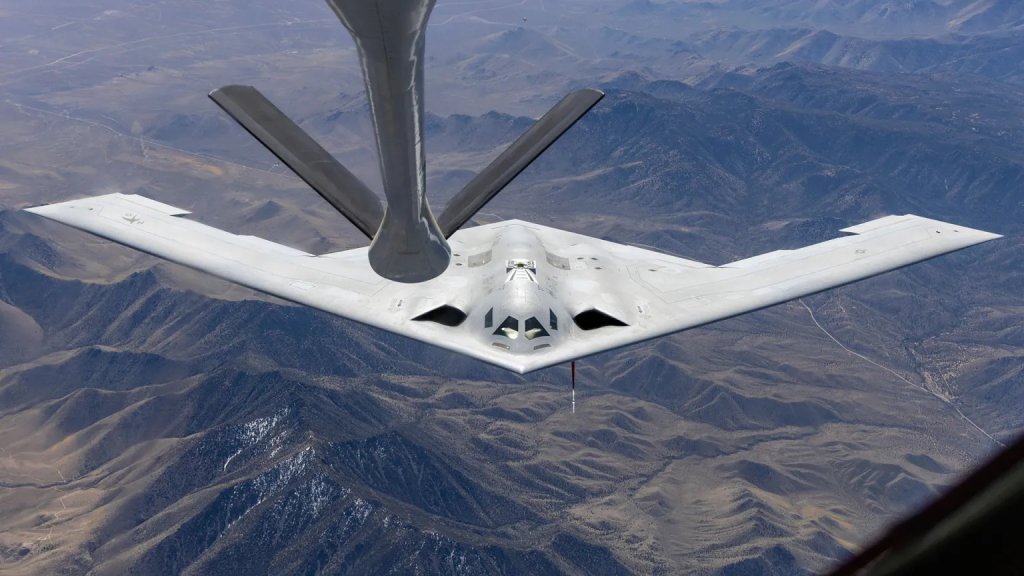 A pre-production B-21 Raider bomber seen during aerial refueling testing. USAF
 The AFLRW will also have to cover the very long distances it flies at least relatively quickly, especially to be relevant for attacking time-sensitive or otherwise fleeting targets. This might require a multi-stage or air-launched ballistic missile-like design or even something more exotic.
There is also the question of targeting at such extreme distances. These weapons will not rely on the sensors and targeting information generated by the platforms they are launched from. Above all else, the AFLRW will, by default, have to be tied into a deeply networked ‘kill web’ that brings together tertiary sensors and other supporting elements across vast networking layers. That ‘web’ would be spread across the air, land, sea, space, and even cyberspace domains, and incorporate assets from other branches of the U.S. military beyond the Air Force.
Above all else, the space-based aircraft tracking layer will be very important when it comes to enabling this weapon. The Air Force’s 2024 report on future threats confirmed this. The U.S. military itself is actively working to field new distributed satellite constellations to provide potentially game-changing persistent air and ground moving-target indicator (AMTI/GMTI) capability globally, with exactly these kinds of long-range kill chains in mind, as you can read more about here. Very stealthy aircraft working farther forward that are in line-of-sight of potential targets are another way these weapons can be employed. The USAF also has just such a platform.
Much remains to be learned about the Air Force’s plans for the air-to-air and air-to-surface versions of the AFRLW, and what other requirements the service has for those missiles. The industry day gathering scheduled for August will provide the service with additional information about what options might be available and on what timeframe.
Regardless, the Air Force has now made clear publicly that it wants a solution that can kill planes a thousand miles away from the launch aircraft. This matches all the signals that the Pentagon has been sending indicating it is very concerned about its ability to pierce an enemy’s protective bubble in the years ahead. Above all else, it points to a new era of net-centric warfare where the kill web is truly king.
Contact the author: [email protected]