By The Rio Times | Created at 2026-08-03 04:41:36 | Updated at 2026-08-04 13:31:45
1 day ago
By The Rio Times | Created at 2026-08-03 04:41:36 | Updated at 2026-08-04 13:31:45
1 day ago
Key Facts
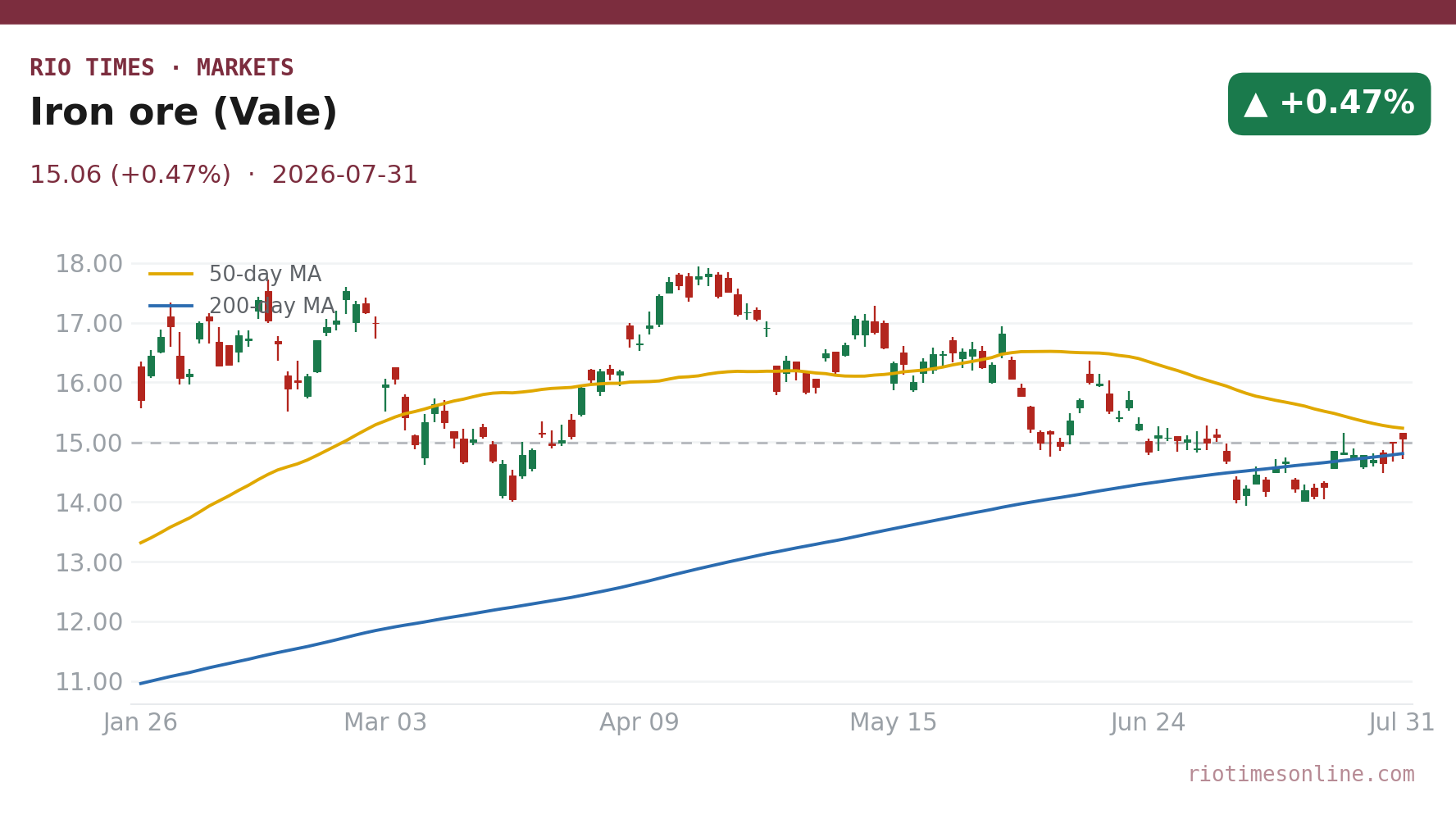
- Vale ADR rose 0.47% to US$15.06 in New York, acting as a liquid proxy for seaborne iron-ore price expectations and Brazil mining risk.
- Rio Tinto fell 0.34% to US$96.85, reflecting a slightly cooler read on Chinese steel demand from the Pilbara giant.
- CSN Mineração dipped 0.17% to R$5.71 on Brazil’s B3, echoing pressure on domestic high-cost producers.
- China’s property drag lingers but infrastructure and grid spending continue to support steel product demand, offsetting some construction weakness.
- High-grade ore premium matters because Chinese mills favour Vale’s low-impurity fines to cut blast-furnace emissions and boost productivity.
- Investor focus is shifting to whether China’s September stimulus follow-through can lift margins on rebar – the steel bar used inside concrete – and push mills to start rebuilding stockpiles.
Today’s Focus
Iron-ore equities traded mixed on Friday, with Vale’s New York-listed ADR adding 0.47% to US$15.06 while global peers Rio Tinto and CSN Mineração slipped. The moves reflected a market still parsing contradictory signals from China, where infrastructure spending supports steel demand even as the property sector and manufacturing exports stay weak.
Vale, the world’s second-largest iron-ore exporter, benefits when Chinese mills prize its high-grade ore to cut blast-furnace emissions. That link makes the ADR a one-click proxy for both China’s steel appetite and the quality premia that Vale can command over some Australian ores.
Friday’s divergence—Vale up, Rio Tinto down 0.34% to US$96.85, CSN Mineração off 0.17% to R$5.71—suggests traders are rewarding the Brazilian name’s exposure to higher-grade demand, while still cautious on the volume-driven Australian producers facing a property-led demand trough.
The session kept the spotlight on China’s policy mix. Without a fresh infrastructure push or clearer production caps, the board shows a market priced for steady but unspectacular iron-ore demand, leaving Vale’s ADR rangebound near the middle of its 52-week band.
What matters today. Friday’s price action flags a market betting that China’s preference for high-grade ore will keep Vale’s premium intact, while volume plays like Rio Tinto face more immediate demand uncertainty.

01 The session in one read
Iron-ore equities sent mixed signals on Friday. Vale’s New York-listed ADR inched up 0.47% to US$15.06, while CSN Mineração on Brazil’s B3 slipped 0.17% to R$5.71 and London-traded mining giant Rio Tinto gave back 0.34% to US$96.85.
The narrow moves reflect a market caught between two competing China narratives: steady infrastructure and grid spending that supports steel demand, and a tenacious property-sector drag that keeps a lid on rebar margins and iron-ore restocking.
Assessment — Vale’s quality premium is the trade MEDIUM
China’s steel sector is being pulled in two directions: infrastructure and grid investment are absorbing rebar and sheet, but the property slump and softer manufacturing exports cap upside. As a result, iron-ore equity proxies are not moving in lockstep—Vale’s ADR advanced while Rio Tinto eased. The market is discriminating by ore quality, not just tonnage, and that rewards Vale’s high-grade portfolio. The variable to watch is whether China’s next purchasing managers’ index print confirms an infrastructure-led recovery strong enough to lift the seaborne benchmark beyond its current range.
02 The board
Vale’s US-dollar-quoted ADR acted as the session’s outperformer among the three main iron-ore proxies we track. Rio Tinto’s US-dollar shares, which give a read on seaborne volumes from Australia’s Pilbara, edged lower in a modest reversal of last week’s cautious optimism.
CSN Mineração’s real-denominated shares in São Paulo continued to lag, reflecting a higher cost structure and thinner domestic steel margins that make the Brazilian miner more sensitive to short-term demand dips than its globally diversified peers.
| Iron ore (Vale) | US$15.06 | +0.47% |
| CSN Mineração | R$5.71 | -0.17% |
| Rio Tinto | US$96.85 | -0.34% |
Source: EODHD close, 2026-07-31. Where a commodity has no spot feed, an exchange-traded tracker or leading producer is shown as a labelled proxy.
Live Market IntelligenceThe live market boardInside: market breadth, the sector heatmap, currencies & rates, the Latin America scoreboard and the full instrument board.Rio Times · Live Market Intelligence
Latin America — Cross-Market Board
Regional
Aug 3, 2026 · 01:30
Ibovespa · benchmark
177,999.00 +0.47%
+33.76% over 12 months
Market breadth · 4 names
25% advancing
1 ▲ advancing3 declining ▼
Currencies, rates & key inputs
Latin America scoreboard
IndexLastTodayStrength
IbovespaBrazil 177,999.00 +0.47%
S&P/BMV IPCMexico 66,935.53 -0.58%
S&P IPSAChile 11,016.85 -0.13%
S&P MERVALArgentina 3,291,323 -0.41%
MSCI COLCAPColombia 2,392.10 +2.12%
BVL S&P PerúPeru 57,890.85 —
Full instrument board
| IBOV | 177,999.00 | +0.47% | +33.76% | 177,158.86 | — | — | — |
| IPSA | 11,016.85 | -0.13% | — | 11,030.67 | 11,040 | 10,928 | 1,513,213,483 |
| IPC MEX | 66,935.53 | -0.58% | +16.62% | 67,327.01 | 67,613 | 66,833 | 138,500,282 |
| MERVAL | 3,291,323 | -0.41% | +41.90% | 3,304,918 | — | — | — |
| COLCAP | 2,392.10 | +2.12% | — | 9.04 | 9.05 | 9.02 | 4,133 |
| BVL PERÚ | 57,890.85 | — | — | — | — | — | — |
| USD/BRL | 5.07 | -0.02% | -8.37% | 5.08 | 5.08 | 5.07 | — |
| EUR/BRL | 5.85 | +0.07% | -8.71% | 5.85 | 5.87 | 5.85 | — |
| USD/MXN | 17.31 | -0.04% | -8.28% | 17.31 | 17.33 | 17.29 | — |
| USD/CLP | 930.47 | +0.00% | -1.74% | 930.47 | 930.47 | 930.47 | — |
| USD/COP | 3,148 | -1.70% | -23.63% | 3,203 | 3,203 | 3,144 | — |
| USD/PEN | 3.39 | -0.06% | -2.31% | 3.39 | 3.40 | 3.39 | — |
| USD/ARS | 1,485 | -0.03% | +9.93% | 1,486 | 1,485 | 1,485 | — |
| USD/UYU | 40.20 | +0.00% | +2.98% | 40.20 | 40.20 | 40.20 | — |
| USD/PYG | 5,931 | +0.00% | -18.33% | 5,931 | 5,931 | 5,931 | — |
| USD/BOB | 12.10 | +0.00% | +82.47% | 12.10 | 12.10 | 12.10 | — |
| USD/DOP | 57.80 | -0.33% | -2.29% | 57.99 | 58.11 | 57.68 | — |
| USD/CRC | 448.40 | +0.00% | -7.62% | 448.40 | 448.40 | 448.40 | — |
Largest moves today
COLCAP 2,392.10 +2.12%
USD/COP 3,148 -1.70%
IPC MEX 66,935.53 -0.58%
IBOV 177,999.00 +0.47%
MERVAL 3,291,323 -0.41%
USD/DOP 57.80 -0.33%
IPSA 11,016.85 -0.13%
EUR/BRL 5.85 +0.07%
The session read
The Ibovespa rose 0.47%, with breadth negative — 1 of 4 names higher. COLCAP led, while IPC MEX lagged.
V
◆ Live Company Intelligence
Vale
NYSE: VALEVALE3Basic MaterialsOther Industrial Metals & Mining65,805 employees
$64.09B
Market cap
Analyst target $16.87
Wall Street view
3.9Moderate Buy/ 5
14 Buy12 Hold0 Sell
Avg. price target $16.87 · +14% vs 200-day
Valuation & profitability
Market cap$64.09B
Revenue (TTM)$214.86B
P / E ratio22.8
Profit margin0.0%
Return on equity6.8%
Price & risk
52-wk low
$8.9652-wk high
$17.94
Beta (volatility)0.73
200-day average$14.81
Revenue trend · 6y
20202025
Latest $38.23B
Ownership
Institutions21.6%
Shares outstanding4.26B
Top holderCapital World Investors
Institutional holders5+ funds
Dividend
No regular dividend — earnings reinvested for growth.
What Vale does. Vale S.A., together with its subsidiaries, produces iron ore and nickel in Brazil, Asia, the Middle East, North Africa, Europe, the Americas, and Oceania. The company operates in two segments, Iron Ore Solutions and Vale Base Metals. It extracts, produces, and distributes iron ore, iron ore pellets, briquettes, nickel, copper, other ferrous…
03 What moved it
China’s construction softness remains the dominant headwind. Environmental curbs on steel output and sluggish residential completions have cooled the pace of iron-ore imports, even as provincial governments accelerate grid and road projects to meet stimulus targets.
Vale held firmer because Chinese mills are increasingly willing to pay a premium for the company’s high-grade fines and pellets, which lower blast-furnace emission intensity per tonne of steel. That decarbonisation tilt gives Vale’s ore a structural bid that volume-driven Australian cargoes do not share to the same degree.
04 The Latin American read
For Brazil, Friday’s small ADR gain offers only modest relief. A high-grade premium helps Vale’s earnings, but the Brazilian real against the US dollar and freight costs on the Brazil-to-China route remain swing factors that can erode that advantage when demand wobbles.
CSN Mineração’s 0.17% dip in São Paulo underscores the tougher environment for domestically focused, higher-cost miners. With China’s property overhang unresolved, Latin American investors are watching for any sign that Beijing’s autumn policy window delivers a fresh wave of steel-intensive public works.
05 The names to watch
Vale’s ADR remains the standout liquid proxy for iron-ore price expectations, carrying both the quality-premium story and Brazil-specific regulatory tailwind following years of post-Brumadinho tailings-de-risking and volume recovery.
Rio Tinto serves as the bellwether for Pilbara volumes, while CSN Mineração gives a closer read on LatAm domestic steel and cost pressures. Together, the three names show a market that is differentiating by ore grade, not simply betting on a broad demand rebound.
06 The outlook
Investors are waiting for China’s next infrastructure disbursement data and the monthly steel PMIs for signs that rebar consumption is strong enough to absorb still-elevated portside iron-ore inventories. Another tepid reading would test Vale’s US$15 handle, while a positive surprise could lift Rio Tinto and CSN Mineração out of their recent soft patch and push the ADR toward the top of its trading band.
07 What to watch
- China steel PMIs: A rebar-focused purchasing managers’ index will confirm whether infrastructure spending is translating into actual steel offtake and restocking.
- Vale volume guidance: Any update on northern and southeastern system shipments will signal whether output recovery can meet China’s high-grade appetite.
- Brazil-to-China freight rates: Freight rates for the giant Capesize ore carriers on the Tubarão-Qingdao route are a swing factor for Vale’s net realised price versus Australian miners.
- China property sales: A sustained pick-up in residential transactions is the missing piece for a broader iron-ore demand recovery.
Frequently Asked Questions
Why is Vale’s ADR a proxy for iron ore?
Vale is the world’s second-largest iron-ore exporter, so its New York-listed American Depositary Receipt moves in step with expectations for seaborne prices and China steel demand.
Why did Vale rise while Rio Tinto fell?
Vale’s high-grade ore commands a quality premium when Chinese mills seek to cut blast-furnace emissions, giving it a different demand driver than volume-led Pilbara cargoes.
How does China’s property sector affect iron ore?
Construction uses roughly two-fifths of China’s steel; a property downturn shrinks rebar demand and iron-ore imports, even when infrastructure spending stays firm.
What makes CSN Mineração different from Vale?
CSN is a smaller, higher-cost Brazilian miner that sells partly into the domestic steel market, making it more sensitive to local demand and less exposed to the China quality-premium trade.
This article was produced by The Rio Times’ automated newsroom system. How we use AI · Report an error
LatAm Markets: Live Signals → — real-time movers, turnover leaders and FX across Latin America.
The Rio Times · Power Map
See who really holds power in Latin America
Click to open the Power Map →