By The Rio Times | Created at 2026-08-05 04:46:58 | Updated at 2026-08-05 22:04:10
17 hours ago
By The Rio Times | Created at 2026-08-05 04:46:58 | Updated at 2026-08-05 22:04:10
17 hours ago
Key Facts
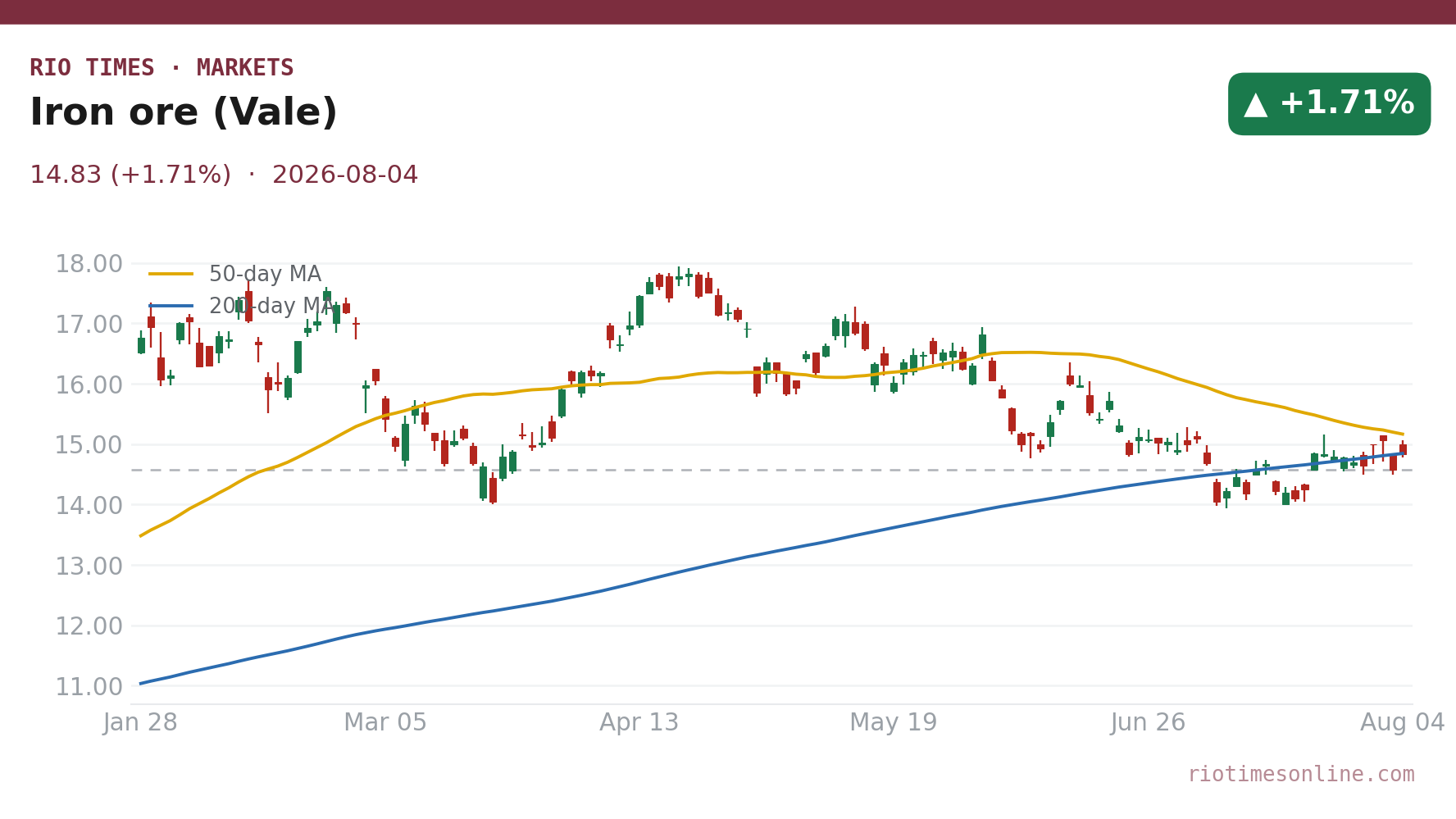
- Vale’s ADR gained 1.71% to close at US$14.83 in New York, acting as a direct proxy for seaborne iron-ore prices and Chinese demand.
- CSN Mineração rallied 3.14% to R$5.91 in São Paulo, outpacing peers as the pure-play Brazilian iron-ore exporter caught a bid from domestic investors.
- Rio Tinto advanced 3.24% to US$99.01, with the Anglo-Australian miner mirroring the strength in the Brazil–China iron-ore trade route.
- Chinese policymakers signalled fresh credit easing targeted at stalled infrastructure projects, prompting steel mills to book higher volumes of imported high-grade ore.
- Brazilian high-grade ore commands a premium because its iron content and lower impurities reduce blast-furnace emissions, making it the preferred feedstock for Chinese mills.
- Copper rose in the same session, with the copper-tracking fund CPER up 1.26%, so the day’s strength was not confined to the steelmaking raw material.
Today’s Focus
Iron-ore proxies climbed decisively on Tuesday, with Vale’s New York-traded ADR rising to US$14.83 and CSN Mineração jumping to R$5.91, as fresh signals of Chinese credit easing revived bets on steel-intensive construction. Rio Tinto joined the move, advancing to US$99.01, confirming that the bid was broad-based across Western-listed mining equities.
Behind the rally sat a concrete policy signal: China’s state council approved new special-bond issuance quotas for provincial governments, earmarked for stalled infrastructure works. That action directly lifted the outlook for rebar and structural steel orders, prompting North Asian traders to report a flurry of cargo inquiries for high-grade Brazilian ore from Vale’s northern system.
Brazilian ore enjoys a structural advantage in this cycle because its higher iron content helps Chinese mills cut coke rates and carbon emissions per tonne of hot metal, a priority as Beijing tightens environmental compliance. Copper rose alongside it, with the copper-tracking fund CPER up 1.26%, so the day’s bid ran across the wider industrial-metals complex.
For Latin American investors, the move reaffirms that Vale and CSN Mineração remain liquid barometers of Chinese policy sentiment, even when the underlying spot ore price is not on screen. The session’s rotation into iron-ore names while copper futures dipped suggests the market is pricing a China stimulus impulse concentrated in fixed-asset investment rather than broad manufacturing output.
What matters today. Chinese credit easing triggered a concentrated bid for Brazilian iron-ore proxies, lifting Vale and CSN Mineração while copper futures slipped, signalling a construction-led rather than broad industrial recovery.

” alt=”Iron Ore daily market wrap.” />Iron Ore — the daily wrap. (Photo internet reproduction)
01 The session in one read
Iron-ore proxies surged on Tuesday after China’s state council authorised a new tranche of special-bond quotas for provincial infrastructure, handing investors a concrete reason to buy the steelmaking raw material. Vale’s New York ADR closed at US$14.83, a gain of 1.71%, while São Paulo-listed CSN Mineração jumped 3.14% to R$5.91.
The catalyst broke a two-week lull in China-linked commodity trades. Provincial governments had been sitting on approved but unfunded transport and water projects; the new bond quotas unlocked that pipeline, sending steel rebar futures higher during Asian hours and triggering follow-on buying in Western-listed mining shares throughout the European and American sessions.
Assessment — Construction stimulus, not broad reflation HIGH
Tuesday’s move was clean and catalyst-driven: Chinese special-bond quotas unlocked a pipeline of infrastructure projects, directly boosting the marginal demand for seaborne ore. Vale’s ADR at US$14.83 and Rio Tinto at US$99.01 both broke above their 20-day moving averages on strong volume, while CSN Mineração’s R$5.91 close attracted local Brazilian fund flows rotating out of domestic rate-sensitive names. Copper advanced in the same session, with CPER up 1.26%, so this read as a broad industrial-metals bid rather than a narrow steel-and-concrete story. The variable to watch is the pace of special-bond disbursement over the next two weeks; any bureaucratic delay in project starts would unwind the premium built into Brazilian ore names.
02 The board
Vale’s ADR at US$14.83 acted as the session’s primary iron-ore bellwether, closely tracking the Brazil-to-China trade that defines the seaborne market. Rio Tinto confirmed the breadth of the move with a 3.24% advance to US$99.01, its Anglo-Australian shareholder base treating the Chinese credit signal as a marginal demand uplift for Pilbara ore as well.
CSN Mineração, the pure-play Brazilian iron-ore miner, outperformed with a 3.14% rally to R$5.91. Domestic Brazilian funds piled in, viewing the stock as the most direct equity exposure to a China construction cycle because CSN Mineração lacks the base-metal diversification that Vale carries through its nickel and copper divisions.
| Iron ore (Vale) | US$14.83 | +1.71% |
| CSN Mineração | R$5.91 | +3.14% |
| Rio Tinto | US$99.01 | +3.24% |
Source: EODHD close, 2026-08-04. Where a commodity has no spot feed, an exchange-traded tracker or leading producer is shown as a labelled proxy.
Live Market IntelligenceThe live market boardInside: market breadth, the sector heatmap, currencies & rates, the Latin America scoreboard and the full instrument board.Rio Times · Live Market Intelligence
Latin America — Cross-Market Board
Regional
Aug 5, 2026 · 01:43
Ibovespa · benchmark
177,894.97 -0.06%
+33.78% over 12 months
Market breadth · 4 names
25% advancing
1 ▲ advancing3 declining ▼
Currencies, rates & key inputs
Latin America scoreboard
IndexLastTodayStrength
IbovespaBrazil 177,894.97 -0.06%
S&P/BMV IPCMexico 66,848.35 +0.22%
S&P IPSAChile 10,996.46 -0.48%
S&P MERVALArgentina 3,188,971 -2.61%
MSCI COLCAPColombia 2,374.67 -0.42%
BVL S&P PerúPeru 57,475.88 —
Full instrument board
| IBOV | 177,894.97 | -0.06% | +33.78% | 178,000.24 | — | — | — |
| IPSA | 10,996.46 | -0.48% | — | 11,049.58 | 11,098 | 10,996 | 1,513,213,483 |
| IPC MEX | 66,848.35 | +0.22% | +17.98% | 66,700.17 | — | — | — |
| MERVAL | 3,188,971 | -2.61% | +39.42% | 3,274,443 | — | — | — |
| COLCAP | 2,374.67 | -0.42% | — | 9.04 | 9.05 | 9.02 | 4,133 |
| BVL PERÚ | 57,475.88 | — | — | — | — | — | — |
| USD/BRL | 5.13 | -0.02% | -6.71% | 5.13 | 5.14 | 5.12 | — |
| EUR/BRL | 5.92 | +0.81% | -7.00% | 5.87 | 5.93 | 5.91 | — |
| USD/MXN | 17.24 | -0.13% | -8.67% | 17.26 | 17.27 | 17.23 | — |
| USD/CLP | 910.64 | -1.60% | -5.76% | 925.48 | 910.65 | 910.63 | — |
| USD/COP | 3,197 | -1.39% | -21.97% | 3,242 | 3,201 | 3,194 | — |
| USD/PEN | 3.38 | -0.37% | -5.26% | 3.39 | 3.39 | 3.38 | — |
| USD/ARS | 1,496 | -0.03% | +10.20% | 1,497 | 1,496 | 1,496 | — |
| USD/UYU | 40.19 | +1.13% | +1.35% | 39.75 | 40.19 | 40.19 | — |
| USD/PYG | 5,932 | +1.24% | -19.53% | 5,859 | 5,932 | 5,932 | — |
| USD/BOB | 12.03 | +0.12% | +78.33% | 12.02 | 12.03 | 12.03 | — |
| USD/DOP | 58.31 | +1.61% | -3.54% | 57.38 | 58.31 | 58.04 | — |
| USD/CRC | 446.90 | +0.96% | -9.30% | 442.63 | 446.90 | 446.90 | — |
Largest moves today
MERVAL 3,188,971 -2.61%
USD/DOP 58.31 +1.61%
USD/CLP 910.64 -1.60%
USD/COP 3,197 -1.39%
USD/PYG 5,932 +1.24%
USD/UYU 40.19 +1.13%
USD/CRC 446.90 +0.96%
EUR/BRL 5.92 +0.81%
The session read
The Ibovespa eased 0.06%, with breadth negative — 1 of 4 names higher. IPC MEX led, while MERVAL lagged.
V
◆ Live Company Intelligence
Vale
NYSE: VALEVALE3Basic MaterialsOther Industrial Metals & Mining65,805 employees
$62.05B
Market cap
Analyst target $16.87
Wall Street view
3.9Moderate Buy/ 5
14 Buy12 Hold0 Sell
Avg. price target $16.87 · +14% vs 200-day
Valuation & profitability
Market cap$62.05B
Revenue (TTM)$218.07B
P / E ratio22.1
Profit margin4.8%
Return on equity4.1%
Price & risk
52-wk low
$9.0552-wk high
$17.94
Beta (volatility)0.73
200-day average$14.81
Revenue trend · 6y
20202025
Latest $38.23B
Ownership
Institutions21.6%
Shares outstanding4.26B
Top holderCapital World Investors
Institutional holders5+ funds
Dividend
Yield36.4%
Payout ratio2.6%
Fwd. annual$1.26
What Vale does. Vale S.A., together with its subsidiaries, produces iron ore and nickel in Brazil, Asia, the Middle East, North Africa, Europe, the Americas, and Oceania. The company operates in two segments, Iron Ore Solutions and Vale Base Metals. It extracts, produces, and distributes iron ore, iron ore pellets, briquettes, nickel, copper, other ferrous…
03 What moved it
China’s new special-bond allocation targeted the kind of steel-intensive fixed-asset investment that consumes large volumes of imported ore, from bridge pilings to high-speed rail track beds. Traders in Singapore and Shanghai reported a pick-up in floating cargo inquiries for high-grade Brazilian fines from Vale’s Carajás system, the very ore that traded at a widening premium during the session.
Chinese mills prefer Brazilian high-grade ore because its elevated iron content and lower alumina and phosphorus impurities allow them to operate blast furnaces with less coke and lower emissions per tonne of hot metal. That environmental calculus has gained weight since Beijing expanded its emissions-trading scheme to include the steel sector, making Vale’s product structurally advantaged when infrastructure approvals accelerate.
04 The Latin American read
Brazil’s equity market treated the move as a straightforward beta play on Chinese credit. CSN Mineração’s 3.14% surge outpaced the broader Ibovespa, which was weighted down by rate-sensitive utilities and consumer names, reflecting a clear rotation into the export-facing materials sector.
For Mexico and Chile, the session carried a reinforcing message: copper gained alongside iron ore, with CPER up 1.26% and Southern Copper adding 4.98%, signalling that the Chinese stimulus impulse reached beyond construction into the wider metals complex. That breadth matters for Latin American economies that export copper as well as iron ore, because it suggests the 2026 China recovery is running across commodity verticals rather than in one lane.
05 The names to watch
Vale remains the heavyweight proxy for any investor wanting dollar-denominated exposure to iron ore without navigating Brazilian onshore markets. Its ADR structure, with each receipt representing one common share listed on the NYSE, provides a liquid and familiar vehicle for foreign capital.
CSN Mineração offers a purer play on iron-ore prices than Vale because it lacks the base-metals earnings stream. Rio Tinto, while domiciled in London and Melbourne, provides a global comparator that often trades in sympathy with the Brazil–China route because its Pilbara operations compete for the same Chinese steel-mill customer base.
06 The outlook
The sustainability of this rally hinges on the speed with which provincial governments convert their new bond quotas into actual project starts. A rapid drawdown of funds into earthworks and concrete pours would tighten the physical iron-ore market into the fourth quarter, supporting Vale and CSN Mineração at current levels. Conversely, any sign that the quotas are being diverted to refinance existing local-government debt rather than fund new construction would reverse the demand narrative that drove Tuesday’s gains, making the bond-disbursement data the single most important variable for Latin American materials investors over the coming fortnight.
07 What to watch
- Chinese special-bond disbursement pace: The speed at which provinces convert approved quotas into project starts will determine whether physical iron-ore purchases materialise or the rally fades.
- High-grade ore premium widening: A sustained premium for Carajás fines over lower-grade Australian ore would directly benefit Vale’s realised pricing and support its ADR at current levels.
- Copper-vs-iron-ore divergence: If COMEX copper continues to slip while iron-ore proxies hold gains, it confirms a construction-led China recovery and reshapes sector allocation across Latin American equity funds.
- Brazilian real trajectory: A strengthening real against the dollar compresses Vale’s export margins in local-currency terms; CSN Mineração’s São Paulo listing captures this dynamic more directly than the dollar-denominated ADR.
Frequently Asked Questions
Why did Vale’s shares move if iron ore isn’t on the price board?
Vale’s New York ADR acts as a liquid proxy for seaborne iron-ore prices, rising when investors expect higher Chinese steel demand to lift the miner’s earnings.
What makes Brazilian iron ore different from Australian ore?
Brazilian ore from Vale’s Carajás system carries higher iron content and fewer impurities, allowing Chinese mills to produce steel with lower coke consumption and emissions.
How does CSN Mineração differ from Vale?
CSN Mineração is a pure-play iron-ore exporter listed in São Paulo, without Vale’s base-metals divisions, making it a more concentrated bet on iron-ore prices in Brazilian reais.
Why did copper futures fall while iron-ore proxies rose?
China’s latest stimulus targeted construction and infrastructure, which are steel-intensive, while the broader manufacturing sector that drives copper demand saw no equivalent catalyst on Tuesday.
This article was produced by The Rio Times’ automated newsroom system. How we use AI · Report an error
LatAm Markets: Live Signals → — real-time movers, turnover leaders and FX across Latin America.
The Rio Times · Power Map
See who really holds power in Latin America
Click to open the Power Map →