By Literary Hub | Created at 2026-10-07 09:50:03 | Updated at 2026-10-07 12:07:15
2 hours ago
By Literary Hub | Created at 2026-10-07 09:50:03 | Updated at 2026-10-07 12:07:15
2 hours ago
If there is one thing that the last decade ought to have taught us, it is that strong objective factors do not automatically translate into powerful movements, let alone into the spontaneous discovery of the correct line by the masses.
Article continues after advertisement
Even if we may still see major social explosions in the coming years, there is no reason to believe that they will take forms that will be easily recognizable to the left or that they will be immune to instrumentalization from the right.
This is usually the point at which the conversation might turn to fake news and propaganda, and it is undeniable that part of Bolsonaro’s and Trump’s surprising resilience even outside of government stems from the fact that they possess a far more efficient informational infrastructure than do their opponents to get their version of facts across.
Yet the path I wish to pursue here is a different one. It consists in relating the mystery of these two resiliencies—that of far-right discourse and the one displayed by neoliberalism post-2008—not just to show how they communicate and feed back into another but equally to point out what lies behind the sway of disinformation and constitutes the terrain in which it flourishes.
To put it bluntly: If the far right has managed, using lies or otherwise, to mobilize the anti-systemic feelings of people who feel they have been failed and left behind, it is because those sentiments exist. In other words, it is only because many people sense that there is something profoundly wrong about the existing economic and political system that the far right’s message can take hold. Combating this message, therefore, is not just a matter of fighting deception; it is ultimately about addressing the issues that are at the source of those feelings. This cannot happen, however, for as long as we are in denial about those issues.
Discipline has become starker even as—or precisely because—the normative claims behind it have become more suspect.
Let us start with the first mystery. Those who believed radical change was inevitable after 2008 underestimated two factors. First, they did not foresee the extent to which our political systems have become inured to running on low legitimacy. In the absence of any sustained challenge to their power, elites seem to trust their capacity to continually outmaneuver the majority of the population regardless of whether or not they are actually trusted. This was made possible by the concentration of political power that has followed directly from the concentration of economic power since the 1980s, but equally by decades of institutional reforms that have served to subtract ever more areas, particularly fiscal and monetary policy, from any sort of social control—the design of the Eurozone, for example, the antidemocratic nature of which was made explicit by the 2015 Greek crisis, or the “expenditure ceiling” introduced in Brazil after the impeachment of Dilma Rousseff in 2016.
The second factor is the sheer inertial force of neoliberalism’s disciplinary mechanisms—labor precarity, reduction of social protections, private debt, etc.—and the reprogramming of subjectivity that they serve to constantly (re)produce. While these have no doubt become more draconian in an age of austerity and uberization, we should not forget that neoliberalism has always had a retributive or punitive dimension, which is manifested in its intimate connection with crisis situations, famously summed up by Naomi Klein in the expression “shock doctrine.” Crisis is neoliberalism’s greatest disciplinary device:
Every time one breaks out, neoliberalism not only uses it to accentuate the economic coercion to which people are subjected but does so by reactivating the foundational myth with which it narrated its own rise in the 1970s and 1980s—that of being the rational and technocratic cure for the excesses of a previous period, which exempts it from debate and converts it into the only available alternative. It matters little that most crises we experience today are in effect a product of neoliberalism itself: We are no longer living in a crisis of management but in an era of management by means of crises.
If today’s neoliberalism seems to take on increasingly “punitive” characteristics, as Will Davies has observed, this is because the calls for belt-tightening are no longer accompanied by anything more than a pale prospect that they may one day be loosened again. Discipline has become starker even as—or precisely because—the normative claims behind it have become more suspect. If sacrifice was once presented as a way to make life better, it now appears increasingly as an end in itself: the sheer imperative to adapt to a horizon of lowering expectations. This tendency reached its culmination with the pandemic, when official discourse in places like Brazil and the United States literally began to say that people had to choose between the economy and life. As Texas Lieutenant Governor Dan Patrick pungently put it in 2020, “There are more important things than living and that’s saving this country”—that is, the economy.
That this was politically possible, that it did not destroy the careers of such leaders, is a sign of how much, since the end of the golden age of real or promised welfare protection of the postwar period, populations have become accustomed to declining expectations. When Michel Foucault called liberalism “the general framework of biopolitics,” what he was saying is that it was in liberalism that, for the first time, state management of the processes related to the life of the population was posed as based on a cost-benefit calculation (the greatest effect at the lowest cost), with the market as the ultimate judge of its success or failure.
But what he did not notice at the time is that there is an asymmetry between “greatest benefit” and “least cost”: while the former is vague and has no defined threshold, the latter does––it is zero. What neoliberalism has done over four decades is to increasingly measure “greatest benefit” by its proximity to “zero cost,” with the upshot that the best public intervention ended up being, by definition, that which costs nothing––that is, no intervention at all.
For this is the great irony and paradox of far-right politics: what it proposes is a very conformist kind of revolt.
By exempting themselves, as far as possible, from the duty to intervene to protect life, Trump, Bolsonaro, Johnson, and others tested the extent to which this logic has already become naturalized; the result is grim. Nothing is more symbolic of this transformation than the way in which the expression “herd immunity” changed meaning during the pandemic: From designating the immunization achieved at the end of a public vaccination effort, it came to be used mainly by those who intended it as the protection that results from letting a disease freely wreak its havoc across a population.
One of the reasons why Bolsonaro’s overall ratings were up 10 percent at the height of the pandemic—despite him losing a sizable chunk of his upper-class support—may of course be the very basic income program he had initially opposed. Another reason, however, was that, for the poor voters who came to approve of his government, framing the issue as a choice between life and the economy was objectively true. Since inequality made quarantining an unattainable luxury for them, posing the situation as a choice between potentially dying from COVID-19 and potentially starving to death showed that Bolsonaro understood their reality more profoundly than did the hypocrites telling them to stay at home when they had no option but to go out to work.
The painful reality is that, in cases such as this, the story that the far right tells effectively makes more sense to a lot of people than whatever the other side are saying. This is because it corresponds more clearly to the world as most people encounter it on a daily basis; it resonates with lived experience. For many, being told that life is a series of dark trade-offs in a deadly struggle over finite resources does not sound far-fetched at all. What is more, it agrees with the disciplining effect that these experiences effectively have: the deeply entrenched feeling that this is all there is, that nothing else is possible, that the fundamental facts of how we live could not change.
For this is the great irony and paradox of far-right politics: what it proposes is a very conformist kind of revolt.
Even as it purports to be an attack on elites—understood not in economic but in cultural and political terms, which explains how a billionaire could campaign as a champion of the common man in the United States—the future the far right projects is very much like the present. As far as social structure is concerned, their vision is quite resigned to the status quo. What it promises is, in short, an anti-systemic politics for people who do not really believe the system could change in any major way: Everything stays essentially the same but yields better results for some of those feeling left out now.
__________________________________
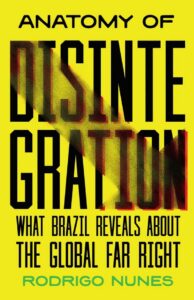
Excerpted from Anatomy of Disintegration: What Brazil Reveals About the Global Far Right by Rodrigo Nunes and published by Haymarket Books.