By Literary Hub | Created at 2026-08-25 09:33:46 | Updated at 2026-09-26 05:45:57
1 month ago
By Literary Hub | Created at 2026-08-25 09:33:46 | Updated at 2026-09-26 05:45:57
1 month ago
While Giotto sought to communicate the Christian messages that he had been commissioned to depict by encouraging his viewers to empathize with the characters in his realistic scenes, Hieronymus Bosch (c. 1450-1516) took a different tack. In his paintings, the Netherlandish artist used humor and fantasy to draw his viewers into a bizarre and tempting, yet dangerous, world, before admonishing them for viewing his scenes of pleasure and revelry with anything other than condemnation. But this approach to his art and his audience is not immediately clear to viewers today and can only be appreciated with some understanding of Bosch’s worldview. Even compared to other art of his time, Bosch’s images were idiosyncratic and unconventional, and his way of thinking particularly pessimistic.
Article continues after advertisement
Bosch’s best-known surviving work, for example, The Garden of Earthly Delights, is one of the strangest and most difficult to read paintings in European art history. Now in the Prado Museum in Madrid—where the shop is full of jaunty merchandise bearing brightly colored details from the piece—the painting was relatively unusual for its time as a triptych that was probably made for a secular setting rather than as an altarpiece for a church. And as such, rather than being limited to Biblical subject matter, it includes images of everyday humans on Earth—although the Earth that Bosch presents on the huge central panel could not be further from the real world. In a cheerfully vivid palette of reds, greens, blues and pinks, the central scene depicts hundreds of naked people frolicking, cavorting, reveling, merry-making and pleasure-seeking in all manner of ways in a fantastical landscape with ponds and rivers, lush vegetation and giant fruit. It is a kind of paradise on Earth in which all humans, uninhibited, have succumbed to all of their desires. Some ride on giant birds or other beasts, some take bites from luscious berries or pluck apples from the trees. There is an orgiastic feel to the whole composition as bodies mix and mingle, tumble and twist, intertwine and embrace.
Even compared to other art of his time, Bosch’s images were idiosyncratic and unconventional, and his way of thinking particularly pessimistic.
Indications for how to process this central scene can be found on the side panels, which follow the same visual language but are more overtly religious in their subject matter. On the left, we see God presenting Eve to Adam in the Garden of Eden. She is yet to unleash evil into the world by eating a forbidden apple, but there are signs of what is to come among the creatures around them, which include a cat with a mouse in its mouth and a lion eating a deer. On the right-hand panel, Bosch presents us with a terrible vision of hell where, among the demons and the damned, we are shown, among other oddities, a set of giant human ears with the blade of a knife protruding from between them, a man with a musical instrument up his backside and a pig dressed as a nun. The two outer panels are designed to close, covering the central panel, and on the outside, in grey monochrome, Bosch has painted an image of the newly created world inside a giant bubble, with God looking on.
The Garden of Earthly Delights was probably commissioned by the aristocratic Engelbert II, Count of Nassau (1451-1504) for his palace of Coudenberg in Brussels between about 1495 and 1504. As early as July 1517, it was seen there by a visitor, who described it as “bizarre” and clearly didn’t quite know what to make of it. The painting, and Bosch’s art in general, has been delighting, troubling, amusing and puzzling viewers ever since. But Bosch’s own intentions were clear and were much more serious than his art might today suggest.
Hieronymus Bosch grew up as Jeroen van Aken, surrounded by artists. His father Antonius was a painter, as were four of his paternal uncles, and it is likely that young Jeroen (the Dutch version of Jerome) trained in the family workshop. Painting was a paternal family tradition. Both Bosch’s grandfather, Jan, and his great-grandfather, Thomas van Aken, had also made their living in this way. In 1404, Thomas had moved from the German city of Aachen to Nijmegen in the Duchy of Guelders in the Low Countries (a geographical region that included modern-day Netherlands, Belgium and Luxembourg). By about 1426, Thomas’s son Jan was living in ’s-Hertogenbosch, a town in the Duchy of Brabant, now part of the Netherlands and often shortened to ‘Den Bosch.’ Jeroen van Aken was born there in about 1450.
From 1462, the family owned a house off the town’s main square, the Markt, which included a workshop. It is not surprising, therefore, that Bosch and two of his brothers joined the family business. As an artist, he styled himself ‘Hieronymus Bosch,’ probably to appeal to an educated elite by using the Latin version of his first name and emphasizing his identification with ’s-Hertogenbosch rather than Aachen. Although a relatively lively commercial town, ’s-Hertogenbosch was not a leading cultural center and, unlike nearby Antwerp or Brussels, did not have a thriving artistic community, but Bosch nevertheless remained there for his whole life. This relative isolation almost certainly contributed to the highly idiosyncratic style for which he is known.
Remaining in his hometown, Bosch soon became a big fish in a small pond. In around 1486, he joined the Brotherhood of Our Lady, a local religious association that had thousands of members in the town and beyond, and through which Bosch obtained his earliest commissions, sometimes working alongside his father and other members of the family. Socially, however, his big break came in 1487 or 1488 when he was elevated to a ‘sworn’ rather than a ‘common’ member of the Brotherhood, an elite tier comprising members of the clergy, wealthy landowners and businessmen, magistrates, aristocrats and, as seems to have been the case with Bosch, those with exceptional skills.
By this time, he was married to Aleid van de Meervenne, a woman from a relatively wealthy local family who owned several properties. The couple were living in a house on the north side of the Markt that Aleid had inherited from her grandfather and which was fancy enough for Bosch to host a dinner for the sworn members of the Brotherhood in 1488. There is no doubt that his position in the organization opened doors for Bosch and as such, it is likely that he waived his payment for much of the work that he undertook for them. This work included wings for an altarpiece featuring St. John the Evangelist and St. John the Baptist for their chapel in St. John’s Church, the main church in ’s-Hertogenbosch. Painted between 1490 and 1495 and now held in the Gemäldegalerie, Berlin (St. John on Patmos) and the Lázaro Galdiano Museum, Madrid (Saint John the Baptist), these paintings abound with allegorical details and contain elements of Bosch’s strange visual world, including a bizarre spectacle-wearing lizard-bird-human-demon.
Compared to his later work, however, the scenes are relatively conventional. Bosch also made other paintings for St. John’s Church, including an altarpiece depicting the Creation of the World for the high altar, probably commissioned by the church itself, and panels for other chapels depicting various Biblical scenes. Commissions also came from other patrons in the town, helped by the connections that he made through the fraternity.
Bosch’s reputation grew throughout the 1490s, enabling him to make an impact beyond the small pond of ’s-Hertogenbosch, despite remaining in the town. His fame was probably enhanced by the handful of engravings based on his paintings made by Alart du Hameel, a printmaker, goldsmith and architect who worked on the Brotherhood’s chapel in St. John’s. Connections among the other sworn members are also likely to have spread the word about his skills and unique style, leading to the sale of his work to some high-profile patrons.
In around 1494, for example, he painted a triptych on the theme of the Epiphany for the Antwerp civic leader Peeter Scheyve and his wife, Agnes Gramme (Prado, Madrid). Around this time, he also made work for various international clients, including several Spanish patrons living in Brabant as well as clients in Brussels and possibly Italy, and received his commission from the Count of Nassau. At some point, paintings by him also found their way into the possession of Margaret of Austria, Duchess of Savoy (1480-1530) and, by the 1520s, the prominent Grimani family in Venice, among other elite collectors. His most prestigious commission, however, came from Philip the Fair, Duke of Burgundy (1478-1506), who visited ’s-Hertogenbosch in 1504-1505 and, while there, ordered from Bosch a large altarpiece depicting the Last Judgement. He followed this with a commission for the Temptation of St. Anthony the following year, which he presented to his father Maximilian, the future Holy Roman Emperor.
Like most painters of this period, Bosch took on a wide range of paid work, from painting altarpieces and other works on wooden panels, to adding color to decorative objects and furniture, and designing stained-glass windows, metalwork and textiles. But the works for which he is best remembered are his panel paintings and specifically his triptychs. Bosch is known to have produced at least sixteen, eight of which survive intact. The earliest are relatively conventional in depicting subjects such as the Adoration of the Magi (about 1475, Metropolitan Museum of Art, New York) and Ecce Homo, the presentation of Christ to the crowd before his Crucifixion (same period, Städel Museum, Frankfurt).
These early examples show the influence of Netherlandish painters of the preceding generations such as Jan van Eyck (died 1441) and Rogier van der Weyden (died 1464), as well as some of Bosch’s contemporaries, such as the painter and printmaker Martin Schongauer (1448-91) from whom he borrowed some ideas. By the 1490s, however, Bosch’s paintings had become notably unconventional in their subject matter and were populated by the kind of weird and fantastical creatures and imagery that filled the inner panels of The Garden of Earthly Delights. The central image of the Haywain, for example, a triptych from about 1512-15 (also now in the Prado), depicts a large haystack on a wagon being pulled by demons with the heads of various animals. Merrymakers sit on its top, including a canoodling couple and a trio enjoying some music. Beneath, members of the lower social classes pluck at the hay, jostling and tumbling as they try to get close, while a group of aristocrats follow on horses behind. Violence has broken out at various points amid the chaos, which is surveyed from the sky by a pitying Jesus. On the panel to the left, we again find ourselves in the Garden of Eden, where we follow Adam and Eve from their moment of creation to Eve’s acceptance of the apple from the serpent and the couple’s banishment from Paradise. In the background, rebel angels are cast down from heaven. On the right wing, we are presented with scenes of torture and destruction in hell.
Unusually for the time, the painting on the back of the wings, which forms a full image when the wings are closed, is a secular scene: a traveling Everyman walking along the path of his life with his worldly belongings in a basket on his back. Portentous vignettes mark the route behind him, including an executioner’s scaffold, a fellow traveler being robbed and a man playing some pipes. The image carries a moralizing message, warning against the various temptations that might lead to a less-than-virtuous life. Bosch was innovative in painting triptychs in which the exterior image was intended to be read alongside the images inside, and in his integration of religious imagery with scenes of life on Earth.
It is tempting today to look at Bosch and to read his work as light and playful….But to do so is to fundamentally misunderstand his intentions.
It is tempting today to look at Bosch and to read his work as light and playful. There is certainly humor in his depictions of naked figures performing handstands, oversized strawberries, fish-headed demons and objects protruding from human orifices. It is also tempting to view Bosch as a kind of proto-Surrealist, or a trippy eccentric on a wild ride. But to do so is to fundamentally misunderstand his intentions. Bosch’s paintings were, in fact, deeply moralizing and pessimistic about human nature. He had a particularly dim view of the lower classes, depicting the poor and those on the margins of society, including sex workers and unskilled people, as being those most likely to succumb to sins such as gluttony, drunkenness, idleness and lewdness.
These views were not uncommon for the time, however, and his emphasis on the individual to take responsibility for their actions was in keeping with contemporary Christian and humanist thought. In Bosch’s view, the pleasure-seeking figures in the central panel of The Garden of Earthly Delights are behaving on Earth in a way that will condemn them to hell, showing no self-restraint or moderation and giving in to their base desires and urges. Bosch tells us this by first showing us the creation of the world on the exterior, then the introduction of human beings in the Garden of Eden, where sin will first be introduced, and finally, the terrible punishments of hell. In the Haywain, the hay is a symbol for earthly goods, which are all essentially transient (hay will soon wither away) but which humans nevertheless clamor to grab, leading to all manner of bad behavior. A similar message is delivered on the outer panel, where we see the Everyman besieged by danger as he navigates his path through life, determined to hold on to his material possessions.
Bosch created his weird and wonderful visual language to hold a mirror up to society and to warn against folly and sin. In doing so, he employed the tools of satire, a genre practiced by ancient writers such as Horace and Juvenal and contemporary writers such as Sebastian Brant and Erasmus, in which aspects of society could be criticized through metaphor in a light-hearted way. In addition to the weirder elements, Bosch’s metaphoric language included recognizable imagery that could be more readily understood by his viewers, including references to folk customs, festivals and proverbs. In his world, it seems almost inevitable that humans will disappoint and give in to temptation. The many owls that appear in his works, including The Garden of Earthly Delights, are to remind his viewers that they are always being watched and should behave accordingly.
Hieronymus Bosch died aged about 65 during the summer of 1516, from an infectious illness (possibly the plague) that had already claimed the lives of many others in the town. He was given a requiem mass at St. John’s Church in ’s-Hertogenbosch, in the chapel of the Brotherhood of Our Lady. His work was collected enthusiastically in the sixteenth century by King Philip II of Spain, but it seems that within decades of his death, if not earlier, it was already being misunderstood and misinterpreted. For the last five centuries, people have seen what they have wanted to see in Bosch’s art, perhaps unwilling to accept the pessimism and judgement in his messages.
_______________________________
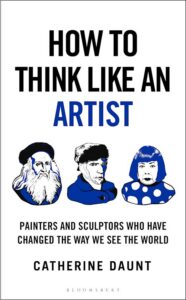
Excerpted from How To Think Like an Artist: Painters and Sculptors Who Have Changed The Way We See The World by Catherine Daunt. Run with permission of the author, courtesy of Bloomsbury Continuum, an imprint of Bloomsbury Publishing Plc. Copyright © Catherine Daunt, 2026.