By The Rio Times | Created at 2026-09-18 08:22:05 | Updated at 2026-09-18 09:52:26
2 hours ago
By The Rio Times | Created at 2026-09-18 08:22:05 | Updated at 2026-09-18 09:52:26
2 hours ago
Venezuela · Politics
Key Facts
—What happened. Delcy Rodriguez assumed the presidency of Venezuela on 5 January 2026.
—Who says so. A UN fact-finding mission report and a US presidential determination both call her interim president.
—The catch. No Venezuelan legal text setting out the mechanics of the handover has been published.
—The clock. The constitution allows a temporary absence of 90 days, extendable once by parliament.
—The talks. A second round of US-backed transition talks opened in Caracas on 17 September.
—The drug list. Venezuela stayed on the 23-country majors list on 16 September.
Almost every institution now writes as though Venezuela has a new government. None has published the document that would explain how.
One-stop reference
Company Intelligence
Every listed company in Latin America — financials, ownership and structure for 1,450+ companies across 26 exchanges, in one place.
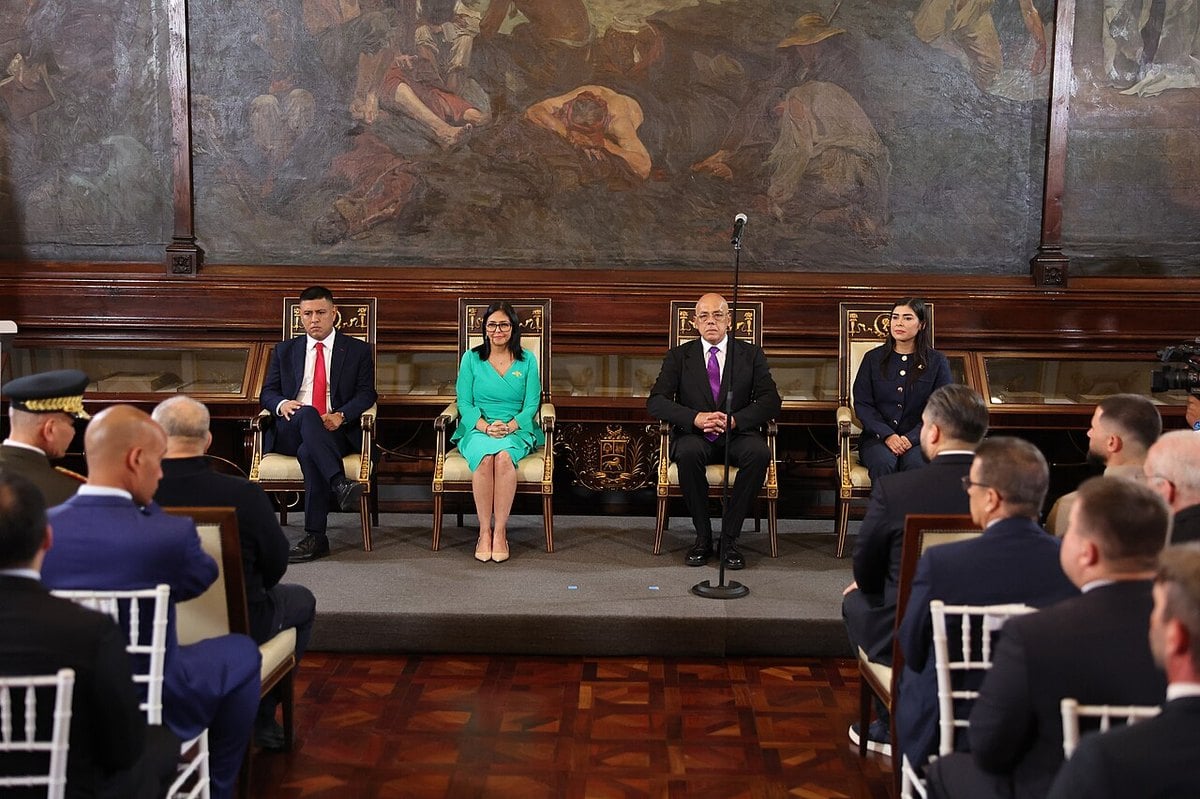
Venezuela’s second round of US-backed talks on a political transition opened in Caracas on 17 September 2026. The government side was led by Jorge Rodriguez, brother of the woman who has run the country since 5 January.
The Signals Are Everywhere
Start with the volume of corroboration, because it is unusual. The wire service EFE calls her “la presidenta interina de Venezuela” in routine copy.
A UN report uses the term interim President; a US presidential determination uses it too. Trinidad and Tobago recognised her as acting president in April 2026, Caribbean outlets reported.
CBS News and the Los Angeles Times reported on 1 April 2026 that Washington lifted its sanctions on her. Diplomatic relations between the two countries, broken since 2019, were restored in March.
What the UN Mission Put in Writing
The most specific account comes from a UN document published this week. The independent international fact-finding mission on Venezuela issued report A/HRC/63/57 on 16 September.
The advance edited version is dated 17 August 2026 and covers 1 September 2025 to 31 July 2026. Its summary describes US military attacks on 3 January 2026 that resulted in Maduro’s “apprehension”.
The same sentence adds the words “and his removal from power”. The Spanish-language OHCHR press release of 16 September uses the word “captura”.
Paragraph 17 is the closest thing to a legal account anywhere in the public record. It says the Supreme Court appointed the Vice-President, Delcy Rodriguez Gomez, as interim President.
She assumed power on 5 January 2026 and announced what she called a “new political moment”. The mission was due to present the report to the Human Rights Council on 18 September.
How a Presidential Vacancy Is Meant to Work
Venezuela’s constitution draws a sharp line between two kinds of presidential absence. Article 233 lists the grounds for an absolute absence, and the list is narrow.
It covers death, resignation, removal by a Supreme Court judgment, certified permanent incapacity, abandonment of office and recall. An absolute absence triggers a new election within 30 days.
Article 234 covers temporary absences, which the Executive Vice-President fills for up to 90 days. Parliament may extend that by a further 90 days, and no more.
The Document That Has Not Been Published
Neither route appears to have been formally taken. The legal monitor Acceso a la Justicia examined the question in an analysis dated 9 April 2026.
It says the Constitutional Chamber issued a decision on 3 January 2026 describing the absence as exceptional. The chamber attributed it to foreign aggression and a kidnapping, according to that analysis.
Acceso a la Justicia says the chamber declined to classify the absence as temporary or absolute. It ordered the Vice-President to take over as encargada, the group says, without setting a time limit.
The National Assembly has not declared an absolute absence, according to the same analysis. The Rio Times has not been able to locate a published text of that ruling.
The Clock Ran Out in July
The arithmetic matters because the constitution sets a ceiling. Six months from 3 January 2026 fell on 3 July, and parliament never voted the second extension.
Infobae reported on that date that the maximum period for an encargaduria had been reached. Acceso a la Justicia told Infobae that parliament’s silence was itself a failure of its functions.
Acceso a la Justicia told Infobae the country was entering open and previously unseen unconstitutionality. The government’s stated rationale, per that report, is administrative continuity; no presidential election has been called.
Officials have said economic recovery comes first. Officials said before the June earthquakes that economic recovery came first.
Washington’s Own Wording
The clearest American statement is buried in an annual drug document. The presidential determination on major drug transit countries went to Congress on 15 September 2026.
It names 23 countries as major drug transit or major illicit drug producing countries. Venezuela is on that list, alongside Colombia, Mexico, Peru, Ecuador and Bolivia.
Only Afghanistan, Bolivia, Burma and Colombia were designated as having failed demonstrably. Venezuela was not, and that is the whole of the change announced on 16 September.
The text credits “my Administration’s arrest and removal of former illegitimate dictator and drug trafficker Nicolas Maduro”. It then cites “positive steps taken under interim President Delcy Rodriguez” as the reason for dropping the tag.
The Meeting That Has Not Happened
Axios reported on 17 September that Trump wants a bilateral meeting with Rodriguez next week. EFE, reporting from Washington, said the venue would be the margins of the UN General Assembly.
The general debate of the 81st session runs from 22 to 26 September and again on 28 September 2026. Trump is due to address the assembly on the Tuesday, according to EFE’s account of the Axios report.
Reuters reported on 15 September, citing Bloomberg News, that Rodriguez was planning a UN visit. Neither government has announced a meeting; it would be the first between the two leaders.
Inside the Second Round of Talks
The second cycle of negotiations opened at the Hotel Melia Caracas after 17:30 local time on 17 September. EFE reported that photographers were admitted only briefly and that neither side detailed the agenda.
The opposition delegation is led by Dinorah Figuera, a former National Assembly president. Maria Corina Machado and the majority opposition leadership are not at the table.
The first round ran from 6 to 12 August and produced two agreements, according to EFE. One covered a full renewal of the Supreme Tribunal; the other covered reserves held at the Bank of England.
Those funds were earmarked for victims of the double earthquake of 24 June 2026. This round is billed as covering civil and political guarantees and freedom of expression.
Two Gestures and One Arrest
Two things happened around the opening that read as a test of the process. On 17 September the government unblocked 12 news portals, announced through its peace and coexistence programme.
The monitoring group VE sin Filtro said more than 200 pages and platforms remain blocked. At least 65 of those are media outlets, according to the press workers’ union SNTP.
The same day, Javier Oropeza, a former mayor of Torres in Lara state, was detained in Barquisimeto. He had returned from two years of exile in Spain and had received a case dismissal the day before.
Figuera said she raised the detention with the government delegation, which promised to seek his release; he was released that night. Opposition parties said he was freed under substitute measures.
The Sanctions Conversation
A third track runs through the United Nations, and it is about money rather than legitimacy. Michelle Muschett, the UNDP regional director for Latin America, spoke in Bogota on 17 September.
She said she understood that talks between Venezuela and the United States were under way. Diario las Americas reported her words and noted that sanctions affect the arrival of aid.
The UN humanitarian chief Tom Fletcher has called for flexibility on earthquake recovery. The US Treasury issued temporary relief on 25 June 2026 that expires on 23 October, the same report says.
Separately, a US-Venezuela oil accord has reopened the sector to American operators. EFE reported that the arrangement gives the United States control over about a fifth of Venezuela’s crude reserves.
What It Means If You Are Investing or Living There
Treat the legal basis of the current government as unsettled, because it is. Contracts signed with a government whose mandate has no published constitutional footing carry a specific risk.
That risk is not political sentiment; it is the possibility of later challenge in a Venezuelan or foreign court. Counterparty diligence should ask which decree or ruling authorises the signatory, and request the text.
For residents, the practical signals are mixed rather than uniformly better. The UN mission recorded 64 new torture cases after 3 January and estimates 379 to 500 people still held for political reasons.
It also recorded a pattern of short arbitrary arrests aimed at intimidating activists and journalists. The Oropeza case fits that pattern closely, on the opposition’s account of it.
What Is Not Yet Known
No published legal instrument sets out how the presidency actually changed hands. The Rio Times does not assert that a constitutional transition has taken place.
What exists is a large body of consistent usage and one unpublished court decision described by third parties. What does not exist, so far as we can establish, is a published ruling, a parliamentary declaration or an election.
It is not known whether the National Assembly will ever declare an absolute absence. It is not known what legal status the interim presidency will carry after the 180-day ceiling passed in July.
It is not known whether the Trump meeting will take place, or what it would formalise. It is not known when, or whether, a presidential election will be scheduled.
Frequently Asked Questions
Is Nicolas Maduro still president of Venezuela?
He has not held office in practice since 3 January 2026. No published Venezuelan instrument records a resignation, removal or declared absolute absence.
Who is Delcy Rodriguez?
She was Maduro’s Executive Vice-President from 2018 and assumed the presidency on 5 January 2026. The UN mission says the Supreme Court appointed her interim President.
Did the United States remove Maduro?
The presidential determination of 15 September 2026 refers to the administration’s arrest and removal of Maduro. The UN mission calls the 3 January attack a breach of international law.
Was Venezuela taken off the US drug list?
No. It stayed on the 23-country majors list and only lost the separate failed demonstrably designation.
Sources: UN fact-finding mission on Venezuela, report A/HRC/63/57, OHCHR press release on the mission’s findings, 16 September 2026, Presidential determination on major drug transit countries for fiscal year 2027, United Nations, high-level week 2026, EFE on the second round of transition talks in Caracas, EFE on the Axios report of a planned Trump meeting, Acceso a la Justicia on the presidential absence and articles 233 and 234, Diario las Americas on the sanctions talks, Diario las Americas on the unblocked news portals