By Literary Hub | Created at 2026-06-01 09:01:28 | Updated at 2026-06-07 13:09:42
6 days ago
By Literary Hub | Created at 2026-06-01 09:01:28 | Updated at 2026-06-07 13:09:42
6 days ago
After finishing an early draft of my novel New Skin, I realized that I had been writing all along for someone specific to read the book and finally understand what I felt. I don’t mean that I consider the novel itself to be fundamentally a rhetorical act that presupposes a reader, though it very well may be. I mean that a writer once told me all novels have an addressee. Think of it like this: When we are getting dressed up to go to a party, who are we getting dressed for? Who do we imagine might see us and be impressed, seduced, or intimidated?
Article continues after advertisement
I consider my novel to be many things. An embarrassing diary. A compendium of jokes. A chronology of my life as lived by an avatar. A lab for working out ideas. In the most ideal of possibilities, I would like my book to be a pill for readers to swallow so that it affects their bodies on a molecular level. The novel is, among all these things, also a letter to my mother that holds inside it everything I ever wanted to say to her but couldn’t. Fiction is a miracle in that way. I can still recall the heartbreak, outrage, and utter devastation I felt when I read Flowers for Algernon in junior high. It lives inside me forever.
The paradox of writing something for someone who will never read it isn’t a math problem that I need to be solved. But what is it, then?
New Skin isn’t an epistolary novel, nor did I intend for it to be a form with which to communicate to my mother directly. But I cannot deny that it is the story of us: an immigrant mother and daughter trying to survive in a country that disfigures them with promises of reinvention and an American dream that doesn’t exist. The difficulties that the characters experience are contiguous to ours in real life: enmeshment, betrayal, abandonment, resentment. The twenty-six-year-old protagonist loves her mother more than anyone else in the world and though the novel doesn’t portray this future, I imagine she will go through life searching for a love that compares and will never find it.
I’ve written this story to say it out loud. All of my rage and fear and wonder. I’d like my mother to read it and know how I feel about her, how sorry I am for everything I’ve ever done to her, and, maybe like my protagonist, how I have spent my life in failed pursuit of a love like ours. If my mother read my book, she would receive the message I have inscribed into each scene, each metaphor. I have always known, however, that she would never read it.
My mother can speak and read English. The language native to her body and brain is Mandarin. Though she can communicate in English, the level at which she is literate precludes reading novels. If my novel is a letter to her that she will never read, then what is the purpose of having written it? The book is a paradox.
No other reader will understand our story like she would. The way the bougainvillea vines grew thick on our trellis, a crown of magenta flowers welcoming us home, held so much meaning within it. Our house, ruined by the 1987 Whittier Narrows earthquake, was rebuilt from the foundation up. My mother planted every rosebush and flowering vine in the garden, her knees in the dirt. To see them flourish was to see our own hopes for life reflected within them. In the novel, the story of our bougainvillea is whittled down to a single image of its flowers falling at our feet like cusped hands.
People say, in a hopeful tone, that the book could be translated into Chinese and then my mother will be able to read it. “Maybe,” I say. It’s not likely. She’s getting older and not doing so well cognitively. The paradox of writing something for someone who will never read it isn’t a math problem that I need to be solved. But what is it, then?
My grandfather was a writer. When I once asked my uncle how many books my grandfather had written, my six-foot tall uncle said that if you stacked all the books, it would be taller than him. I have a collection of eight of my grandfather’s books on my shelves that I kept when he died before his library was hauled into a dumpster. He wrote about psychology and taught at the Taipei National University of the Arts. His books are written in Chinese. My mother translated some of the titles and tables of contents for me.
The Heart, Inside: vol. I and II.
“Dissect, inspection, sort out. Responsibility. Everybody help each other. Don’t judge me. I have my reasons.”
A Person’s Life—Remember: vol. II
“Essays on weather, nostalgia, thoughts while reading the news, dreams about the war.”
Young Girl’s Feeling
“Ten things to not do in love. Secrets. Crazy crush but you don’t understand it yet.”
Writing an entire book for someone who will never read it is worth writing so that you may know what you wanted to say to this person in the first place.
It is this Young Girl book that I cherish, whose cover with an abstract Helen Frankenthaler painting in pink color wash and black paint soaking raw canvas I see as a teenage girl thrashing. I love this book as if it were written for me. But not unlike my mother and New Skin, I have not read Young Girl because I cannot read Chinese. When I use the camera translation function on a phone app, the language delivered to me on my screen is gibberish. I’ll never read this or any of his books but what they mean to me has everything to do with what the book contains: literary lineage and my place in the world. This includes my place not only as a writer—who like my grandfather had, is writing books, teaching college, and engaged in psychoanalytic thought—but also as a someone who has similarly dedicated her life to the pursuit of learning, understanding, and expression through language. Books, of course, have meaning beyond what’s written inside of them.
I think through the process of writing. I started this essay not knowing what the answer to my question would be, of what it means to write a book for someone who will never read it. Now that I have written my and my mother’s story, it is splayed out in pages before me.
In a long-ago draft of a story I’d written and never published, I wrote about dialysis. A character had kidney failure and had to go to a dialysis clinic three times a week to rid her blood of toxins. She was hooked up to a hemodialysis machine where her blood flowed out of her body to be purified and was then transferred back into her body where it was reabsorbed. I used the process of dialysis as a metaphor for what it means to write. The story comes out of you, is laid on the page to be contended with, clarified, then reabsorbed back into your body as you apprehend what you have written. Writing an entire book for someone who will never read it is worth writing so that you may know what you wanted to say to this person in the first place.
My mother held my unread book in her hands sitting in the passenger seat of my car, marveling at what I had made. She knew it was the story of us.
__________________________________
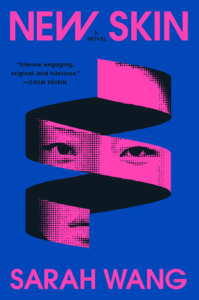
New Skin by Sarah Wang is available from Little, Brown and Company, an imprint of Hachette Book Group.