By The Straits Times | Created at 2026-07-18 21:11:14 | Updated at 2026-08-08 11:32:53
2 weeks ago
By The Straits Times | Created at 2026-07-18 21:11:14 | Updated at 2026-08-08 11:32:53
2 weeks ago
KUALA LUMPUR – “My parents were living here, so I took a test and obtained Malaysian citizenship,” recalls Goh Choon Piow, 86, a naturalised Malaysian, as he reflected on giving up his Chinese citizenship in the 1960s.
As part of the citizenship test, he had to pronounce the Malay words for “identity card” (kad pengenalan) and state the name of Malaysia’s then king.
When the Straits Times met Goh in early July, he had just watched Dear You for the fifth time. A Teochew, he says the film resonates deeply with him because it mirrors his own journey from China to Malaysia at the age of 16.
“It was a very hard time,” Goh recalls. His first job was as a sundry shop assistant, working 15-hour days in Gombak, Selangor. Many of his customers were Malay rubber tappers, which was how he picked up the national language quickly.
The mainland Chinese hit, which was filmed almost entirely in the Teochew dialect, tells the poignant tale of Nanyang migrants torn between working in South-east Asia and longing for their hometowns in China. It has taken at least RM15 million (S$4.8 million) at the Malaysian box office, making it the country’s top-grossing Chinese-language film of 2026.
Becoming Malaysian did not sever Goh’s ties with his Teochew ancestral village in Da’an, Guangdong province. After China opened up in the 1990s, he returned regularly and in 2022 donated 20 million yuan (S$3.81 million) to build an arts centre there in memory of his grandfather.
Goh’s story reflects that of many Chinese Malaysians, who see little contradiction between being loyal citizens while maintaining deep cultural and ancestral ties to China. The popularity of Dear You reflects how it has struck a chord with this community because it mirrors that enduring connection across generations.
Its themes have resonated with Malaysian audiences, making the country the film’s highest-grossing overseas market outside China.
Malaysia has 30.8 million citizens, including about 6.8 million ethnic Chinese, who make up 22.4 per cent of the population. Malays account for 58.1 per cent and Indians 6.6 per cent, with other ethnic groups making up the remainder, according to the statistics department.
The country is home to South-east Asia’s largest Chinese-language education system, more than eight Chinese-language newspapers and 10,000 Chinese clan associations, making it easier for many Chinese Malaysians to preserve their language, traditions and links with their ancestral hometowns.
Insecurity and belonging
Associate Professor Pek Wee Chuen, who heads the South-east Asian Department at the New Era University College in Selangor, says the Chinese Malaysian community has long felt insecure about its identity in a multicultural society, giving rise to a dual identity.
“During the British colonial period, many Chinese felt they were second-class citizens despite mastering English. After independence, the May 13 incident and the New Economic Policy (NEP) did not provide Chinese Malaysians with a sense of security. As a result, mainland China became an alternative source of belonging.”
The May 13 incident refers to the 1969 racial riots between Malays and Chinese that erupted after the Alliance coalition, the predecessor of Barisan Nasional, lost its two-thirds parliamentary majority despite retaining control of the federal government.
In the aftermath, the NEP was introduced to improve the economic position of Malays and other bumiputeras, or sons of the soil, through affirmative action. However, some Chinese Malaysians have viewed the policy as discriminatory, arguing that it favours the Malay majority at the expense of other ethnic groups.
Against this backdrop, many Chinese Malaysians developed an identity that combined loyalty to Malaysia with enduring cultural ties to China.
Home is Malaysia
One of them is my uncle Tey Jeih Kuang, 66, who traces his family’s Teochew roots to Chaoshan in Guangdong. As a child, he developed a fondness for pickled black olives after his mother brought a jar home from a trading trip to southern China in the late 1960s.
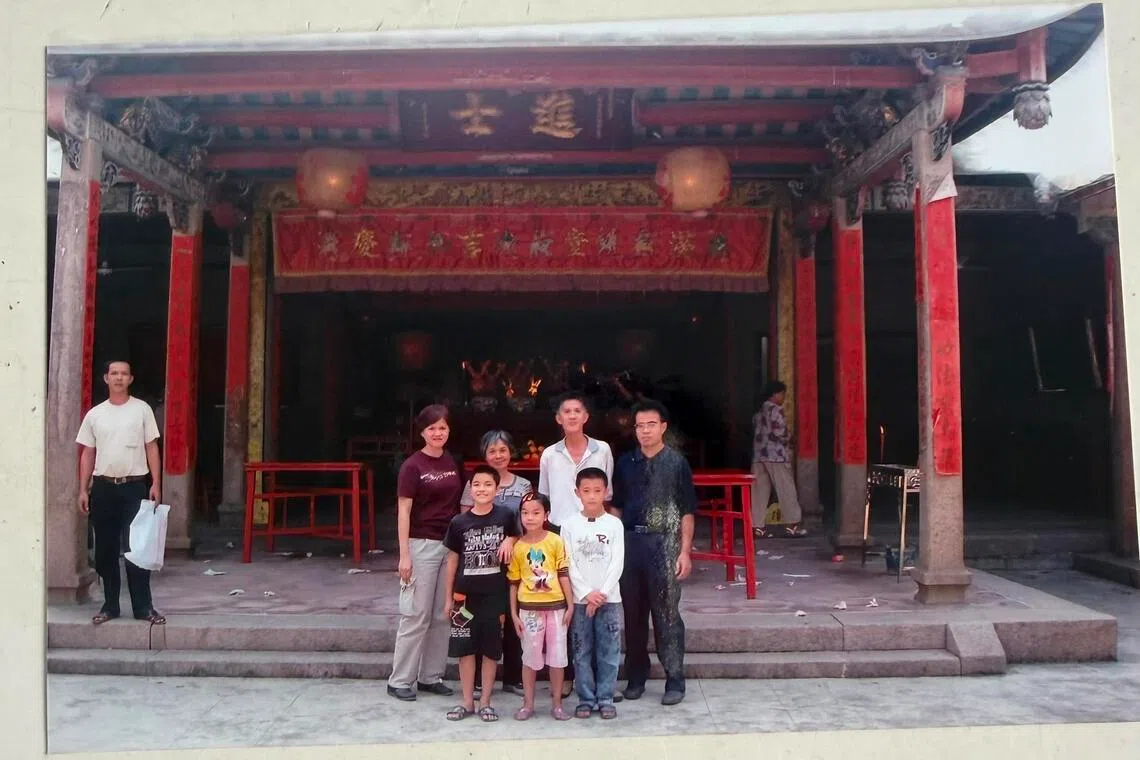
Tey Jeih Kuang (second from right) and his family visited an ancestral shrine in Shantou, China, in 2007.
PHOTO: TEY JEIH KUANG
Years later, he bought the same olives for my grandmother – only for her to ask, puzzled, why her future son-in-law had chosen such an unusual gift.
The same pickled black olives appear in Dear You, where protagonist Ye Shurou gives them to Thai Chinese Xie Nanzhi as a token of gratitude and shared heritage.
Despite visiting China several times, Tey says Malaysia remains his true home. While he values his ancestral roots, he has “no desire” to become mainland Chinese and hopes to spend the rest of his life in Malaysia.
Balancing two identities
A similar sentiment is evident among younger Chinese Malaysians. Cindy Ong, 21, a Chinese studies student at a local college remains firmly rooted in her Malaysian identity despite having a mainland Chinese boyfriend.
“For example, parents in mainland China place greater emphasis on filial piety, while Chinese Malaysian parents tend to be more open-minded. Those differences are what distinguish me as a Malaysian from someone from mainland China,” she notes. The couple watched Dear You during Ong’s visit to China in early July.

Chinese studies student Cindy Ong remains firmly rooted in her Malaysian identity despite having a boyfriend from mainland China.
PHOTO: CINDY ONG
For some younger Chinese Malaysians, social media has also become a gateway to reconnecting with their ancestral roots.
Ong’s classmate Lock See Ching, 18, who discovered Dear You on Douyin, says watching the film reinforced her belief that it is possible to embrace her ancestral roots while remaining unmistakably Malaysian.
“There is no conflict between the two identities for me. I want to learn more about my Hakka ancestral roots, my family’s temple in Huiyang, Guangdong, and how my ancestors came to Malaysia. My roots in China are an important part of who I am, but I am still Malaysian.”
Sign up for our weekly Asian Insider Malaysia Edition newsletter to make sense of the big stories in Malaysia.