By The Straits Times | Created at 2026-06-15 21:16:38 | Updated at 2026-06-16 06:16:45
9 hours ago
By The Straits Times | Created at 2026-06-15 21:16:38 | Updated at 2026-06-16 06:16:45
9 hours ago
TOKYO – If all goes according to plan, the skyline of Tokyo’s bustling Shibuya district will finally lose its matrix of construction cranes in March 2035, marking the conclusion of a “once-in-a-century” redevelopment pushed nearly eight years behind schedule.
Planning began in the early 2000s for a massive public-private undertaking that was originally due to finish by 2027. Milestones include the opening of the Shibuya Hikarie building in 2012, Shibuya Scramble Square in 2019, Miyashita Park in 2020 and Shibuya Sakura Stage in 2024, but newer facilities such as the Hachiko Plaza and Shibuya Upper West Project are still down the line.
The makeover ran into a perfect storm of logistical complexities and economic shifts. Skyrocketing material prices and an acute manpower squeeze – compounded by strict new overtime regulations since 2024 – have relentlessly pushed costs upwards.
Shibuya Station is also the world’s second-busiest transit hub – after Shinjuku Station – serving 2.9 million daily commuters across nine lines run by four railway operators. To keep services running seamlessly, engineers have had to resort to frequent, highly complex structural modifications.
“This is a once-in-a-century makeover for its scale and involvement of multiple stakeholders,” Shibuya Mayor Ken Hasebe said, acknowledging that containing costs has been a major hurdle.
But rather than a mere vanity project to replace ageing facilities with gleaming skyscrapers, Hasebe stressed that the transformation is a critical upgrade for disaster resilience and traffic management.
Shibuya Scramble Crossing sits at the lowest point of a valley, making it a severe flood risk. The district has also regularly been forced to ask visitors to stay away on Halloween and New Year’s Eve to mitigate dangerous overcrowding.
To fix this, a sweeping network of elevated decks and pathways will improve foot traffic by connecting facilities across multiple floors in what Hasebe calls an “Urban Core”. Deep below, an underground cavern capable of storing 4,000 tonnes of rainwater during extreme weather has been built.
Yet, even as Shibuya inches closer to its delayed finish line, urban projects across Japan are hitting the skids in what the domestic media describes as a “wait-and-see domino effect”.
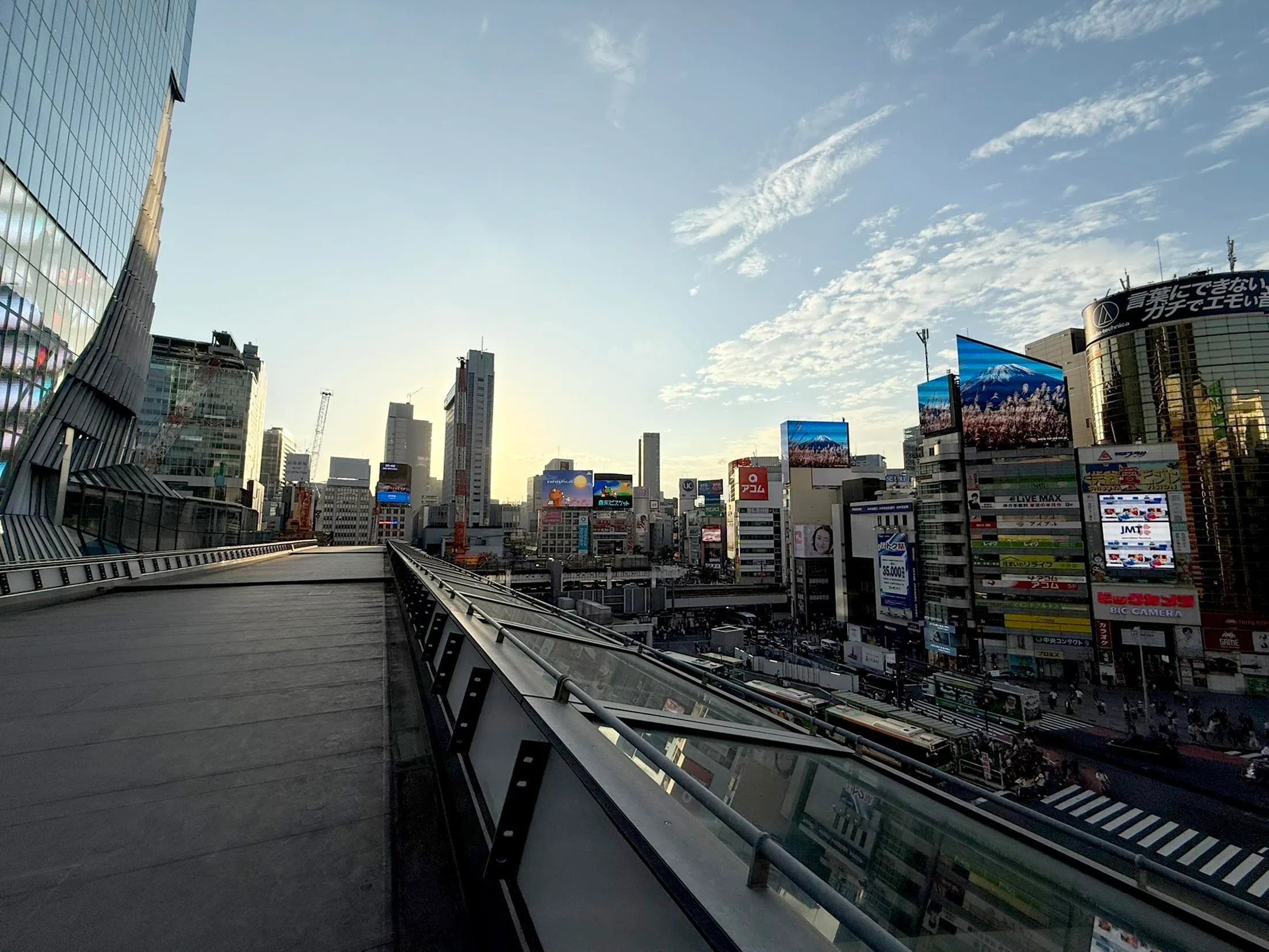
The view from an elevated walkway that, when open, will allow commuters to walk across Shibuya without passing through ground level. This is part of a city design aiming to improve the flow of human traffic.
ST PHOTO: WALTER SIM
To protect bottom lines, developers have been forced to downsize blueprints or shelve ground-breakings entirely, as construction firms withdraw from urban projects with untenable budgets.
The financial data backs up that caution. According to the Japan Federation of Construction Contractors (Nikkenren), material costs for aluminium, glass and steel have surged by up to 40 per cent since Russia’s invasion of Ukraine in 2022, while manpower costs have climbed 28 per cent.
Nikkenren leader Yoshikazu Oshimi, who is president of construction giant Kajima, told an April press conference: “To put it crudely, we can pass on the costs for projects such as data centres. Whether we can do the same for urban redevelopment projects will be key.”
But Naoki Umeda, senior executive officer of Mitsubishi Estate, one of Japan’s “Big Three” developers, said during an earnings call on May 13 that it “would take courage to push ahead recklessly” in the current environment.
A survey by public broadcaster NHK, conducted in March and April, found that 70 per cent of local governments and developers have been forced to significantly revise or delay their plans, signalling what it described as a “nationwide crisis in urban redevelopment”.
This stems from a fundamental divergence in profitability.
Unlike industrial data centres funded by deep-pocketed Big Tech or private equity firms, or high-end condominiums snapped up by wealthy investors, urban redevelopments involve a delicate and heavily regulated dance. Because many of these projects rely on taxpayer monies or are accountable to public shareholders, developers must carefully consider how much financial risk they can absorb.
Initially, the pressure was most acute in rural Japan, where low rents make it difficult to recoup heavy capital investment. But the gridlock has quickly spread to vital second-tier hubs from Sapporo to Fukuoka, and is now freezing projects in metropolitan Tokyo and Osaka.
In Gifu City, plans for two 34-storey “Twin Towers” were upended in March 2025 when the general contractor withdrew, citing an unworkable financing model. The project is now being redesigned as 32-storey and 20-storey towers.
Another project has stalled outside JR Fukushima Station, with developers mulling over a 10 per cent reduction in total floor area. The site remains a vacant lot, despite the beloved 146-year-old Nakago Department Store having been demolished three years ago to make way for a complex originally meant for a 2026 completion.
The paralysis is also acute in Nagoya, where railway operator Meitetsu recently froze the planned demolition of its iconic flagship department store. The pause came after a consortium of general contractors abruptly withdrew their bids in late 2025, spooked by severe labour shortages as projected costs ballooned to 900 billion yen (S$7.2 billion) from 540 billion yen.
Over in Sapporo, JR Hokkaido has delayed construction of a planned 43-storey mixed-use development linked directly to the city’s main station. Where the 45-year-old Sapporo Esta mall once stood is now an empty lot, as developers look at reducing the building’s height and delaying completion targets to 2034 or later, far beyond the original 2028 goal.
In some cases, the maths has led to outright cancellation. JR Kyushu scrapped its “Hakata Station Sky City” project in Fukuoka in September 2025 after cost estimates doubled from 435 billion yen to 870 billion yen.
Japan’s largest metropolises are proving no more immune than the regions.
In Osaka, a plan to modernise and earthquake-proof the Osaka Gas Building, a national cultural property dating to 1933 along the main Midosuji thoroughfare, remains in limbo. The project has yet to break ground despite plans to begin construction in 2024.
Over in Tokyo, cultural touchstones are being swallowed by the crisis. The redevelopment of the 53-year-old Nakano Sunplaza, a concert hall with a triangular-shaped facade that once hosted foreign titans such as U2 and Nirvana, is back at square one.
Nakano Mayor Naoto Sakai and the ward assembly chose to terminate their agreement with the lead developer after the firm stated costs had swelled 35 per cent to 350 billion yen. To claw back profitability, the developer proposed a redesign with a much heavier residential footprint at the expense of the site’s cultural heritage.
“The revised proposal was inadequate for a project intended to represent the face of our ward even 100 years from now,” Sakai said.
Luxury hotel developers are blinking, too. The owners of the prestigious Imperial Hotel and the Grand Prince Hotel Shin-Takanawa separately said on May 14 that they would push back construction dates indefinitely to reassess business viability.
The Imperial Hotel, in a filing to the Tokyo Stock Exchange, noted that the decision was made in the light of “recent trends in construction and labour costs, energy prices, and other price fluctuations”, adding that the delay was necessary to “consider a higher-quality business plan”.
The same day, Seibu Holdings shelved its plan to tear down and rebuild its flagship Grand Prince Hotel Shin-Takanawa, near Shinagawa Station. Instead, it will keep the existing hotel open beyond its planned 2026 closure to scrutinise the project’s timeline and the external financial environment.
In response to this industry-wide paralysis, an unprecedented joint meeting on June 1 brought together real estate developers and construction executives to seek a collective path forward, in what Land Minister Yasushi Kaneko hailed as a historic initiative between client and contractor.
Oshimi of Nikkenren expressed hope that the dialogue would “resolve friction and deepen mutual understanding” while Mitsubishi Estate chairman Junichi Yoshida, who heads the Real Estate Association of Japan, said the aim was to “move in the same direction and achieve sustainability for both industries”.