By The Straits Times | Created at 2026-06-04 05:51:43 | Updated at 2026-06-08 01:28:06
3 days ago
By The Straits Times | Created at 2026-06-04 05:51:43 | Updated at 2026-06-08 01:28:06
3 days ago
JAKARTA – The firing and arrest of the head of the agency overseeing Indonesia’s free meals programme marks a moment of reckoning for President Prabowo Subianto’s troubled flagship scheme.
On June 2, Dadan Hindayana was dismissed as chief of Indonesia’s National Nutrition Agency (BGN). A day later, he was arrested along with two former deputies, over allegations of abuse of power.
The US$15 billion (S$19.3 billion) scheme has been dogged by food poisoning cases since its launch in January 2025, with some also questioning its price tag at a time when Indonesia is grappling with a weak currency and surging fuel costs.
BGN deputy chief Nanik Sudaryati Deyang, a longtime Prabowo ally, has been installed as Dadan’s replacement. The question now is whether Nanik can deliver meaningful reforms and restore public confidence in the programme, or whether its problems are more deeply entrenched.
Dadan’s removal was justified, said analysts and observers, given the scale of the controversies that had engulfed the agency, from food poisoning cases to alleged procurement irregularities.
Among the allegations against Dadan are claims that he oversaw the marked-up procurement of more than 21,000 electric motorcycles, 32,000 pairs of shoes and 5,400 televisions. If found guilty, he could face up to 20 years in jail.
Several analysts said Prabowo’s willingness to remove Dadan signalled that the President was prepared to act against officials linked to the controversy rather than simply defend the programme.
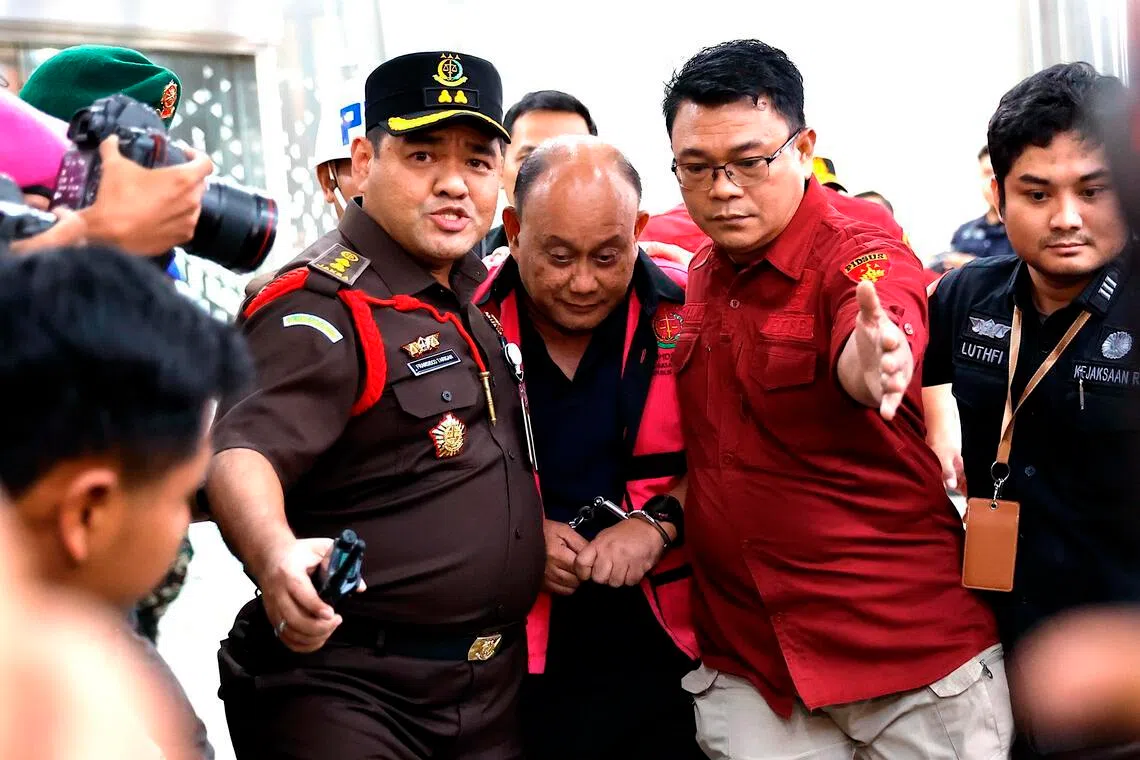
Prosecutors escort Dadan Hindayana (centre) to a detention vehicle at the attorney general's office in Jakarta, Indonesia, on June 3.
PHOTO: EPA
Arya Fernandes, a political analyst at the Jakarta-based Centre for Strategic and International Studies, said Dadan’s arrest should be used as “a stepping stone” to improve the scheme’s governance and management
The key promise of Prabowo’s 2024 election campaign, the programme aims to address chronic malnutrition among children in Indonesia, where more than one in five suffering from stunting. It aims to provide free meals to about 83 million children and pregnant or breastfeeding women, roughly a third of Indonesia’s population.
The government said in March 2026 that the programme has provided meals to more than 61 million people so far. But there have been at least 11,000 food poisoning cases linked to the it, with more than 600 hospitalised, Dadan told Parliament in November 2025. Observers believe actual figures are likely to be much higher.
Dadan’s removal, while necessary, is not a silver bullet, said analysts.
“Changing the head of BGN is a management response to what is fundamentally a governance problem, and those are two very different things,” said Yanuar Nugroho, a visiting senior fellow at ISEAS – Yusof Ishak Institute and former senior aide to former president Joko Widodo.
Yanuar said that many of the programme’s shortcomings came from structural weaknesses, including inadequate oversight mechanisms, weak quality controls and the absence of independent auditing systems.
Arya agreed that the scandal should serve as an opportunity to improve governance and management rather than merely replace individuals. He said that a programme operating on such a scale inevitably carried risks relating to implementation, transparency and budget management.
The National Nutrition Agency itself is still relatively new, having been established only in 2024.
A’an Suryana, visiting senior fellow at ISEAS – Yusof Ishak Institute, said that many of the programme’s problems reflected the growing pains of an agency that was still developing its organisational culture, management systems and operational capacity.
“Recurring problems, such as food poisoning, inefficient allocation of resources and budget inefficiency, are due to poor management capacity,” he said.
A pressing priority, he added, was strengthening management capabilities throughout the system, from the agency’s leadership in Jakarta to the local Nutritional Fulfilment Service Units, the kitchens responsible for preparing and distributing meals to beneficiaries across the country.
Made Supriatma, a visiting fellow at ISEAS – Yusof Ishak Institute, said that one of the scheme’s weaknesses lay in its design, with a public welfare programme implemented largely through privately-run contractors.
He added that the programme had become overly reliant on these contractors. “If BGN truly wants MBG (Makan Bergizi Gratis) to be a welfare programme, it should involve as many stakeholders as possible at the beneficiary level — schools and their teachers, local communities and parents,” he said, referring to the scheme’s official name.
Attention has also turned to Nanik, a former journalist who has spent much of the past decade in Prabowo’s political orbit.
She worked on his presidential campaigns, later held several government-linked roles, including as a deputy at the Agency for the Acceleration of Poverty Reduction and an independent commissioner at Pertamina, before joining BGN as deputy chief in 2025.
“Nanik has a close relationship with Prabowo and his inner circle… She has been part of Prabowo’s team across two elections,” said Arya.
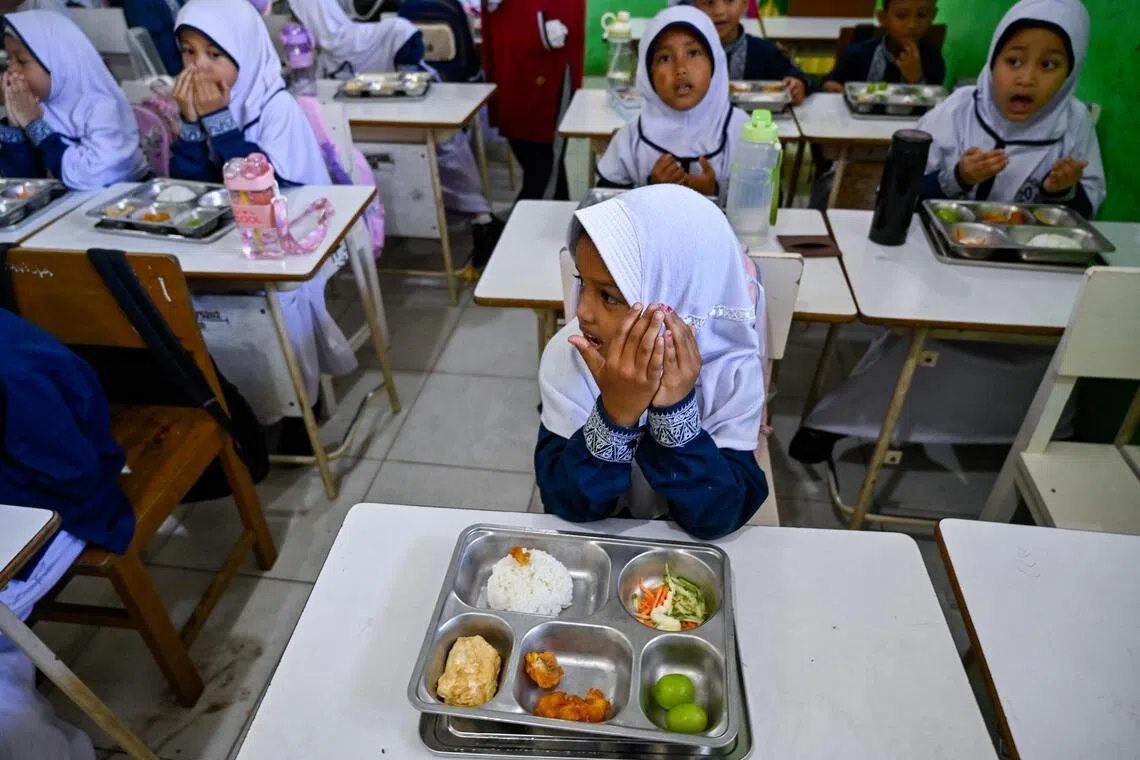
The key promise of Prabowo’s 2024 election campaign, the programme aims to address chronic malnutrition among children in Indonesia, where more than one in five suffering from stunting.
PHOTO: AFP
That closeness could prove valuable as she attempts to push through reforms in an organisation that has become both politically sensitive and operationally complex. But her appointment has also prompted questions about whether political trust is being prioritised over technical expertise.
Yanuar noted that Nanik’s background was more in politics and communications than nutrition, food safety or public health, while A’an said it remained unclear whether she has the managerial experience required to oversee one of Indonesia’s largest public programmes.
Others saw Nanik’s appointment as reflecting broader political considerations. “This programme has become a liability for Prabowo and his administration,” said Made.
He added that the administration appeared keen to draw a line under the scandal by removing Dadan and elevating a trusted insider to lead the agency.
Prabowo himself has largely framed the crisis as a leadership problem.
Speaking at an MBG event in Bogor, West Java, on June 3, he said he had received reports of irregularities and indications of misconduct within the agency, and argued that the quality of an organisation was ultimately shaped by the quality of its leaders.
“Good leaders make good organisations. Bad leaders make bad organisations,” he said.
But observers ST spoke to all cautioned that changing leaders would have limited impact if deeper weaknesses in governance and implementation were left unaddressed.
The programme’s underlying weaknesses would persist unless accompanied by broader reforms to oversight, governance and implementation, they said.
“When political programmes fail, you change the people. When nutritional programmes fail, you change the system,” said Yanuar.