 By Miltary.com | Created at 2026-08-19 15:40:41 | Updated at 2026-08-19 15:54:13
22 minutes ago
By Miltary.com | Created at 2026-08-19 15:40:41 | Updated at 2026-08-19 15:54:13
22 minutes ago
Seven months after President Donald Trump first predicted that Cuba would “fall” in comments shortly after the capture of Venezuelan strongman Nicolas Maduro in a U.S. military raid, the prospects that regime change is coming to Cuba soon are receding.
The island’s communist leaders remain firmly in control despite unprecedented U.S. pressure, and negotiations between Washington and Havana seem paralyzed. Cuba’s repressive apparatus is still standing, ensuring that the population, though enduring 20-hour-long blackouts daily and all kinds of shortages and misery, does not stage the sort of mass demonstrations that may trigger a U.S. intervention.
The protracted U.S. war with Iran and an earthquake in Venezuela have pulled resources and military assets away. Trump’s almost constant remarks about “taking Cuba” and Cuba “being next” have disappeared from his public appearances.
“I think the administration was ready to go in that direction, but Iran flared back up, and now the summer’s pretty much come and gone, and you haven’t seen the mass protests or uprisings that they were expecting,” said Brian Fonseca, vice provost for Defense and National Security Research at Florida International University. “I don’t think the White House is going to give up on it, but the expectation that people have that there’s going to be this big bang, a shock to the regime’s structure is probably not going to happen at this stage.”
In a recent interview, Secretary of State Marco Rubio, who has been leading the charge on Cuba policy, went out of his way to temper expectations that change in Cuba would come “overnight.”
Asked if Cuba was “next,” he replied: “I am confident that Cuba, by the time this administration’s over, before this administration ends, will be on an irreversible path towards a much different future.”
Rubio said the issue is “a priority” but cautioned that “you can’t have something in place for 70 years, it grows roots, and then think overnight you’re just going to rip out the whole thing and put something brand-new into the ground.
“There’s a transition that has to happen and a process to get there,” he added.
His comments have been received with disappointment and despair by Cuban Americans and Cubans on the island who believed they would see the end of the communist regime in Havana as soon as this summer.
In response to his comments, Cuban influencer Alexander Otaola, who believes Rubio’s Cuba agenda is being attacked by people with different interests close to Trump, is organizing a rally in Washington in October to press the administration to act decisively, using the hashtag #DoItTrumpDoIt to promote it. Other Cuban Americans have been warning on social media that the Cuban American community could turn on the Republican Party if Trump doesn’t act on his words about “freeing up Cuba.”
Managing expectations
“There is a mismatch of expectations. The White House has set the expectations high for changing Cuba,” Fonseca said. And that resulted not just from the prominent space Cuba took in public statements by the White House and the State Department, but in concrete steps such as ramping up intelligence surveillance flights around Cuba, sending the CIA director to Havana to negotiate with Cuban leaders, and indicting Cuba’s historic leader Raúl Castro.
U.S. officials have labeled Cuba a national security threat, and the State Department also published a report accusing Cuba of spying and sowing domestic discord by supporting far-left organizations in the United States, making the case for future retaliation. The administration has piled up sanctions against Cuban military companies, government entities and officials and even foreign companies. It has also blocked fuel sales to Cuba.
Still, since the administration began putting maximum pressure on the Cuban government to enact economic and political reforms, Rubio has been careful in managing expectations, stating that the administration was not expecting Cuba “to change from one day to the next. Everyone is mature and realistic here,” he said in a press conference in Saint Kitts in March, on the same day his team met with Castro’s grandson, Raúl Guillermo Rodríguez Castro.
“The problem is that his boss has no strategic discipline or patience, and he has animated that expectation in South Florida, with off-the-cuff remarks, and I think others have picked up on that,” said Michael Bustamente, a historian who is the Emilio Bacardí Moreau Chair in Cuban and Cuban-American Studies at the University of Miami. He notes that Trump’s statements have been amplified locally, by activists, influencers and local Republican politicians like U.S. Rep. Carlos Gimenez.
In Cuba, a recent online survey by news outlet El Toque found that 60% of the roughly 25,000 respondents living on the island were in favor of a U.S. military action to get rid of the communist government.
William Freeman, a fellow for Latin America Studies who leads a Cuba task force recently created by the Council on Foreign Relations, said he was struck by how much support he found for Trump’s pressure campaign among Cubans during a recent trip to the island.
“I wouldn’t say it wasn’t uncomplicated. Obviously, people said, ‘Look, this is painful, but we need something to change so desperately that it’s better to continue suffering this for another few months or a year or whatever it takes to bring about political change’,” Freeman said. “I don’t know if people would still feel that way if they see Trump mentioning Cuba less and less, if they hear the comments from Marco Rubio about how maybe this will last 2.5 years.”
Iran, midterm elections
But as the midterm elections in the U.S. approach and questions about what the Trump administration has achieved in Venezuela and Iran mount, Fonseca believes the president “is not going to give the secretary that much more leeway to do things. I don’t think the U.S. wants a major mess in Cuba on their hands right now.”
With polls showing some Republican candidates lagging and the state of the economy being a major issue, “I don’t see Republicans touching Cuba now,” said Ric Herrero, the executive president of the Washington-based Cuba Study Group. “The window opened and closed, and Cuba policy will likely be on autopilot as Rubio considers running for president.”
Herrero added that the administration’s bet on Castro’s grandson, Rodriguez Castro, as the Cuban version of Delcy Rodriguez, the Venezuelan vice president who became interim president with U.S. support, but U.S. officials came to realize his power is limited.
His grandfather, Raúl Castro, built a collective leadership model which resulted in “no one calling the shots because you need 10 people to agree on everything and you never get consensus.”
That the Cuba issue seems to have been put on the back burner is a familiar situation.
“This is the perennial challenge with Cuba policy. It’s always easy to shuffle it off because it’s a relatively small place and doesn’t seem that strategically important compared to others,” Bustamante said.
Doubling down on sanctions
Other observers have remained skeptical that the administration ever intended a swift military action in Cuba to bring about regime change. Among them is John Kavulich, president of the U.S. Cuba-Trade and Economic Council, who believes the administration is instead betting on a war of attrition through sanctions and is satisfied with the result. Several foreign companies, including Spanish hotel chains Melia and Iberostar and Canadian mining company Sherritt have suspended their operations in Cuba because of the U.S. sanctions.
Rubio recently told the Axios news site that sanctions will continue and that the administration wanted to teach Cuban leaders that this time there was “no escape.
“Every time they create a new mechanism in which they try to get out of the noose, we just close it off,” Rubio said. “They certainly can’t wait us out. Certainly this isn’t going to go away for the next 2½ years.”
But that strategy comes with its own risks too, including worsening the suffering of Cubans on the island, who had already been enduring years of the worst humanitarian crisis in the island’s recent history, and making the work of rebuilding the country a much more daunting task.
“It’ll make it much harder to build a stable and prosperous Cuba if you have two and a half more years of this kind of energy scarcity and state breakdown. Obviously, it’ll increase the humanitarian crisis and migration pressures,” Freeman said. “They’re playing with fire here to some extent.”
There is also no guarantee that the pressure will work, given Cuban leaders’ track record of resisting and surviving for more than 60 years.
“The White House has increased the pain; it has continued to slowly but persistently increase pressure on Cuba,” Fonseca said. “But again, Cuba has historically withstood an extraordinary amount of pain to survive by basically passing the pain to the population and then blaming the Americans for it.”
The pressure also has not resulted in an uprising, as some U.S. officials expected.
The country’s population is becoming older, and even if U.S. borders are closed to Cubans, the young, who are more likely to join demonstrations, will continue to emigrate to countries like Guyana and Brazil, Bustamante said. Those remaining on the island now openly criticize the government and its leaders on the streets and in the presence of neighbors, Freeman noted, but they know protesting would land them in prison.
“People were astonishingly willing to criticize the government in public,” Freeman said. “But I ask people, okay, if you feel that way, would you go out and join one of these daytime protests? And they said, ‘No, no, no. I mean, I will be found quickly.’”
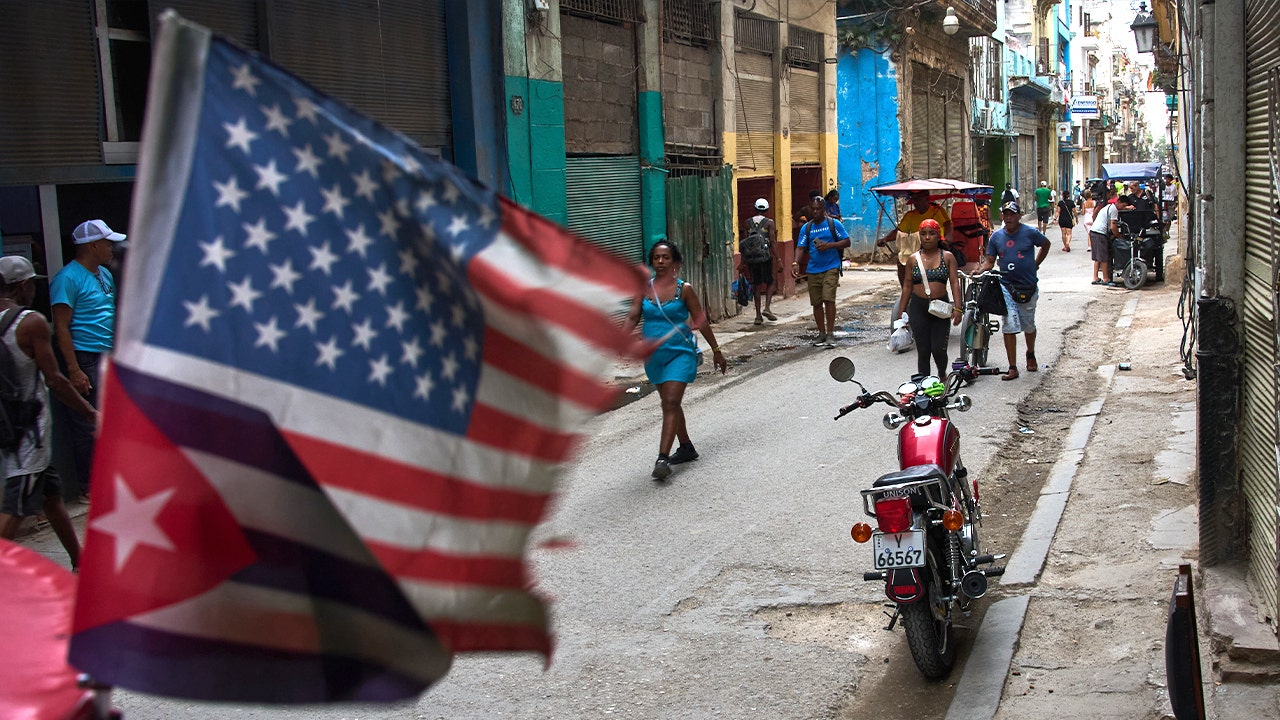
Videos coming out of Cuba show many are consumed by the daily struggle to survive, sleeping on improvised beds in the streets or on buildings’ roofs during the blackouts in the hot summer nights, taking water from broken street pipes after days with no running water and roaming the city to get a bottle of cooking oil for twice the average monthly salary.
“At what point does the misery become so awful that it’s actually a disincentive to go out and protest?” Bustamante said.
Kavulich believes that at some point, the situation is going to turn so awful that either Cuban leaders will be forced to change, or the United States will intervene.
“What will trigger the moment requiring the government of the Republic of Cuba to materially change, and what is the moment requiring the government of the United States to intervene?” Kavulich asked. “The moment will arrive in the form of a photograph … of an old woman lying dead on a pile of garbage on a street in the city of Havana.”
“This will be the trigger.”
_____
©2026 Miami Herald. Visit at miamiherald.com. Distributed by Tribune Content Agency, LLC.