By The Straits Times | Created at 2026-09-01 09:31:35 | Updated at 2026-09-05 06:09:59
3 days ago
By The Straits Times | Created at 2026-09-01 09:31:35 | Updated at 2026-09-05 06:09:59
3 days ago
BEIJING – Chinese President Xi Jinping is setting off on what is shaping up as his busiest travel schedule in more than seven years, partly in a bid to convince nations that Beijing offers better global leadership than the United States.
In September, Xi is visiting Kyrgyzstan and Egypt, and is widely expected to attend a BRICS summit hosted by Indian Prime Minister Narendra Modi.
When those visits are done, he is set for a late September stop in Washington, where he will meet President Donald Trump in a bid to keep the two nations’ trade truce in place.
The last time Xi was as active abroad was mid-2019, when he visited five countries, including North Korea. The current spurt of travel stands out because Xi has cut his foreign travel back in recent years, choosing instead to court foreign leaders in Beijing.
The travels come as China portrays itself as a predictable partner in trade and investment opportunities. That is an apparent contrast to the Trump administration, which is fighting a war with Iran, taking control of a major portion of Venezuela’s oil after seizing its leader, and angering old friends like Canada with trade disputes.
“This tour allows Xi to arrive in Washington after demonstrating that China has diplomatic breadth across Eurasia and the Global South,” said Zongyuan Zoe Liu, a senior fellow for China studies at the Council on Foreign Relations.
“In this sense, Xi would arrive in DC not just as one leader coming for a bilateral negotiation but as a show of having strength and options,” she said.
Xi is now in Bishkek, Kyrgyzstan, where in addition to meeting President Sadyr Japarov, he is also attending a meeting of the Shanghai Cooperation Organization (SCO).
Beijing sees the SCO as a valuable platform for putting forward its policies and building influence with a range of nations, especially in the Central Asia region once dominated by Moscow.
Besides meeting Modi in Bishkek, Xi will also sit down with Russia’s Vladimir Putin and Iranian President Masoud Pezeshkian, conversations that give him a chance to gain insight into the wars in Ukraine and Iran.
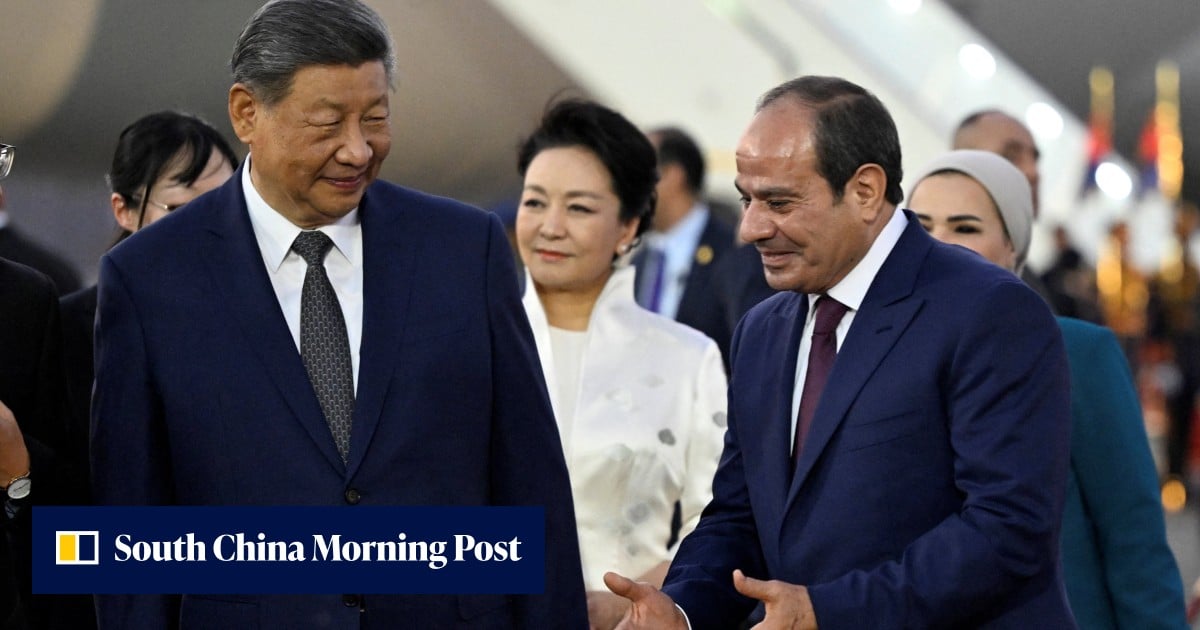
Xi’s travels underscore several of the key elements of what Beijing sometimes calls “Xiplomacy”. That approach places a strong emphasis on face-to-face meetings, developing ties with neighbouring countries and strong engagement with Global South countries like Egypt, Africa’s second-largest economy.
Selling China
When asked about Xi’s trips, Foreign Ministry spokesman Guo Jiakun said during a news briefing on Sept 1 that “head-of-state diplomacy represents the highest form of Chinese diplomacy”.
China wants to “expand practical cooperation across various fields” with the engagements, Guo added.
Xi’s travels in September will eventually take him to the White House for an expected meeting with Trump. That summit will give the leaders a chance to keep ties on track given that they seem to be tested nearly daily.
In the latest example, Treasury Secretary Scott Bessent said this week he would push Group of 20 nations to rethink their trade terms with China.
The crowded itinerary will also give Xi a chance to sell countries on China’s AI tech, which compares well with American options in performance at a fraction of the cost.
China wants nations around the world to use its models and buy AI processing power in the form of tokens, seeing it as a new source of income much like the EVs now hitting roads around the world and solar power tech have been.
Xi’s trip to Egypt comes as Huawei Technologies bids to build AI data centres for Cairo, demonstrating its global chip ambitions. The effort echoes the playbook Huawei used to become the world’s preeminent telecoms-equipment provider in that it represents a small initial project designed to gain a foothold in a key market.
Huawei’s plans drew alarm in the US, prompting Washington officials to start working on a counteroffer to Egypt.
“Clearly, both Washington and Beijing know that they cannot convince each other to use American or Chinese AI services and products, so the competition for AI business goes to the whole world,” said George Chen, a partner and chair of digital practice for The Asia Group, an advisory firm based in Washington.
“The two state heads, Xi and Trump, are now the top salesmen to promote their own country’s AI technology,” Chen added. BLOOMBERG