By CryptoSlate | Created at 2026-10-09 20:26:03 | Updated at 2026-10-09 21:47:19
1 hour ago
By CryptoSlate | Created at 2026-10-09 20:26:03 | Updated at 2026-10-09 21:47:19
1 hour ago
The XRP Ledger (XRPL) now lets institutions delegate account tasks while retaining control of their primary signing keys.
The PermissionDelegationV1_1 amendment went live on Oct. 8 at ledger 107,524,865. It lets account owners assign specific transaction permissions to other accounts.
The upgrade mirrors the division of responsibilities in traditional finance. Treasury departments, compliance officers and asset managers can operate under different levels of authority.
For example, a stablecoin issuer can let its compliance team approve counterparties while a separate account executes payments. Owners can modify or revoke delegated permissions without exposing their primary signing keys during routine operations.
Vet, an XRP Ledger Foundation contributor, said the change lets asset issuers and treasuries manage account responsibilities in a way familiar from traditional finance while protecting their primary keys.
The framework does not support custom spending limits or asset-specific delegation restrictions. XRPL developers also warn against delegating PaymentBurn until fixCleanup3_4_0 activates. A flaw can let authorized accounts mint issued tokens in certain circumstances.
XRPL's tokenized asset market expands
The controls arrive as XRPL's real-world asset market grows.
An Oct. 7 RWA Foundation snapshot puts XRPL's year-to-date growth in tokenized asset value at about $3.7 billion, excluding stablecoins. It leads BNB Chain's $3.5 billion, Stellar's $2.8 billion and Solana's $2.2 billion.
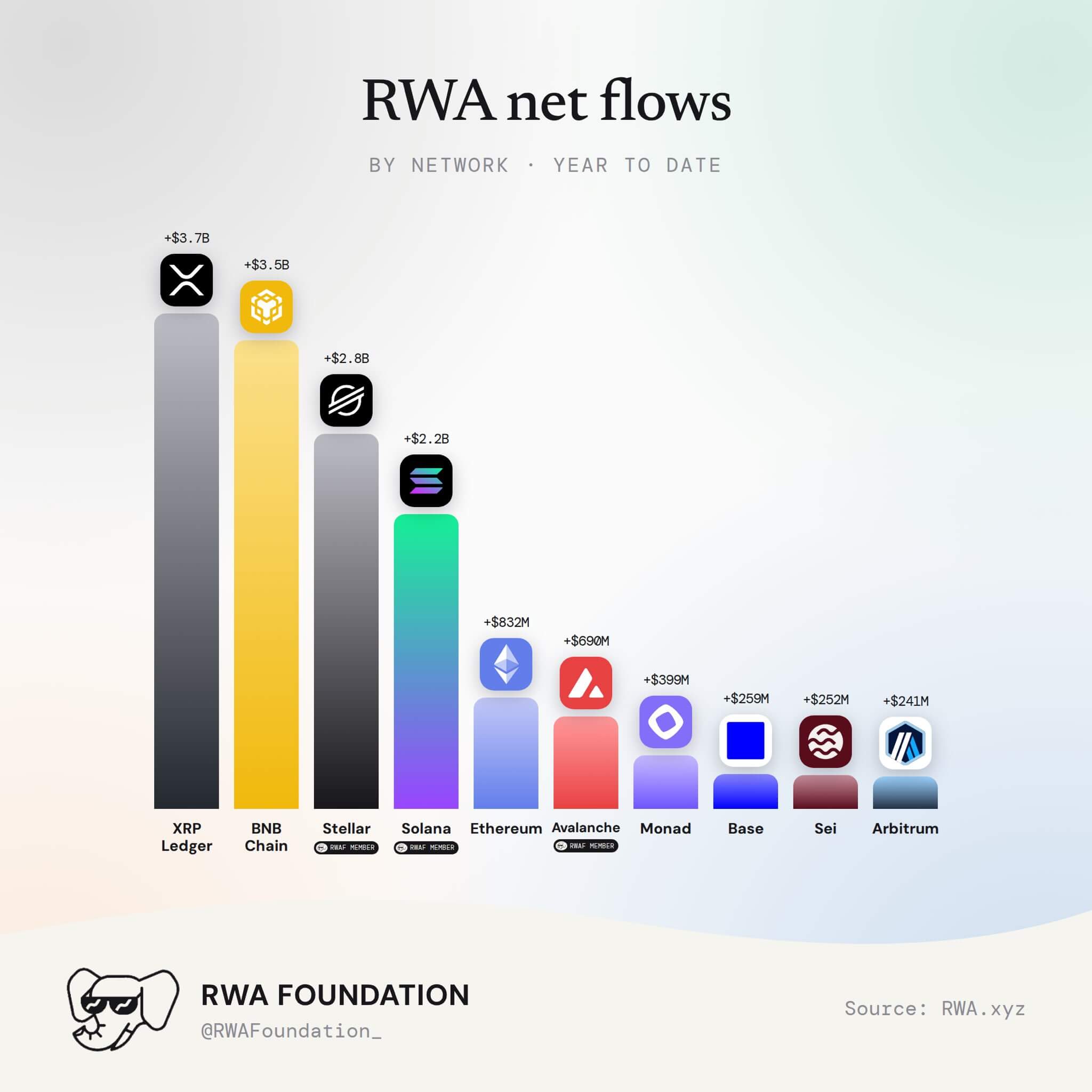 Year-to-date RWA net flows as of Oct. 7, 2026, excluding stablecoins. Source: RWA Foundation, using RWA.xyz data.
The four networks account for roughly $12.2 billion of the $14.9 billion recorded across the chart's 10 blockchains, highlighting competition for tokenization activity.
The figures track changes in tokenized asset value, including issuance, redemptions and valuations.
Meanwhile, RWA.xyz's Oct. 9 network table lists about $4.54 billion of represented real-world assets on XRPL and $499 million of distributed assets, excluding stablecoins. XRPL ranks 10th by distributed asset value.
Under RWA.xyz's definitions, represented assets use blockchain records but remain on the issuer's platform. Distributed assets can move between holders outside that platform, including through permissioned transfers.
In July, Aviva Investors launched a tokenized share class of its US Dollar Liquidity Fund on XRPL, following approval from the Central Bank of Ireland.
Eligible investors can access the fund through tokenized holdings. The share class retains the conventional fund's investment objective, liquidity characteristics and regulatory protections.
The launch involved institutional custodian Komainu and tokenization infrastructure provider Licuido, with the fund's underlying assets held by BNY Mellon.
Ripple subsequently announced investments in Licuido and transfer-agency technology provider ZILO. The investments expand its capabilities in digital asset issuance, fund administration and collateral management.
RippleX lays groundwork for round-the-clock collateral transfers
The next stage of XRPL's institutional infrastructure development focuses on using tokenized assets as collateral outside conventional banking hours.
In an Oct. 8 technical article, RippleX outlined five capabilities: Permission Delegation, Atomic Batch, Confidential Transfers, Dynamic Multi-Purpose Tokens and Sponsored Fees.
RippleX illustrated the idea with a hypothetical bank borrowing stablecoins against $50 million in tokenized money market funds on a Sunday evening.
The bank could pledge fund shares for stablecoins, with the collateral and payment settling together. Ripple has also positioned its RLUSD stablecoin as a cash leg for delivery-versus-payment settlement.
Atomic Batch is now live: BatchV1_1 activated on Oct. 9 at ledger 107,540,993. Its all-or-nothing mode lets linked transfers succeed together or revert together.
Confidential Transfers would hide Multi-Purpose Token transfer amounts while giving selected parties, including auditors and regulators, access to the information.
Dynamic Multi-Purpose Tokens would let issuers update designated token properties as financial instruments change. Sponsored Fees would let third parties cover charges and reserves for institutions unable to hold XRP directly.
RippleX says the combination could move tokenized assets into secured financing and liquidity management.
Permission Delegation and Atomic Batch are live, while ConfidentialTransfer, DynamicMPT and Sponsor still await validator approval. Those remaining upgrades would supply the privacy, token-update and fee-sponsorship components of RippleX's plan.