 By The Epoch Times | Created at 2026-10-03 11:12:10 | Updated at 2026-10-03 11:51:40
51 minutes ago
By The Epoch Times | Created at 2026-10-03 11:12:10 | Updated at 2026-10-03 11:51:40
51 minutes ago
WASHINGTON—National attention is turning to elections that will shape the last two years of President Donald Trump’s final term.
Republicans’ majority in both the House and the Senate is at stake in November. Voters will also weigh in on key gubernatorial races.
Opinion polling suggests the economy dominates Americans’ thinking as Election Day—Nov. 3—looms just a month away. Surveys have also found that voters are concerned about the state of the U.S. government, data centers, the Iran War, and immigration, among other issues.
Republicans currently control the lower chamber, with 218 seats to Democrats’ 214 seats. Despite GOP victories during this cycle’s redistricting war, Democrats are widely expected to reclaim the House amid declining approval ratings for the Trump administration.
In the Senate, Republicans were long expected to retain their 53-seat majority. However, with Republicans slipping in the polls across key states like Maine, North Carolina, Georgia, and Texas, Democrats are within reach of reclaiming the upper chamber.
This year will also see critical gubernatorial elections, with Republicans entering the election controlling 26 governors’ mansions to Democrats’ 24. Close races are expected in Ohio, Kansas, Michigan, Iowa, Georgia, and New Hampshire, among other states.
Though polling suggests Republicans face some headwinds, Austin Hein—a Republican strategist working on Bo French’s campaign for the Railroad Commission of Texas—was skeptical that they tell the whole story.
Those surveys “always underestimate Republican voters,” he told The Epoch Times. “I believe that a lot of the doom and gloom narrative is overstated.”
Here are six things to know about the midterms one month out.
Top Issues
Polling shows that Americans’ top concern is the economy, and by a wide margin.
Pew Research found that economic issues have been the driving political force this cycle for 29 percent of Americans. That aligns with data from Gallup and other pollsters.
The most recent Consumer Price Index report from the Bureau of Labor Statistics shows that annual inflation in the United States is 3.4 percent for all items.
That includes a roughly 25 percent increase in gasoline costs over the past year—a surge driven largely by the Iran War, which disrupted the global oil supply chain. Food price inflation sits around 3 percent.

Gas prices in Los Angeles on Sept. 29, 2026. John Fredricks/The Epoch Times
“Voters are frustrated with gas prices, cost of living, inflation, and are looking for change,” said Nicholas Gonzales of the nonpartisan campaign analysis platform Inside Elections.
He told The Epoch Times that similar concerns drove the Republican victory in 2024.
Morgan Jackson, a Democrat advising former Gov. Roy Cooper in his Senate run, chalked up Democrats’ 2024 losses to the fact that his party “would not talk about the economy.”
“This cycle, you see Republicans caught in this place where they are only talking about crime and immigration, trans and other culture and social issues, when all voters want to hear from people is, ‘How are you going to make my life better?’” he said.
Hein said that while “the economy is not where we want it to be … this is still a bit of a Biden economy hangover.”
The Iran war has divided Americans, with polls from The Associated Press, The Economist, and other sources showing that most Americans disagree with how Trump has handled Iran, with roughly one-third or fewer respondents backing the administration.
Hein said that Republicans “have confidence in the Trump administration that this is not going to be another forever war.”
Another major concern for Americans, according to Pew Research, is government ethics and reform, with 9 percent labeling this a top priority.
Meanwhile, 7 percent of Americans described immigration as a top issue. Healthcare, foreign policy, and Trump each polled at around 5 percent.
A recent poll by Emerson College identified the same top-line issues, with economic worries leading the pack, followed by concerns about threats to democracy in the United States.
Data centers and artificial intelligence (AI) are also key priorities for voters as the primary season comes to a close.
House Races
Polls also suggest that House Speaker Mike Johnson (R-La.) faces a tough fight to keep his gavel in 2027.
Two years ago, with Trump at the top of the ticket, Republicans led the national House ballot by 2.6 percent.
However, without Trump to drive low-propensity, Republican-leaning voters to the polls, the GOP has found itself in a more challenging electoral environment—though the party’s victories in the mid-decade redistricting battles could soften the impact.

House Speaker Mike Johnson (R-La.) speaks during the second day of the 2026 Republican Midterm Convention in Dallas on Sept. 10, 2026. Madalina Kilroy/The Epoch Times
In RealClearPolitics’ aggregate of generic ballot polls, Democrats lead by 8.3 percent.
If the November vote swings in line with that data—representing a roughly 10.9 percent shift toward Democrats—Republicans may have to cope with some unexpected losses.
“Democrats have the best opportunity to take the House,” said Gonzales, predicting they would gain between 7 and 15 seats—enough to narrowly control the chamber.
Johnson has expressed confidence that Republicans will retain the lower chamber.
“We’re going to hold this House majority, because the American people understand the stakes of this, and they understand this really is a contrast election,” Johnson said.
Republicans have emphasized victories by some candidates aligned with the Democratic Socialists of America in House, Senate, and gubernatorial primaries, saying that they show that the Democratic Party is moving too far to the left for the American people.
Democrats, meanwhile, have highlighted what they call Republican failures on the economy, foreign policy, and other issues.
Swing districts in Wisconsin, Texas, California, Ohio, Pennsylvania, New York, and other states will help decide whether a Democrat—most likely House Minority Leader Hakeem Jeffries (D-N.Y.)—takes the gavel from Johnson.
Senate Races
Republicans will enter November controlling 53 seats in the Senate to Democrats’ 47.
Democrats would need to flip a minimum of four seats to unseat Senate Majority Leader John Thune (R-S.D.). Battlegrounds such as Ohio, Maine, and Alaska have long been at the center of that fight.
Yet, over recent months, the battlegrounds have expanded, generally, though not entirely, into GOP-leaning territory, including Kansas, Nebraska, Iowa, and Texas.
Observers have steadily raised the party’s odds of reclaiming the upper chamber as polling continues to show a strong lead for Democrats in some crucial races.
In Georgia, Sen. Jon Ossoff (D-Ga.) leads Rep. Mike Collins (R-Ga.) by around 7 percent, on average, in polls. Similarly, in nearby North Carolina, Cooper, the Democratic former governor, leads by nearly 10 percent against former Republican National Committee Chairman Michael Whatley.
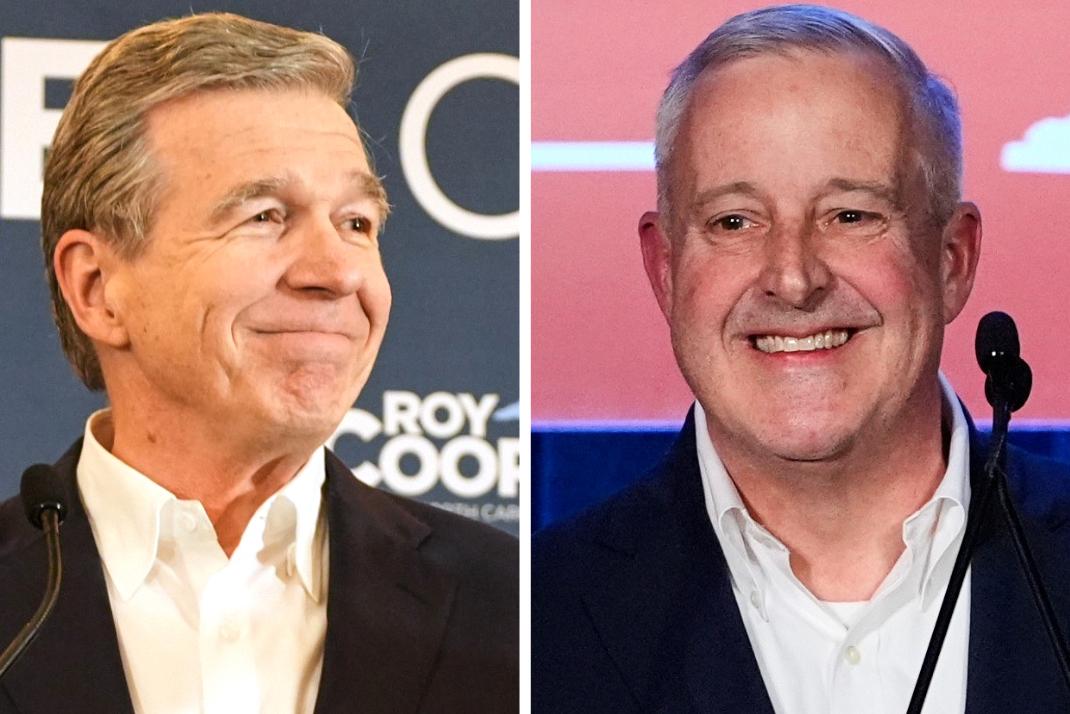
North Carolina Democratic Senate candidate former Gov. Roy Cooper (L) and Republican candidate former RNC Chairman Michael Whatley speak at separate primary election night watch parties in Raleigh and Charlotte, N.C., on March 3, 2026. Matt Ramey, Erik Verduzco/AP Photo
Jackson, Cooper’s advisor, said the candidate benefits from being widely known in the state and campaigning on kitchen table issues.
Meanwhile, Republicans have narrowed the race in New Hampshire—where Chris Sununu, brother to the state’s popular former governor, is running—and are holding on in Michigan and Maine.
Governors
Governors’ races tend to be more isolated from national politics. This year, however, some of the same trends are emerging even as Republicans prepare to enter the midterms with a slight edge.
In several contests this year, data centers have emerged as a top issue for voters as some Americans contest their arrival in local communities citing concerns about rising energy costs, water usage, and other issues. Governors often play a strong role in facilitating those hubs, which Trump has described as critical to the United States’ AI-driven reindustrialization effort and national security amid a technological race with China.
Some key races are in Wisconsin, Michigan, Maine, Iowa, Georgia, Ohio, and Nevada.
Democrats lead polls in Wisconsin, Michigan, and Iowa.
The races in Georgia and Ohio are toss-ups, with both parties leading or tied in some polls.
Recently, Republicans have faced warning signs in Texas, where Gov. Greg Abbott is facing a tough challenge from Democrat Gina Hinojosa.

Texas Gov. Greg Abbott speaks onstage on the second day of the 2026 Republican National Convention in Dallas on Sept. 10, 2026. Alex Wong/Getty Images
A loss in that race would mark a major shift for Texas Republicans.
Hein said that the Texas governor race isn’t seriously vulnerable—but warned that “we should take the threat seriously.”
Big Spending
The midterms have been marked by heavy spending on both sides, particularly in the most contested Senate and House races.
Some races are on track to be among the most expensive in history.
The contest between Texas Attorney General Ken Paxton and Texas state Rep. James Talarico is shaping up to be among the costliest. That comes on the heels of a historically expensive Republican primary between Paxton and Sen. John Cornyn (R-Texas).
In the final months, after relatively little spending, Republicans have opened the floodgates.
Trump announced in early September that his Super PAC, MAGA Inc., will spend up to $500 million in the midterms.
Democrats, though not entirely overawed, have dealt with some financial struggles this cycle. As of late June, the Democratic National Committee had more than $2 million in debt, according to federal campaign records.
Hein predicted additional significant financial support for Paxton as the election nears, saying Paxton’s team and Republicans more generally have “saved their ammunition and kept the powder dry.”
Gonzales described the spending from the GOP and its allies as “one of the only things Republicans have going for them right now.”

Texas State Rep. James Talarico speaks to supporters in Round Rock, Texas, on March 3, 2026. Nathan Worcester/The Epoch Times
Jackson said, “There is no question in my mind that Republicans will win some races out there that they shouldn’t, given this environment, because of their financial advantage.”
In North Carolina, however, the GOP may be cutting its losses. The Senate Leadership Fund, which backs Republican Senate candidates, has paused its spending in the race.
Key Questions
While many polls look bad for the GOP, insiders say that key questions remain unanswered that will determine the outcome on Election Day.
“One of the key questions is, can Republicans motivate the base?” said Gonzales.

President Donald Trump speaks during a rally at the Gastonia Municipal Airport in Gastonia, N.C., on Sept. 16, 2026. Travis Gillmore/The Epoch Times
Jackson said he could see Democrats winning in a wave election similar to 2006 or, for Republicans, 1994.
He, too, described Republican motivation as a key variable, saying that enthusiasm for the GOP often increases in October.
“That will determine how big this wave is,” he said of that possible uptick in support.
Trump has been rallying around the country in an effort to spark that enthusiasm.
Gonzales wondered about the potential impact of significant Republican spending in October.
“The question is whether it’s going to be enough,” he said.