 By The Epoch Times | Created at 2026-07-28 21:31:54 | Updated at 2026-07-28 22:15:53
51 minutes ago
By The Epoch Times | Created at 2026-07-28 21:31:54 | Updated at 2026-07-28 22:15:53
51 minutes ago
A special screening of the documentary “A Chip Odyssey” was held on July 24 in Saratoga, a city in California’s Silicon Valley.
Directed by Hsiao Chu-chen and produced by CNEX Studio Corporation, “A Chip Odyssey” places the development of Taiwan’s semiconductor industry within the broader context of Taiwan’s political evolution and changing international environment. Through interviews with engineers, scientists, policymakers, business leaders, and factory workers, the documentary recounts the industry’s transformation from its beginnings in the 1970s to its present-day global prominence.
“This is the story of a half-century gamble undertaken by three generations for Taiwan’s survival,” producer Ben Tsiang told The Epoch Times at the event.
The screening was jointly organized by the Taipei Economic and Cultural Office (TECO) in San Francisco and the Northern California Chapter of the Global Federation of Chinese Business Women.
Tsiang is the co-founder and chairman of CNEX. He said that the idea for the documentary originated after he attended a memorial service for one of Taiwan’s semiconductor pioneers. He saw that the generation that laid the foundation for Taiwan’s semiconductor industry was gradually passing away, and he felt an urgency to preserve those people’s stories for future generations.
Later, he learned that director Hsiao had been considering a similar project. The two of them decided to collaborate on the film.
The documentary begins by revisiting the years following the Chinese Civil War. After the Chinese Communist Party (CCP) seized power in mainland China in 1949, the government of the Republic of China relocated to Taiwan. Facing limited natural resources, diplomatic uncertainty, and ongoing military tensions across the Taiwan Strait, Taiwan began searching for a new path toward security and economic development.
The first generation portrayed in “A Chip Odyssey” includes engineers, educators, and government officials who believed Taiwan’s future depended on cultivating scientific talent and building advanced technology industries. Through government-sponsored training programs in the United States and close cooperation between academia and industry, they laid the foundation for what would eventually become Taiwan’s world-leading semiconductor sector.
The documentary then shifts to the second generation, whose careers unfolded after Taiwan lost its seat at the United Nations in 1971 and as Taiwan became increasingly isolated diplomatically. The film describes how even as more countries established diplomatic relations with Beijing, researchers and industrial planners remained committed to strengthening Taiwan’s economy and international standing through technological innovation.
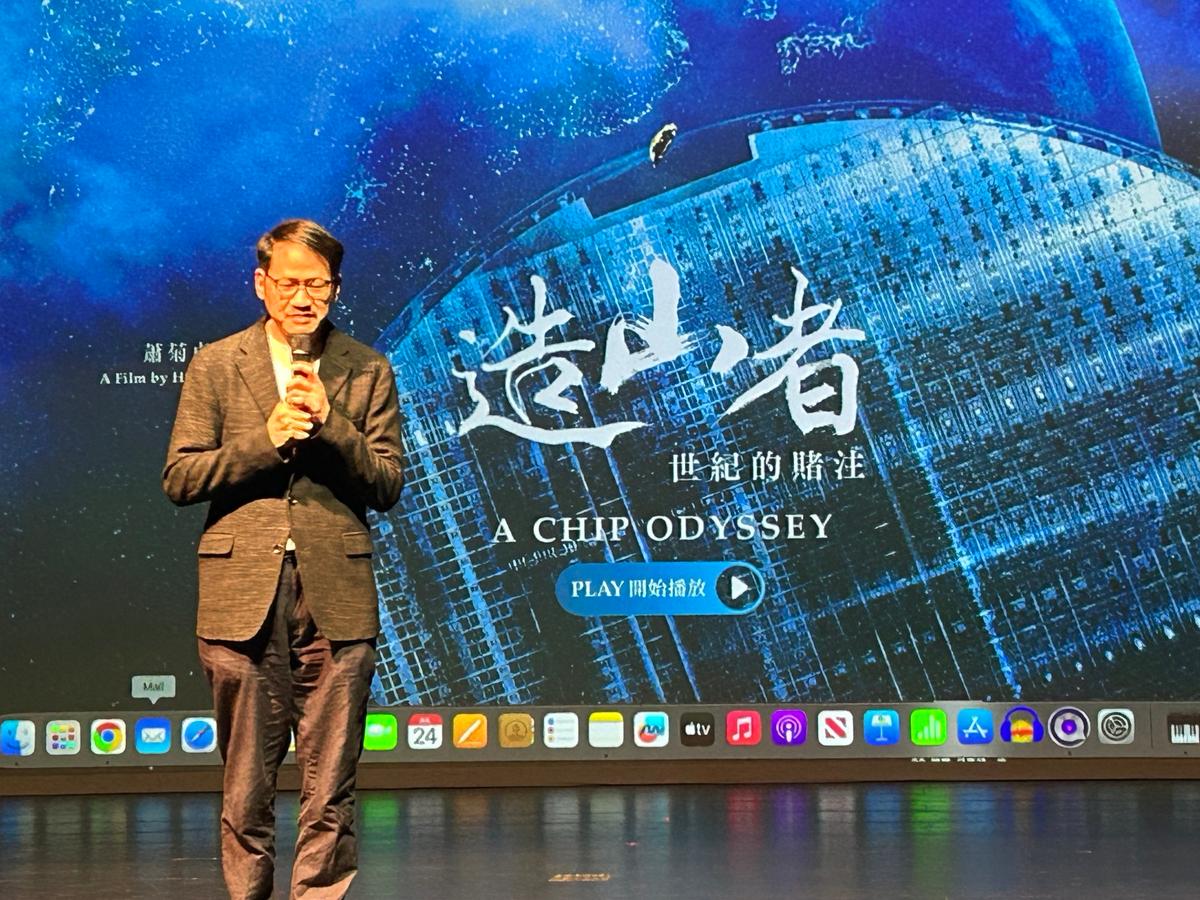
“A Chip Odyssey” producer Ben Tsiang speaks to the audience at the film screening in Saratoga, Calif., on July 24, 2026. Nathan Su/The Epoch Times
During the audience discussion following the screening, Tsiang said many of the first-generation engineers who returned to Taiwan from the United States gave up salaries that were more than three times higher than what they could earn in Taiwan. Some senior executives even worked without pay, volunteering their expertise to help build Taiwan’s future.
Their sacrifices, he said, made possible Taiwan’s economic success and its globally significant position in the semiconductor industry today.
Tsiang said few people in Taiwan at the time could have imagined that its semiconductor industry would one day become a cornerstone of the global economy. The documentary chronicles more than five decades of sustained efforts by both the government and the private sector to make semiconductor development a national strategy for Taiwan’s survival, growth, and future amid a rapidly changing international political landscape.
Throughout the film, archived footage is interwoven with personal recollections to connect major historical events with individual experiences. Factory workers recall the demanding production schedules of the industry’s early years, researchers describe the challenges of developing advanced technologies with limited resources, and business executives and policymakers reflect on the key decisions that shaped Taiwan’s semiconductor ecosystem over several decades.
TECO San Francisco Director-General Wu Chih-hsiang told The Epoch Times that this was the third time he had watched the documentary. What moved him most, he said, was the patriotism demonstrated by generations of Taiwanese people.
He also said he was pleased to see Taiwan working together with the United States to build a non-red supply chain capable of countering threats posed by the CCP to the free world.
Judy Lo, president of the Northern California Chapter of the Global Federation of Chinese Business Women, told The Epoch Times that when she came to the United States from Taiwan to study in the late 1990s, Thailand was far better known internationally than Taiwan. Whenever she told people she was from Taiwan, they often mistakenly assumed she meant Thailand.
Seeing Taiwan’s international standing today, she said, made watching the documentary an especially emotional experience.
Milpitas Mayor Carmen Montano told The Epoch Times after the screening that she hopes her city will have more opportunities to strengthen cooperation with Taiwan in ways that benefit both sides.
Pamela Wu, chief of staff to Santa Clara County Supervisor Otto Lee, told The Epoch Times that she immigrated to the United States from Taiwan at age 15 and has lived in America for more than 30 years. Both her husband and her mother participated in building Taiwan’s semiconductor industry, making the documentary “deeply moving” for her, she said.
She said the film illustrates Taiwan society’s vision for the future, its shared sense of purpose, and its determination to achieve long-term success.