By Literary Hub | Created at 2026-10-06 12:32:36 | Updated at 2026-10-06 20:05:57
10 hours ago
By Literary Hub | Created at 2026-10-06 12:32:36 | Updated at 2026-10-06 20:05:57
10 hours ago
Despite being a book that revolves around a cryonically-frozen (dead) father being transported two thousand miles in the back of a U-haul, Adam Wilson’s Fail Sons is laugh-out-loud funny. It might be aimed at a certain subset of readers—it helps if you know which unremarkable Pavement B-side became a viral TikTok hit—but it’s ultimately a story about being someone’s child and someone’s sibling and someone’s parent. Relatable! And also what’s it like to be a stressed-out person in this ridiculous country at this ridiculous time. At a svelte 224 pages, it’s Wilson’s tightest, funniest, most moving novel yet.
Article continues after advertisement
Critics and Wilson himself refer to Fail Sons as a “midlife-crisis” novel, which makes me feel older than I thought I was. But that’s neither here nor there. What’s here: I asked Wilson some pertinent questions over email as the September days grew chillier. We discussed the vulnerability of writing about aging bodies, Knicks fever, and how much Stanley Elkin is too much Stanley Elkin, among other hot topics. Our exchange has been condensed and edited for length.
*
Sam Axelrod: The bulk of Fail Sons is a cross country trip from Arizona to the East Coast. That’s a lot of geography to cover. What was your research process like? Did you leave the house or was it all from the comforts of your desk?
Adam Wilson: The initial inspiration was a road trip from Los Angeles to Denver that my wife (then girlfriend) and I took in 2014. I also spent a month at a residency in Woody Creek, Colorado the following year. I’d never been to Arizona, Utah or Colorado before, and the project began as a repository for my observations about those places, most of which were, like, whoa, what a beautiful landscape, who knew? (Many people knew.) I started writing it right after my first son was born. The plan was always to go back and retrace the route once I was farther along in the manuscript, but then the pandemic hit, and then I had another kid, and it became unfeasible. Thankfully, the internet exists. My copy editor, Sarah Lyn Rogers, was also a HUGE help with the geography, much of which I got wrong. One thing worth noting, is that my other books have all been set in places I’ve lived, and I wrote them with a local’s authority. Here, I was cognizant of writing as an outsider. The narrator, Scott, views everything from behind a car window, not from inside a community. I think there’s something interesting about looking at a place through a visitor’s eyes, though of course I worry that anyone local to the book’s various settings will only see my mistakes, just as I’m constantly complaining about bad Boston accents in Hollywood films.
SA: Because of the, shall we say, political situation in this country, as well as the pandemic, 2019 is very different from 2020, is very different from 2021, and so on. How’d you decide to set the book in the summer of 2022?
AW: I wanted the pandemic to be far enough in the rearview that it’s no longer the central event of the character’s lives, but recent enough that they’re still feeling its reverberations. In thinking about my coastal elites traveling across America, it was a useful source of animating tension to have a character—Scott’s brother, Nick—who’s still very anxious about getting Covid. It started off as a joke—it’ll be funny if this guy wears a KN95 in a red-state Walmart—but I ended up getting more mileage out of it, plot-wise, than I thought I would. The pandemic screwed up everyone’s lives in different ways. Single people had very different pandemics than married people, and married people with no kids had very different pandemics than married people with kids, and that doesn’t even account for divorced people, or stepparents, or hospital workers, or people with serious medical conditions, etc. I wanted to capture something of that chasm in the novel. The pandemic has shaped both brothers’ lives, but in such vastly different ways that they find it nearly impossible to relate to one another.
SA: This novel is told in a more fragmented way than your previous ones. There’s a lot of white space on the page. Among other things, this makes for a particularly propulsive read. How’d you settle on this form?
AW: I really love Mary Robison’s Why Did I Ever, and I wanted to model the book after its structure. This didn’t end up happening—Fail Sons is much more linear, for one—but the white space allowed me to jump back and forth between the novel’s present and scenes from Scott’s past without my having to expend a lot of verbiage on transitions. It also accommodated short scenes. One thing I love that Robison does is set up a joke, but then end the section before offering the punchline. The result is that her whole novel is colored by a sense of irresolution. I was trying to achieve a similar effect.
I find plot difficult, but I enjoy the challenge, and I find satisfaction in tweaking the narrative beats.
SA: Allow me to oversimplify. Your first novel, Flatscreen, could be considered your least high-concept book. Your next novel, Sensation Machines, is your most high-concept. The new one settles nicely in the middle. (Feel free to disagree!) Not that any of these are evaluative, but it feels like you found a sweet spot here. As someone who’s clearly invested in the art of the sentence, have you felt pressure to inject plot into your books?
AW: The book you didn’t mention is my story collection, What’s Important Is Feeling, which is decidedly low concept compared to all three novels. I think a novel needs a bigger engine in order to sustain a reader’s interest for two or three hundred pages. A writer’s interest too, or at least mine. I find plot difficult, but I enjoy the challenge, and I find satisfaction in tweaking the narrative beats.
But I’m not sure plot and “concept” are necessarily as connected as you suggest. There are plenty of high concept books that are light on plot. In fact, I think a lot of experimental writing might be described that way. Kafka is a high-concept writer, but I wouldn’t call The Trial plotty. I’ve never read William Gass’s The Tunnel, but I might if it sounded like it had anything resembling a plot! There are also plotty, low-concept books. A writer like Thomas Hardy comes to mind, or John Irving, for a more contemporary example. Their novels are filled with narrative twists and turns, but I wouldn’t say they’re high concept.
One mistake I’ve made—at least in terms of my wallet—is that despite publishing high concept novels, I keep writing screenplays that are low-concept to the point of being basically un-pitchable. I’ve learned that “it’s well-written” is just about the most backhanded compliment you can get in Hollywood. Why do I keep doing this? I have no idea beyond my tendency to self-sabotage. I guess it’s also because I like talky, indie films where nothing happens beyond sex and conversation. Eric Rohmer films, there’s not even sex, just innuendo and conversation! Though everyone in his films has really nice clothes, which might make up for the lack of sex.
SA: Speaking of film—There’s a ton of strong interiority in Fail Sons. We’re very much in Scott’s mind. Yet I can also envision the movie version pretty easily. It’s got it all: road trip, sex, drugs. Dead body, high stakes. Did you ever consider writing this as a screenplay? And/or have you thought about adapting this one?
AW: I would love to adapt it if someone was excited about trying to make it into a film, but I definitely conceived it as a novel, albeit one with a lot of dialogue. One of its main mechanisms for comedy is the juxtaposition between the relative nuance of Scott’s inner monologue, and the dumb shit he says out loud. In a screenplay, you’d only get the dumb shit, and you’d have to figure out some other way of representing Scott’s depth and soulfulness. Definitely a challenge I’d be willing to take on, but a challenge nonetheless.
SA: There’s a fair amount of urination in the book, among other bodily functions. Scott has some pretty unpleasant bladder issues, and we see him standing over and sitting on the toilet more than a few times. Many writers pretend their characters don’t have excretion lives, so it’s refreshing to see this depicted at length (though also painful at times). How did you decide to incorporate this thread into the book, and did you get any pushback from your editor or early readers?
AW: The only thing I really got pushback on was the amount of Stanley Elkin references that the average reader might tolerate, which turned out to be considerably fewer than I’d hoped. The final version actually has more peeing than any previous drafts. It was always a thread, but I wanted to make sure it didn’t feel like a joke, and that I captured some real truth about Scott’s experiences with urologists and in pelvic floor PT. I also wanted the breakdown of Scott’s own middle-aged body to run parallel to the decaying corpse in the back of the U-Haul.
When men do write about their bodies, it’s either heart problems or erectile dysfunction, and I wanted to do something different. There are so many other ways our bodies can fail us beyond just heart attacks and flaccid penises!
In many senses this is a novel about human bodies falling apart, and what it means to reckon with that inevitability. There are so many books by women that explore this subject, and I think it’s one that men tend to shy away from, maybe because it’s such a vulnerable thing to write about, even in fiction. I’ve seen whole college classes called, like, “Writing the Body,” in which there’s not a single cis male writer on the syllabus. When men do write about their bodies, it’s either heart problems or erectile dysfunction, and I wanted to do something different. There are so many other ways our bodies can fail us beyond just heart attacks and flaccid penises!
SA: Scott’s wife is more than eight months pregnant during the novel’s action. You have two sons, and I imagine there must be a big dividing line for you: before kids and after kids. This novel is very much an on-the-cusp-of-fatherhood story. What was it like getting back into that child-free mindset?
AW: It generally takes me about five to ten years to process an experience to the point that I can begin to synthesize it into fiction, which probably corresponds to the number of years of therapy I’ve spent talking about it. When I was writing Fail Sons, I was still coming to terms with the fact that this dramatic life change had happened. My oldest son is eight, and I’ve only very recently started trying to figure out how to take all I’ve experienced over the last eight years and use that as grist for the fictional mill. Part of it is that there have been a lot of books about Brooklyn dads. Or maybe there haven’t? I don’t actually know. But I want to find a way to write about parenting that feels fresh and unfamiliar, while simultaneously capturing some profound truth about millennial parenting writ large—not easy! All that said, while Scott isn’t yet a parent, Nick is, and though he isn’t the narrator, I don’t think I could have written his character if I didn’t have kids.
SA: Similarly, I know you’re a Celtics fan. Your narrator is a Knicks fan. How did you inhabit such a radically different perspective?
AW: I’d never write a Yankees fan—it would be too hard to empathize. But I admittedly got into the Knicks this past year. I was reluctant at first because my kids are born and bred New Yorkers, and the only Boston team I’d successfully managed to get them to root for was the Celtics. My oldest son even roots for the Yankees! He also roots for the hated rivals of the English soccer team that my British father (who wrote a great book about soccer) passionately supports, so there may be something Freudian at work there. Anyway, I worried that he’d defect as soon as the Celtics were knocked out of the playoffs and the Knicks remained in, and I was correct. But I’m currently mad at the Celtics for trading Jaylen Brown, and the Knicks are such a likable team. I’ve lived in New York for twenty years, and it was thrilling to see the city come alive like it did during the playoffs, and to experience that with my kids. The night they won, we were hosting a sleepover for my older son’s eighth birthday, so our apartment was filled with second grade boys up way past their bedtimes and wildly sugar high—fun stuff!
________________________________________________
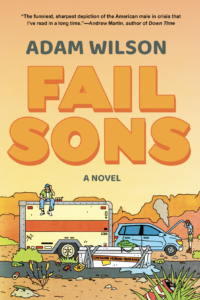
Fail Sons by Adam Wilson is available via Soho Press.