By Literary Hub | Created at 2026-10-06 12:32:34 | Updated at 2026-10-06 18:00:02
8 hours ago
By Literary Hub | Created at 2026-10-06 12:32:34 | Updated at 2026-10-06 18:00:02
8 hours ago
Many readers are perplexed by Austen’s habit of indicating men’s fortunes in terms of annual income, while women’s fortunes are expressed as a lump sum. Mr. Darcy has an estate of £10,000 per annum, for example, while Emma Woodhouse has £30,000 to her name. Among the landed gentry, men’s fortunes were usually put to work on an estate, and their capital was not liquid. Just as in earlier feudal society, their income was based on the crops and rents that their land could generate. Females with dowries, meanwhile, generally had little control over their money, and the capital was invested, often in government bonds. During the time Austen was writing, many men and women with funds but no landed estate would invest them in naval bonds, which averaged 4%-6% interest per year during the Napoleonic wars, depending on naval success. (Austen called them “the Navy fives” when that was their expected rate of return.)
Article continues after advertisement
*
Those of us outside Great Britain struggle to understand even the basics of British currency before it was decimalized. In Austen’s time, the units were guineas, pounds, crowns, shillings, and pence (or pennies). Most of these had a fixed ratio: 1 pound sterling (£) = 4 silver crowns = 20 shillings (s.) = 240 pence (d.). Pence were further subdivided: A single penny (1d.) = 2 halfpennies = 4 farthings. Farthings were the smallest unit of money, amounting to one-quarter of a penny. There were thus 960 farthings in a pound. A crown was worth 5 shillings, or one-quarter of a pound. Confusingly, guineas were worth slightly more than pounds, in Austen’s time around 21 shillings. The value of guineas was based on the cost of gold relative to silver. Austen uses most of these terms in her novels, so much nuance is lost without knowing their relative worth.
It’s important to note that the economy of Austen’s day differed so much from ours that it is impossible to translate their annual income directly to modern purchasing power.
Banknotes could be written for any amount and were similar to, but much less uniform than, today’s paper money. Regency banknotes were essentially promissory notes underwritten by a specific bank. If a bank grew insolvent, the paper notes were worthless. Unfortunately, Austen experienced this firsthand when her brother Henry’s bank failed in 1816, causing heavy losses for his family.
We twenty-first-century readers also have a more difficulty in understanding the relative worth of money in Austen’s period. The million-dollar question among today’s readers is always Darcy’s worth in today’s currencies. And while we can’t assess the value of his estate itself, the annual income of £10,000 in today’s US dollars would be equivalent to about 75-225 times its face value, depending on how you estimate inflation. We will use the conversion rate of 150 for simplicity, which would mean Darcy’s annual liquid income was approximately $1,500,000. Yet it’s important to note that the economy of Austen’s day differed so much from ours that it is impossible to translate their annual income directly to modern purchasing power, partly because our non-agrarian society has such different purchasing needs.
For landed gentry, produce and labor were relatively cheap, while transportation and the upkeep of horses, for example, were very expensive. Hiring a workman to install shelves or fix a clock cost George and Cassandra Austen about 4 shillings per day in 1795, based on an account book still in existence; it cost them 16 shillings to hire three gardeners for three days. Hiring a skilled workman for a full year would cost £60, including the merchant’s cut. The annual salary for a housemaid was approximately £25 plus room and board, while that of a male household servant was £30 plus room and board. Astonishingly, a servant’s wages amounted to only $3,750 to $4,500 per year. For another material example, George Austen bought the mahogany writing slope that he gave to Jane (now housed in the British Library) for 12 shillings in 1794 ($90).
Amounts can be particularly confusing if one reads Austen’s teenage writings, where numbers are humorously inflated:
Colonel Martin is the second son of the late Sir John Martin who died immensely rich, but bequeathing only one hundred thousand pound apiece to his three younger Children, left the bulk of his fortune, about eight Million to the present Sir Thomas. Upon his small pittance the Colonel lived tolerably contented for nearly four months when he took it into his head to determine on getting the whole of his eldest Brother’s Estate.
(“A Letter from a Young Lady,” Juvenilia)
In Northanger Abbey, the character who throws big numbers around is, predictably, John Thorpe: He brags about his wheeling and dealing in horses and carriages for 40-50 guineas as though it were nothing. Money also features in the growth of the central heroine, Catherine Morland. She needs to learn to make the transition from fiction to real life. When Catherine departs for her lengthy stay in Bath, “Her father, instead of giving her an unlimited order on his banker, or even putting an hundred pounds bank-bill into her hands, gave her only ten guineas.” Part of her growth as a heroine is learning the value of money.
Discounting that Austen’s novels are not all set in exactly the same period, comparison of amounts across novels leads us to new insights on relative wealth and, perhaps more importantly, relative expectations. As a historical point of reference, Jane would have paid a great deal of attention to the first marriage among her siblings, that of her eldest brother, James, to Anne Mathew in 1792, when Austen was 16. They lived at Deane parsonage, Rev. and Mrs. Austen Sr.’s former home. James and Anne lived at Deane parsonage on a curate’s income of £300, including a contribution from Anne’s father.
Discounting that Austen’s novels are not all set in exactly the same period, comparison of amounts across novels leads us to new insights on relative wealth and, perhaps more importantly, relative expectations.
The differences in income exhibited in the table on the next page were typical among landed gentry and their dependents; however, it seems likely that Austen is thinking of James Austen when Marianne and Elinor are discussing a “competence” in Sense and Sensibility. It turns out that Marianne’s “competence is eighteen hundred or two thousand a-year,” whereas Elinor says, “One [thousand] is my wealth!” James Austen, talented and ambitious, a keen sportsman used to rich company (including riding and hunting with the future Prince Regent) and who had been indulged with a grand tour of Europe, had difficulty adjusting to his income, as did both his wives.
One can almost hear their protests echoed in Marianne’s defense of her expected income: “And yet two thousand a-year is a very moderate income,” says Marianne. “A family cannot well be maintained on a smaller. I am sure I am not extravagant in my demands. A proper establishment of servants, a carriage, perhaps two, and hunters, cannot be supported on less.” Edward Ferrars expresses his surprise that hunters should be considered a necessity. For a curate, James was also rather extravagant, keeping a pack of hunters while his wife kept a fashionable carriage. In their first six months of marriage, he and Anne spent over £200 at one merchant alone—John Ring of Basingstoke— on household supplies and improvements at Deane. Anne’s father supplemented their income by purchasing a military chaplaincy for James.
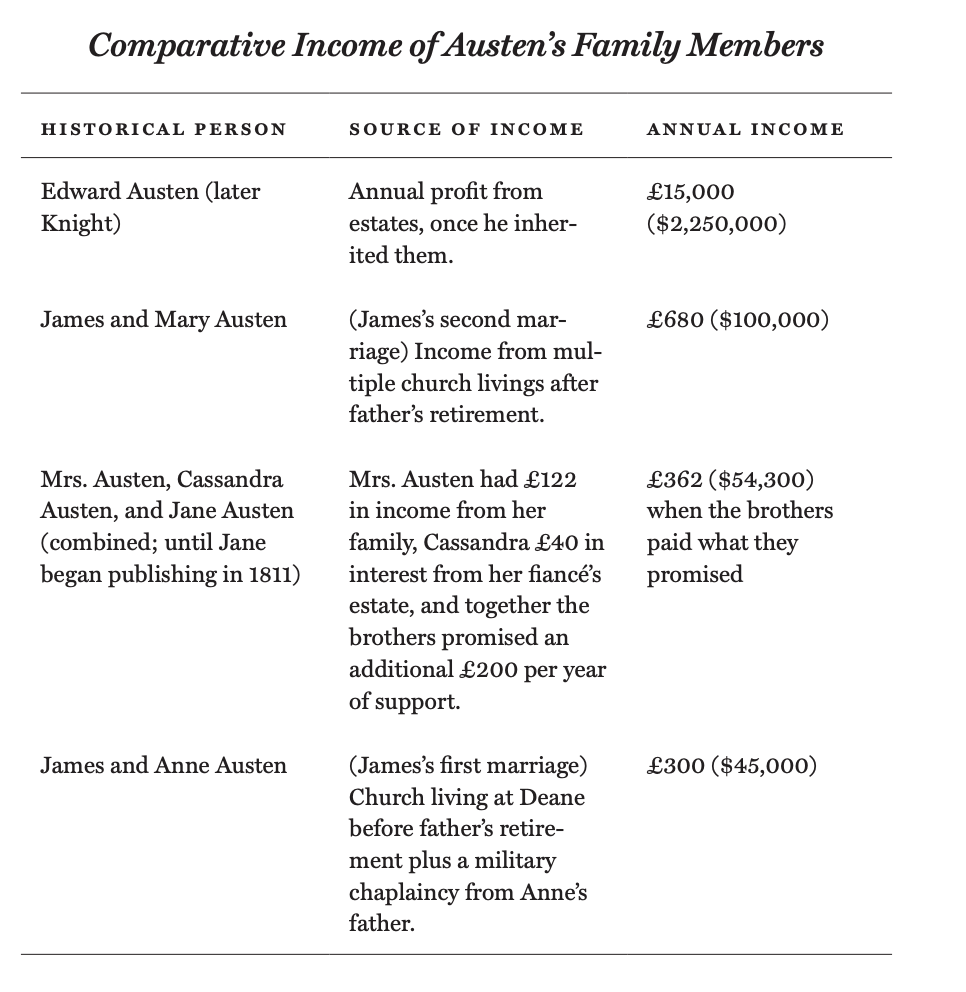
In comparison to her novels again, Elinor and Edward of Sense and Sensibility would have been delighted to receive the £400 church living that Mr. and Mrs. Morland plan to give to their son James in Northanger Abbey, not to mention that James should expect a second similar addition later. Isabella Thorpe spurns this offer, calling it “hardly enough to find one in the common necessaries of life.” Austen might have considered this insulting, since it is more than her own brother’s curacy was worth, although James Austen could also expect a large increase when his father retired as rector. In comparison, the Delaford living in Sense and Sensibility is worth only £200. The narrator informs us that neither Edward nor Elinor was “quite enough in love to think that three hundred and fifty pounds a-year would supply them with the comforts of life.” They only marry when Edward receives a lump sum of £10,000 (which would have been invested in government bonds that paid approximately 4% per year), so that their annual income would increase to £750. Edward and Elinor are presented as reasonable, so it seems that Austen’s brother and sister-in-law must have greatly exceeded their income, given their mode of living.
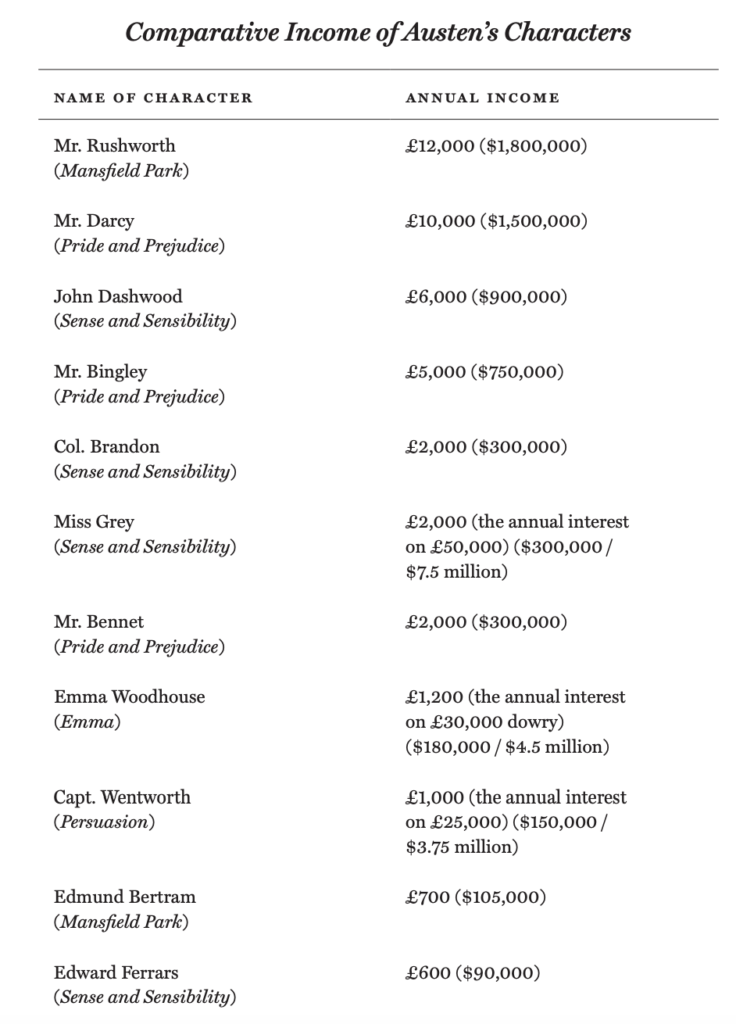
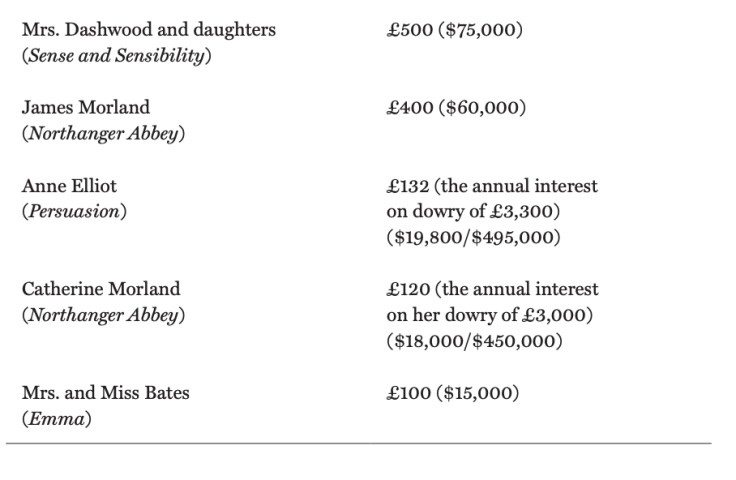
A quick look at the table above makes it clear how much the choice to marry could change one’s future comfort and stability. When we compare Austen’s own finances after the death of her father in 1805 to that of her fictional characters, we can see how much the money made through her novels meant to her. Without assistance from their family, Jane and Cassandra would have had 60% less than Miss Bates (in Emma) to live on. Mrs. Austen had £122 in income from her family, Cassandra £40 in interest from her fiancé’s estate, and together the brothers promised an additional £200 per year of support. Including the cost of lodging, £362 ($54,300) was not enough for them to remain independent, so they moved to Southampton to share lodging with brother Frank and his new wife.
Even though she was underpaid by her publishers and made some poor financial investments, Austen nonetheless made nearly £700 pounds (about $100,000) from her novels. She invested this money in naval bonds, a move that was considered both a patriotic duty and good investment. After publishing her first two books, her annual income was thus boosted by £30 to £35 that she could truly call her own. And for £30 (about $450), she could buy one cashmere shawl or splurge on five writing slopes. (Cashmere was a luxury item, while both wood and woodworking labor were relatively cheap.) The more likely scenario would be that she spent it on a subscription to a lending library, a few favorite books, small gifts for nieces and nephews, and a clothing accessory for herself or Cassandra here and there.
______________________________
Excerpted from An A-Z Guide to Jane Austen’s World by Inger Sigrun Bredkjær Brodey. Illustrations by Harriet Wu. Copyright © 2026. Published with permission of Johns Hopkins University Press.