By Bitcoin News | Created at 2026-06-22 18:46:28 | Updated at 2026-06-22 20:15:18
2 hours ago
By Bitcoin News | Created at 2026-06-22 18:46:28 | Updated at 2026-06-22 20:15:18
2 hours ago
Bitcoin is approaching a compressed August 2026 window in which BIP-110’s mandatory signaling mechanics are scheduled to arrive shortly before Paul Sztorc’s planned eCash hard fork target, placing two separate protocol events on nearly the same timetable.
Key Takeaways
- BIP-110 targets block 961,632 for mandatory signaling in August 2026.
- Paul Sztorc’s eCash fork is aimed at block 964,000 with a 1:1 airdrop.
- Bitcoin miners face BIP-110 signaling pressure before the eCash fork target.
The first event is BIP-110, also known as the Reduced Data Temporary Softfork, a draft proposal authored by Dathon Ohm and assigned in December 2025. The measure would impose a temporary one-year consensus soft fork on Bitcoin by restricting certain forms of arbitrary data storage in transactions. Supporters describe the proposal as a response to incentives they say expanded after the Ordinals and inscriptions wave that began in 2022.
A Temporary Soft Fork With Permanent Stakes
BIP-110 is designed to move into a mandatory signaling phase at block 961,632, with that period running through block 963,647. During that window, nodes running BIP-110-compatible software, primarily Bitcoin Knots forks, would reject non-signaling blocks as invalid. The mechanism is intended to guarantee lock-in no later than block 963,648, with activation following after that.
That design forms the first hard pressure point. It does not simply invite miners to signal. It creates a period in which non-signaling can carry a direct economic cost for miners whose blocks are rejected by the portion of the network enforcing the rule set. The proposal uses version bit 4 and allows early activation if 55% of miners signal within a retarget period, equal to 1,109 of 2,016 blocks.
What BIP-110 Would Restrict
BIP-110’s temporary rules would narrow several transaction behaviors for roughly 52,416 blocks, or about one year. Outputs with a ScriptPubKey greater than 34 bytes would become invalid, except for OP_RETURN, which would be capped at 83 bytes. Large data pushes and witness items would be capped at 256 bytes, while several Taproot-related features would face temporary restrictions.
Inputs spending UTXOs created before activation would remain permanently exempt. The limits would also expire automatically after the one-year period, a design choice supporters frame as a temporary line rather than a permanent rewrite of Bitcoin’s transaction policy.
Supporters See Discipline, Critics See Split Risk
Supporters, including Bitcoin Knots users and Ocean pool participants, argue that BIP-110 would reduce blockchain bloat, lower node operating costs, and reinforce Bitcoin’s monetary purpose. They frame the proposal as a corrective response to non-monetary data embedding and a cultural signal about what Bitcoin block space should be used for.
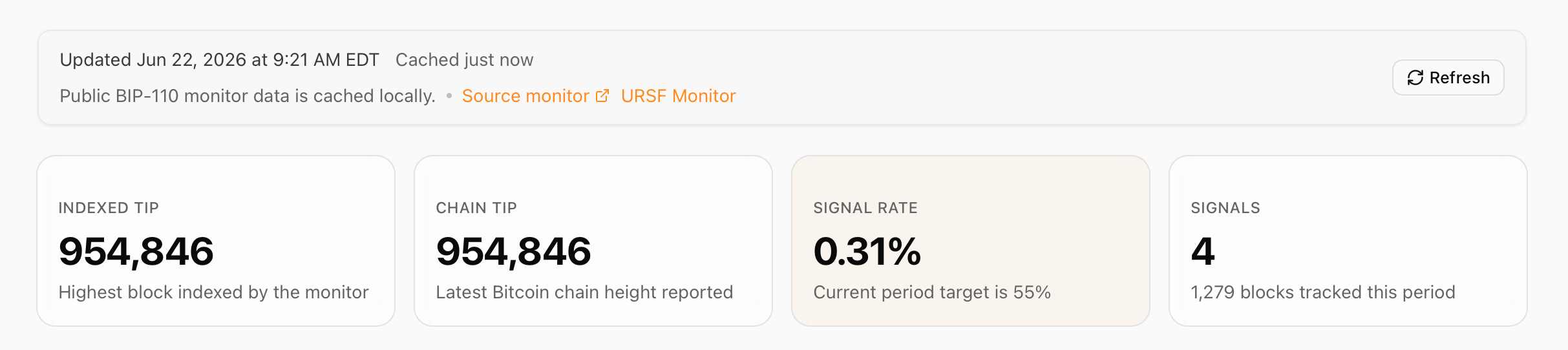 BIP-110 signal rate on June 22, 2026.
Critics have warned that the proposal could fracture consensus, interfere with advanced scripting work, create uncertainty for developers, and set a precedent for protocol-level filtering of paid block space. Current miner signaling remains very low, and at the present time, on June 22, signaling stands at 0.31%, which makes the August deadline more consequential.
Sztorc’s eCash Plan Adds a Separate Fork Fight
A separate August development, unrelated to BIP-110, is also nearing the spotlight. Paul Sztorc, the Drivechain and BIP 300 creator associated with Layertwo Labs, has announced plans for an eCash hard fork targeted around block 964,000 in August 2026. The plan would create a new SHA-256d chain beginning as a near-copy of Bitcoin Core, with a one-time difficulty reset at launch and a 1:1 airdrop to BTC holders based on the fork block.
The eCash proposal is not a data-limit measure. It is a scaling and sidechain project built around activating Drivechains, or BIP 300 and BIP 301, on the new chain from day one. Sztorc has framed the effort as a path to ship functionality that has stalled on Bitcoin mainchain development, while giving holders a new asset at the split.
Airdrop Mechanics Raise Custody and Market Questions
The 1:1 airdrop creates the second pressure point. A hard fork that assigns eCash to BTC holders at the split would force exchanges, custodians, wallet providers, miners, and institutional holders to decide whether and how to recognize, secure, split, account for or ignore the new asset.
The stakes differ from earlier fork cycles because bitcoin is now widely held through spot exchange-traded funds (ETFs), corporate treasuries, and regulated custody structures. The eCash plan has also drawn criticism over how Satoshi-era coins may be handled, with discussions describing a partial reassignment for development or community incentives. Critics have attacked that concept as unfair, while supporters, including Sztorc, argue the fork is voluntary, and holders can decide how to treat the new chain.
One August Window, Two Separate Conflicts
The timing is what turns these two separate events into a dual pressure point. BIP-110’s mandatory signaling window begins at block 961,632 and is designed to guarantee lock-in by block 963,648. The eCash fork is targeted near block 964,000, only a few hundred blocks later. In block-time terms, the two disputes are stacked into the same narrow period.
The interesting thing about both of these events is that they are different proposals, backed by different factions and aimed at different problems. The connection is contextual and operational: one event tests Bitcoin’s data policy and consensus-change process, while the other tests its fork, airdrop, and scaling politics almost immediately afterward.
Miners Face Revenue, Signaling, and Hashpower Choices
For miners, the compressed window could create conflicting incentives. During BIP-110’s mandatory signaling period, a miner may face pressure to signal bit 4 to avoid orphan risk from enforcing nodes. At present, however, only 5.37 exahash per second (EH/s) of Bitcoin’s 940 EH/s aggregate hashrate is signaling for BIP-110. Shortly afterward, the eCash launch could offer a new SHA-256d chain with a difficulty reset and potential sidechain-related revenue.
Because eCash includes a 1:1 airdrop, the planned launch is likely to draw more market and public attention than BIP-110, and in many respects, it already has. The fork gives miners a second economic incentive: They can direct the same SHA-256d hardware, or older machines, toward the new asset while also merged-mining sidechains secured through blind merged mining.
Exchanges and Custodians Become the Operational Front Line
For infrastructure, the burden may be heavier than the market narrative suggests. Exchanges and custodians could be asked to process coin-splitting requests, evaluate replay protection, identify the dominant Bitcoin chain if any BIP-110-related split occurs and explain policy decisions to users in real time.
That operational layer matters because a protocol dispute becomes more than a technical debate once deposits, withdrawals, accounting treatment and user balances are involved. A tight period of stress can magnify small delays, unclear policies or conflicting chain signals.
The Market Reads Timing as Risk
For markets, the setup is less directional than tense. A 1:1 eCash airdrop could encourage some holders to keep bitcoin through the fork block. BIP-110’s contested enforcement path could push others to reduce exposure before the window, especially if exchanges warn of service suspensions, replay concerns, or custody delays.
The central issue here is that two contentious protocol events are landing inside the same compressed window. One is a temporary soft fork with mandatory signaling and data limits. The other is a hard fork with a new asset and Drivechain activation. Together, they create a concentrated test of Bitcoin’s technical discipline, miner coordination, market confidence and public narrative.
What to Watch Next
What matters next is miner behavior heading into block 961,632, node adoption around BIP-110-compatible clients, exchange and custodian statements on eCash, and whether major infrastructure providers flag replay, deposit, withdrawal, or accounting risks before block 964,000. If those signals remain fragmented, August could become less about either proposal in isolation and more about how Bitcoin handles two distinct governance tests at once.