By The Rio Times | Created at 2026-09-30 12:47:04 | Updated at 2026-09-30 14:32:16
2 hours ago
By The Rio Times | Created at 2026-09-30 12:47:04 | Updated at 2026-09-30 14:32:16
2 hours ago
MEXICO · MONETARY POLICY
Key Facts
- —Who spoke Victoria Rodríguez Ceja, governor of Banco de México (Banxico), in an interview with Bloomberg News published on 29 September 2026.
- —The message Mexican policy does not have to react mechanically to expected US rate moves, because the two economies face different conditions.
- —The rate Banxico held its overnight rate at 6.50 percent on 24 September 2026, a third straight hold since the cut of 7 May.
- —The Fed The US Federal Reserve raised its target range by a quarter point to 3.75 to 4.00 percent on 16 September 2026.
- —What comes next Minutes of the September meeting are due on 8 October; the next Banxico decision is on 5 November 2026.
The Banxico governor says spare capacity at home lets Mexico set its own course while the US Federal Reserve raises rates.
Free daily brief — no card needed
Get every Markets story in one morning email
We build you a personalized brief around the topics you follow — free for 7 days. Love it? Your first month after that is US$1.
Yes, email me my free daily brief — I can unsubscribe any time.
One-stop reference
Company Intelligence
Every listed company in Latin America — financials, ownership and structure for 1,450+ companies across 26 exchanges, in one place.
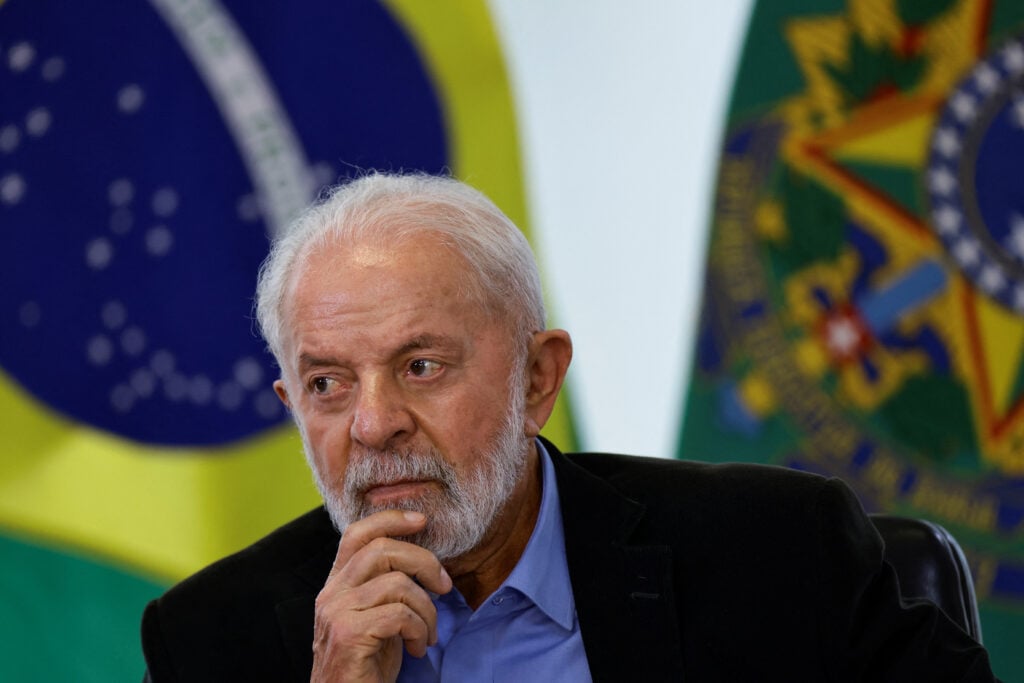
The Banxico governor, Victoria Rodríguez Ceja, said on 29 September 2026 that Mexico’s central bank need not copy the US Federal Reserve. Mexican monetary policy does not have to react mechanically to expected US rate moves, she told Bloomberg News.
What the governor said
Banco de México, known as Banxico, sets interest rates for Latin America’s second-largest economy. Rodríguez Ceja has led it since January 2022.
In the interview, carried in Spanish by the Argentine outlet Perfil, she explained why Mexico can take its own path. The United States has a strong labour market and price pressure from high demand and dearer energy.
Mexico, she said, has spare capacity, meaning factories and workers are not fully used. “The Mexican economy does not face these same pressures as in the United States”, she said.
She added that the bank looks at the whole picture. “We evaluate the outlook and the information as a whole, and not just one data point”, she said.
A rate held at 6.50 percent
Her words repeat and explain the bank’s last decision. On 24 September 2026 its Governing Board voted unanimously to keep the overnight interbank rate at 6.50 percent.
The rate has not moved since a cut on 7 May 2026. The holds of 25 June, 6 August and 24 September make three in a row.
The board weighed the exchange rate, the different stages of the two economic cycles and weak demand at home. It also weighed how tight policy already is.
Conditions in Mexico differ from those in the United States, the statement said. So policy “would not have to react mechanically” to expected moves in the Fed’s key rate.
A quiet change in guidance
The September statement also dropped a line. In August the board had said it would be appropriate to keep the rate at its current level.
That line is gone. Future decisions will depend on how fast inflation falls and how much a weaker peso lifts prices. Slack in the economy and inflation expectations also count.
Bloomberg read the change as opening the door to future cuts. Rodríguez Ceja said Banxico wants to give more detail on the factors behind its next moves.
She has not said when, or whether, the board will cut again. The next scheduled decision is on Thursday 5 November 2026, and minutes of the September meeting are due on 8 October.
The Fed moves the other way
The Federal Reserve, the US central bank, raised its target range by a quarter point on 16 September 2026. The vote was 12 to 0, and the range is now 3.75 to 4.00 percent.
Its statement said inflation “remains elevated”. The Fed next meets on 27 and 28 October.
Mexico’s rate now stands 2.50 to 2.75 percentage points above the US range. For years that gap has drawn investors who borrow cheaply elsewhere and hold pesos for the extra yield.
When the gap narrows, part of that incentive fades. That is why markets watch every Fed move for its effect on the Mexican peso.
The peso tests the argument
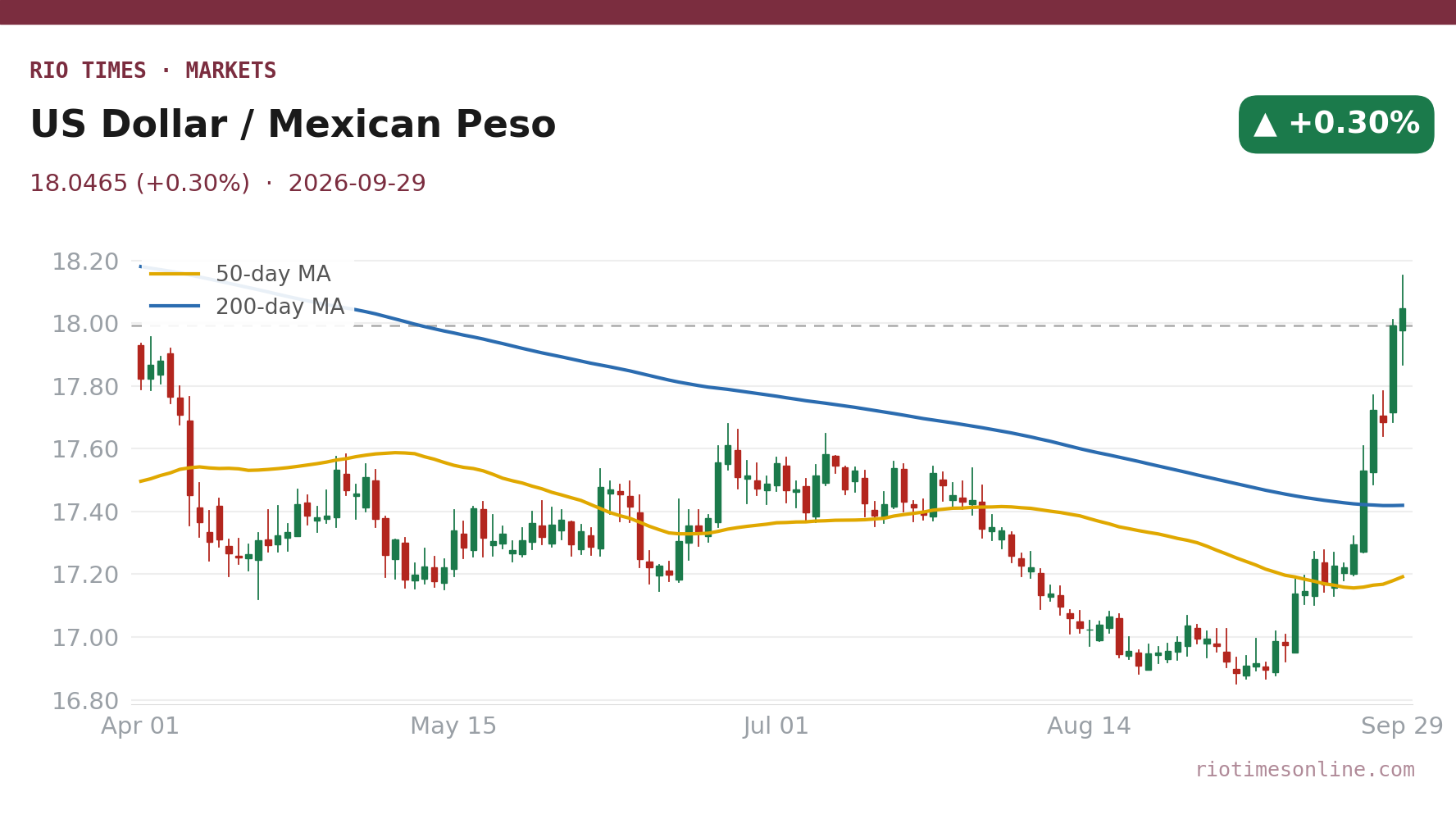
The peso has weakened as US yields climbed. The dollar bought about 17.04 pesos on 28 August and 18.05 on 29 September, according to EOD Historical Data.
In peso terms that is a loss of about 5.6 percent in a month. Bloomberg called it the largest fall among emerging-market currencies over that period.
The Rio Times covered the peso’s fall through 18 per dollar on 29 September. The dollar stood near 18.06 pesos on 30 September.
Banxico itself lists a trend of peso depreciation among the risks that could push inflation higher. It judges the balance of those risks as tilted upward.
What holds the picture steady
Inflation is moving roughly as the bank expected, Rodríguez Ceja said. Headline inflation rose from 3.10 to 3.42 percent between early July and early September, driven by volatile items.
Core inflation, which strips out farm produce, energy and regulated prices, kept falling, from 3.95 to 3.79 percent. Banxico targets 3 percent, with a tolerance of one point either side.
The governor also pointed to the floating exchange rate, which lets the peso absorb shocks from abroad. Government measures have softened the domestic impact of energy price shocks linked to the war with Iran, she said.
Banxico still does not expect headline inflation to reach 3 percent until the fourth quarter of 2027. That leaves a long stretch in which a weaker peso could feed into prices.
What it means for people in Mexico
For borrowers with peso loans, nothing changes this month, and savers keep rates well above those in the United States. A future cut would lower both.
For foreigners paid in dollars, a weaker peso stretches their income further. For Mexican firms that import goods or owe dollars, the same move raises costs.
The central bank’s message is that Mexico sits at a different point in the cycle from the United States. The October minutes and the November decision will show how far the board is willing to let the two paths diverge.
More: Mexico news, every day from The Rio Times.
Frequently Asked Questions
What did the Banxico governor say about the Fed?
Victoria Rodríguez Ceja told Bloomberg News on 29 September 2026 that Mexican policy need not react mechanically to expected US rate moves. She said Mexico has spare capacity, while the United States faces strong demand and a tight labour market.
What is Banxico’s interest rate?
Banco de México held its overnight interbank rate at 6.50 percent on 24 September 2026, by unanimous vote. The rate has not changed since a cut on 7 May 2026.
When is the next Banxico rate decision?
The next scheduled decision is on Thursday 5 November 2026, with the last of the year on 17 December. Minutes of the September meeting are due on 8 October.
Sources: Perfil (Bloomberg News) · Banco de México — Monetary policy statement, 24 September 2026 · Banco de México — Anuncio de política monetaria, 24 de septiembre de 2026 · Banco de México — Monetary policy statement, 6 August 2026 · Banco de México — 2026 calendar of decisions and minutes · US Federal Reserve — FOMC statement, 16 September 2026