By The Straits Times | Created at 2026-09-12 21:06:29 | Updated at 2026-09-12 22:57:42
1 hour ago
By The Straits Times | Created at 2026-09-12 21:06:29 | Updated at 2026-09-12 22:57:42
1 hour ago
SHENZHEN – It’s not what most people would want to be called. An NPC, or “non-player character”, is internet slang for someone seen to lack independent thought, a term borrowed from video-game speak.
But in China, the term also refers to a job that has grown more common in recent years. Theme parks and tourist attractions around the country are hiring so-called NPCs to liven up their grounds and feed consumers’ demand for unique experiences.
Dressed up as figures like the mythical Monkey King or ancient Chinese poets, NPCs engage visitors with witty banter and eye-catching gimmicks, often remaining in character throughout.
While there is no official count of how many people are employed in these roles, a lawmaker proposed at China’s national parliamentary meetings in March that the state recognise NPCs as a new occupation, a sign of their growing popularity.
This comes as tourist attractions seek new ways to attract more visitors, while some young people turn to these novel jobs for work in a difficult labour market.
On a recent Sunday afternoon at the China Folk Culture Village in Shenzhen, a man in the costume of Song Dynasty poet Su Shi strolled to an open area where visitors were milling around and started speaking in verse.
He opened with a line from one of Su’s most famous poems, then invited someone to respond with the next. “Ming yue ji shi you”, he said to the small crowd which had formed. “Ba jiu wen qing tian”, came a speedy reply.
Thus continued the back-and-forth with lines from Su’s most popular poems, with participants ranging from a little boy in a Spider-Man outfit to an enthusiastic middle-aged man who thrice answered correctly.
Su was played by Yao Fancheng, 23, who has worked as an NPC since graduating from drama school in Sichuan in 2025. He says he makes sure to draw from verses familiar to people of different generations to “ensure that everybody can participate”.
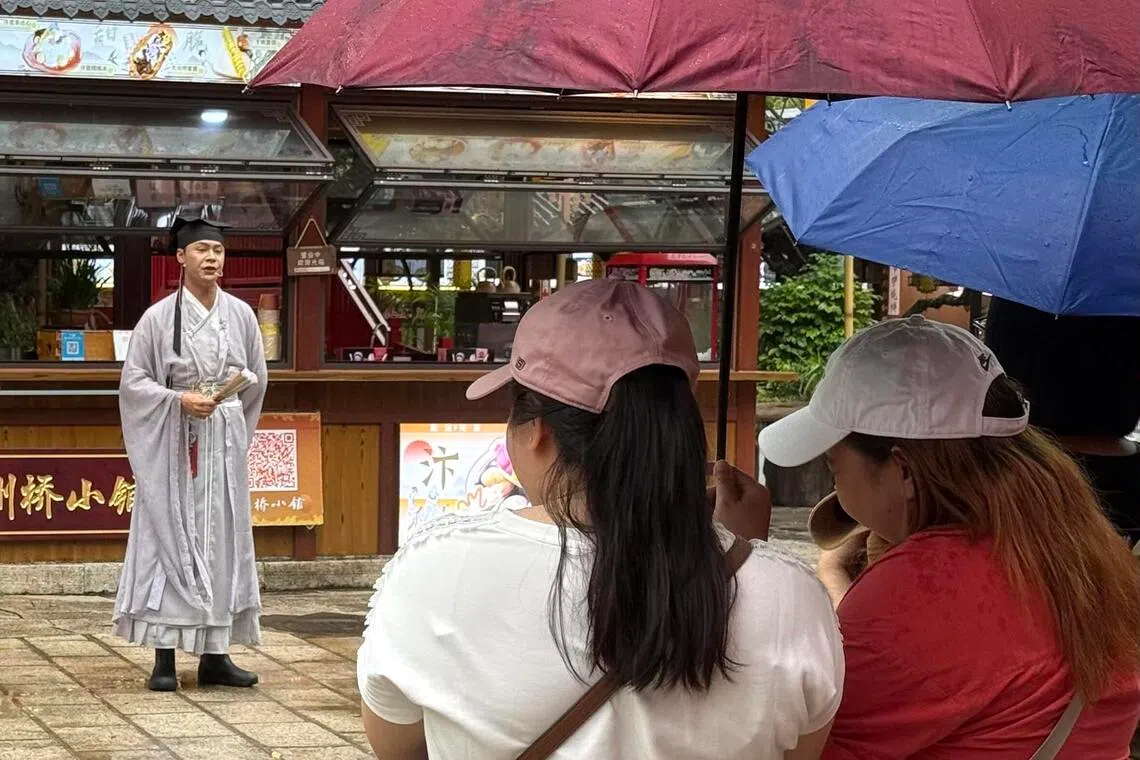
Yao Fancheng plays ancient Chinese poet Su Shi at the China Folk Culture Village in Shenzhen. He makes sure to draw from verses familiar to people of different generations to “ensure that everybody can participate”.
ST PHOTO: JOYCE ZK LIM
The tourist attraction where Yao works employs about 100 NPCs, having stepped up its deployment of these novel roles since 2024 as they surged in popularity nationwide, said staff member Ye Junjie.
Visitors nowadays don’t just want to “passively see things”; they also want something more interactive that they can immerse themselves in, he said.
Around the country, theme parks seeking to refresh their appeal are deploying all manner of NPCs to draw more visitors to their grounds. These characters, if they go viral, can become tourist magnets in their own right.
At the Changchun Zoo in north-eastern Jilin province, tourists from all over China swarm to see a young man dressed up as the Monkey King from the classical novel Journey To The West. Part of his act involves lying prone on the ground under a prop shaped like a mountain, a reference to a scene from the book, as he banters with visitors who feed him snacks.
The 27-year-old’s down-to-earth demeanour, inflected with the blunt humour of the north-east, has won him many fans. In 2024, he became an internet sensation for grousing about the dry rice crackers he had to eat ad nauseam.
Videos of his exchanges with visitors are frequently clipped and uploaded to social media. In one, he tells a child why it is important to go to school. “I’ve been lying here ever since I graduated from college. If you don’t graduate from college, you wouldn’t be able to do this job,” he said.
Among the biggest employers of NPCs in China is central Henan province’s Wansui Mountain Martial Arts City, which has more than 1,000 NPCs on its payroll, according to local media reports. They are paid about 6,500 yuan (S$1,200) a month, according to a report by local news outlet Henan Daily in November 2025.
That year, the average monthly salary for people working in the private sector in urban Henan was 4,412 yuan, while those in non-private enterprises earned an average of 7,585 yuan, according to The Straits Times’ calculations based on official annual figures.
Some NPC jobs are full-time but most are seasonal gig work, with tourist attractions ramping up hiring during holiday periods, said Liu Erduo, a labour economist at Renmin University in Beijing.
Along with other forms of part-time work, these roles help provide young people with some form of employment amid a difficult job market that is also being squeezed by artificial intelligence, he noted.
As AI is increasingly used to create micro-dramas, for instance, the Chinese media has reported that some displaced actors are turning to NPC jobs to make a living. The bet is that visitors’ demand for real-world interactions will not easily be sated by technology.
Liu Simin, a board member at the Beijing Tourism Studies Association, believes that NPCs will continue to feature in the country’s tourism industry but foresees that the boom will rationalise.
“Not every attraction can do NPCs,” he said. And if too many try, the “homogenisation will be severe”, he added.
For now, 23-year-old NPC Xiao Zhao, as she wanted only to be known, is satisfied with her job playing Zhao Pan’er, the female protagonist in historical television drama A Dream Of Splendour, at Shenzhen’s China Folk Culture Village, which she secured after graduating from drama school in 2025.
She isn’t bothered by the dual meaning of the term NPC, as “I think you have to unearth for yourself what makes you happy in the job”, she says.
“Every day, I get to see all sorts of different people”, and improvise different performances, she said. “Currently, I’m still very happy to be an NPC.”