By CryptoSlate | Created at 2026-10-01 03:20:55 | Updated at 2026-10-01 04:38:53
1 hour ago
By CryptoSlate | Created at 2026-10-01 03:20:55 | Updated at 2026-10-01 04:38:53
1 hour ago
Bitcoin is closing its strongest quarter since 2024 after leaving US stocks and gold far behind despite surging bond yields.
The largest digital asset has gained about 43% in the third quarter, putting it on course for its second-best third-quarter since 2013 and its third-strongest quarterly advance since US spot Bitcoin exchange-traded funds began trading in January 2024, according to Bitfinex and CoinGlass.
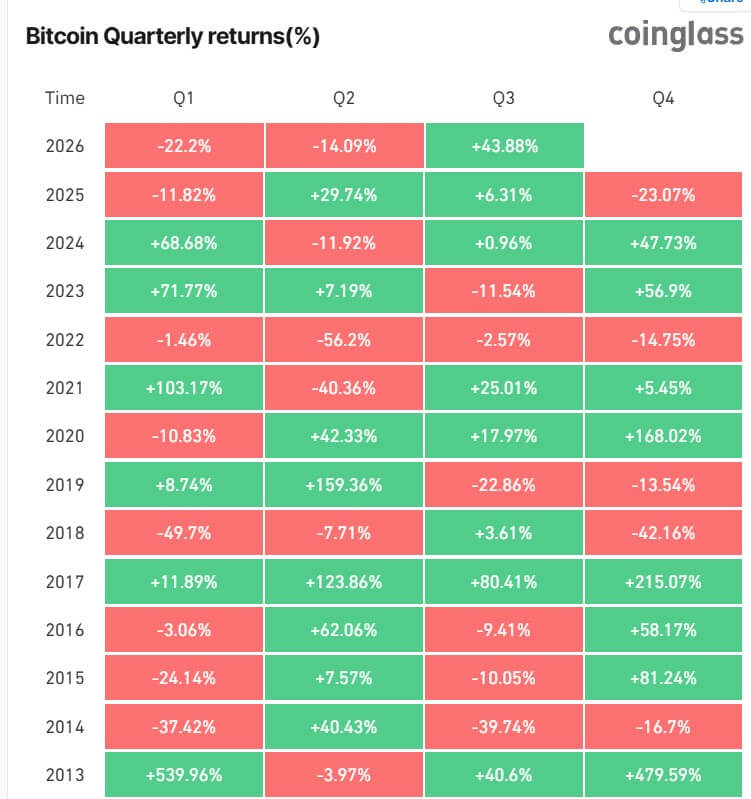 Bitcoin rebounded 43.88% in Q3 2026 after losing 22.2% in Q1 and 14.09% in Q2. Source: CoinGlass
Bitcoin entered July near $58,600 after three consecutive quarterly declines, then accelerated through August and September as institutional demand returned and sellers who had spent much of 2026 underwater were absorbed at progressively higher prices.
Traditional markets barely kept pace. Over roughly the same three-month period through Sept. 29, the Nasdaq Composite gained about 5%, the S&P 500 roughly 4% and gold less than 2%, according to StatMuse data.
Meanwhile, Ethereum was the notable exception, outperforming Bitcoin as the crypto rebound broadened beyond the market leader.
Bitcoin's outperformance accelerated after Aug. 19, even as a Treasury initiative to improve liquidity in longer-dated government debt failed to prevent yields from rising.
The department said it would at least double the maximum size of liquidity-support buybacks for longer maturities to $4 billion per operation, with the increased purchases beginning Sept. 9.
Bitcoin has risen almost 30% since the announcement. However, the 10-year Treasury yield climbed about 81 basis points and long-dated borrowing costs reached multi-decade highs over the quarter, raising the hurdle for assets that produce no yield.
Wall Street money takes over from leverage
US spot Bitcoin ETFs provided a fresh source of capital as financial conditions tightened elsewhere.
The funds moved from roughly $5 billion in year-to-date net outflows at the end of July to about $1 billion in inflows by late September, a swing of about $6 billion in two months.
The reversal culminated last week when the products absorbed $2.39 billion, their largest weekly intake since October 2025. Every session was positive, though daily demand slowed from $999 million on Sept. 21 to about $135 million by Sept. 25.
Analysts at Nexo said Bitcoin enters the fourth quarter with stronger spot demand and an improving market structure, though the outlook still depends on ETF buying persisting, overhead supply being absorbed and inflation remaining contained enough to prevent further Federal Reserve tightening.
At the same time, leveraged traders have been retreating.
Aggregate Bitcoin futures open interest has fallen from more than 700,000 BTC on Sept. 21 to about 644,000, its lowest since early January, according to Bitfinex. The seven-day contraction of roughly 49,000 BTC was the largest since October 2025, while CME open interest dropped 16,075 BTC on Monday alone, its third-biggest daily decline on record.
Futures premiums have also compressed, and implied volatility remains near a one-year low.
The unwind leaves less leverage to accelerate another liquidation-driven selloff, but it also removes speculative buying that can propel sharp advances. That shifts more responsibility onto investors purchasing Bitcoin outright.
Signs of that transition are appearing around current prices. Bitfinex estimates the amount of Bitcoin with a cost basis between $82,500 and $84,000 nearly tripled to 306,000 tokens in three days as buyers absorbed coins sold by both profitable holders below the market and newer investors exiting at losses above it.
A 1.39 million Bitcoin wall waits above $85,000
Bitcoin's improving structure still leaves a substantial concentration of sellers immediately overhead.
Bitfinex estimates investors hold about 1.39 million BTC acquired between $84,000 and $86,500. The group includes long-term holders returning toward breakeven and more recent buyers whose positions slipped underwater after Bitcoin retreated from its Sept. 21 high near $87,400.
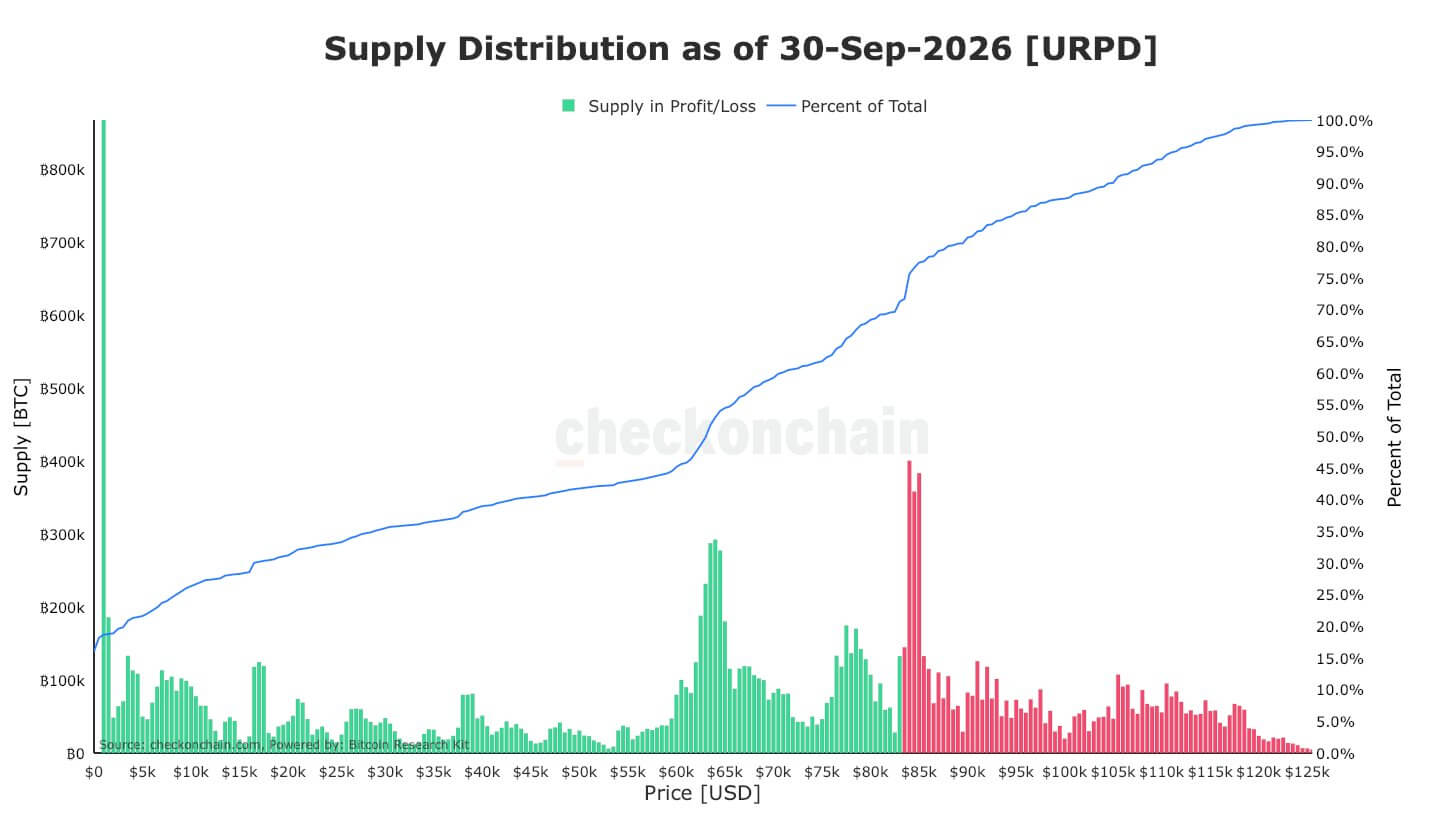 Bitcoin supply clusters near $63,000-$65,000 and $77,000-$80,000, with a sharp overhead concentration around $85,000. Source: Checkonchain
That creates potential selling each time prices push back into the range.
CryptoQuant said Bitcoin reclaimed its 365-day moving average last week for the first time since March 2023. Recoveries above the gauge have accompanied previous transitions into bullish regimes, while sustained moves below it have historically coincided with weaker market phases.
Bitcoin's realized price, which approximates the average cost basis of coins in circulation, has climbed to about $77,000 and held through the latest recovery.
The challenge is whether new demand can clear the supply sitting above spot prices.
Bitfinex's measure of ETF purchases relative to the roughly 450 Bitcoin produced by miners each day fell from 25.6 times issuance during the $999 million inflow session to 1.8 times by Sept. 29. The firm estimates the ratio needs to recover toward five times issuance, equivalent to roughly $190 million of ETF demand a day, to absorb the overhead supply more quickly.
A move above $85,000 would return roughly 760,000 BTC to profit and lift Bitcoin's supply-in-profit measure back toward the 75% threshold Bitfinex associates with stronger bull-market phases. The gauge slipped to 71.3% on Sept. 29 from 78.1% eight days earlier.
Beyond the immediate barrier, Glassnode places another major supply concentration near $88,000 to $90,000, followed by an important level around $96,700.
Options traders are positioned for a break higher nonetheless. Nexo said Bitcoin's put-to-call ratio averaged 0.67 over the past two weeks, while $140,000 calls expiring Dec. 25 represent the largest individual position. Dealer positioning points to the $95,000-to-$97,000 area as another significant test if Bitcoin clears the nearer supply zones.
Bitcoin's best season collides with 5% yields
Seasonality gives bulls another argument heading into October.
The fourth quarter has historically produced Bitcoin's strongest returns, with average gains of roughly 77% to 85% since 2013, depending on the dataset. BloFin Research calculates that matching its 77.07% historical average from current levels would put Bitcoin near $147,000, while its median fourth-quarter return of 47.73% would imply roughly $123,000.
Those are mechanical projections, and successive Bitcoin cycles have delivered progressively smaller advances from their lows.
Monetary policy presents the more immediate constraint.
Markets began this week assigning roughly a 65% probability to another quarter-point Fed increase in October. Softer-than-expected inflation data Wednesday cut those odds to about 38%, showing how rapidly the rate outlook can shift ahead of the central bank's Oct. 27-28 meeting. Another decision follows Dec. 8-9.
Sept. 28 offered an earlier warning about Bitcoin's exposure to broader positioning. The Nasdaq-100, gold and Bitcoin fell together as investors reduced exposure across markets, a pattern Nexo analysts said was more consistent with broad deleveraging than a conventional rotation into safe assets.
For Bitfinex, $81,300 is now an important threshold beneath the recovery. Sustained trading below that level alongside renewed ETF outflows could expose the realized-price region near $77,000.
On the upside, stronger ETF demand and a break through $86,500 would leave Bitcoin approaching its yearly open near $87,700 before the larger supply cluster around $90,000 comes into play.
The Oct. 2 US payrolls report will give traders another read on the economy before the next inflation release and the Fed's October meeting, just as Bitcoin enters its historically strongest quarter with Treasury yields still above 5%.