By The Straits Times | Created at 2026-10-03 21:16:43 | Updated at 2026-10-03 23:40:46
2 hours ago
By The Straits Times | Created at 2026-10-03 21:16:43 | Updated at 2026-10-03 23:40:46
2 hours ago
PUTRAJAYA – Anthony Loke should be leaving Malaysia’s Cabinet. Instead, the Democratic Action Party (DAP) secretary-general is strikingly upbeat about a party that has just suffered a string of electoral setbacks – including his own recent defeat in Negeri Sembilan.
“Negeri Sembilan’s defeat is basically a blessing in disguise for us,” the 49-year-old told The Straits Times in an exclusive interview on Oct 1. He noted that the UMNO-led state government, alongside Parti Islam SeMalaysia (PAS), remains mired in a royal crisis that they had promised to resolve upon coming to power under the Malay unity banner.
His optimism comes at a pivotal point for DAP, which has gone from perennial opposition to a key player in the federal government led by Prime Minister Anwar Ibrahim. Growing frustration among its core Chinese electorate has highlighted the limits of what it can achieve in a multi-party coalition.
Loke’s decision to leave the Cabinet over former prime minister Najib Razak’s house arrest illustrates the balancing act between staying in power and holding to principles the party says it cannot abandon.
Indeed, Loke should have cleared his desk after announcing on Sept 19 that he would quit the Cabinet in protest at Najib being allowed to serve the rest of his graft sentence related to the 1MDB scandal in his Kuala Lumpur mansion instead of Kajang Prison.
Instead, he has courted criticism after clarifying on Sept 29 that his resignation will only take effect once Najib pays the outstanding RM50 million (S$15.7 million) fine under the conditional house arrest order.
“Of course, people say that it’s an act, political, and so on,” Loke said, explaining that this was the agreed timeline with Anwar when he tendered his resignation. “But I’m sticking my head out – the moment he returns, I have to quit. I am not wishy-washy or dilly-dally. He goes home. I leave.”
The Sept 18 decision by the Pardons Board, chaired by Malaysia’s King, Sultan Ibrahim Iskandar of Johor, came despite Anwar’s Pakatan Harapan (PH) alliance campaigning to bring Najib and other perpetrators of the 1MDB scandal to justice. It is also the latest test for DAP, the backbone of Anwar’s coalition, which won 40 parliamentary seats at the 2022 general election.
DAP has also endured electoral setbacks in the Sabah, Johor and Negeri Sembilan state elections, with Loke himself losing Chennah – a seat he had held for three terms – on Aug 1.
Blessing in disguise
Loke remains confident that the Malay unity narrative pushed by UMNO and PAS will not be sustainable. The two major Malay-Muslim parties joined forces in Negeri Sembilan to secure control of the state administration, unseating PH, of which DAP is the largest component party.
“Negeri Sembilan’s defeat is basically a blessing in disguise for us. They (UMNO-PAS) talked about Malay unity and forming a formidable state government to resolve the royal impasse. What decision did they make? They dethroned the state ruler.
“Right now, Malays elsewhere in the entire country can see that an UMNO-PAS government did this. So that’s why I said DAP is being spared this burden right now. In a way, the Malay unity momentum cannot necessarily be sustained in terms of electoral trends,” he told ST.
The dispute centres on the contested removal of state ruler Muhriz Munawir, with competing claims over the legitimacy of the move.
Growing disappointment
DAP still commands strong support among Chinese voters, but that alone cannot deliver federal power.
Growing disappointment among Chinese voters – the core electorate that propelled DAP and PH into power in the 2022 general election – remains a persistent headache for Loke.
Political scientist
Bridget Welsh
estimated 95 per cent of Chinese voters backed PH in 2022, with a 69% voter turnout.
In the subsequent state elections,
PH’s Chinese support
remained high at 97 per cent in Negeri Sembilan with a 67 per cent turnout, but dropped to 80 per cent in Johor alongside a lower turnout of 63 per cent.
Loke, stressing that DAP will never take Chinese support “for granted”, noted that Malaysian political reality demands consensus-building among coalition partners, meaning DAP’s vision can rarely be realised in full.
“We know sometimes it’s frustrating to be in this kind of situation, but that is the reality of Malaysian politics.
“There is no way for DAP to form a government on its own without working with others. This is a reality we must accept: We can only push as far as possible, relying on objective and persuasive arguments to get things done within the system,” he explained.
Full recognition of the Unified Examination Certificate (UEC) for public university entry remains a priority for DAP, but one that is still unresolved.
Under the Anwar administration’s 2026 policy, UEC students are required to meet Bahasa Melayu and History requirements under the national examination framework, while access to public universities remains subject to specified conditions.
For DAP, the long-championed UEC issue illustrates the limits of what it can achieve inside a coalition government.
DAP is at a pivotal point, but staying in government does not mean the party will “sacrifice everything” to retain power.
Drawing a firm line
For Loke, there are limits to pragmatism. He drew a firm line over Najib’s house arrest, while seeking to avoid a mass resignation by DAP ministers and deputy ministers.
Loke officially tendered his resignation as Transport Minister to Anwar on Sept 28, following his announcement to the DAP Central Executive Committee.
“As the leader of the party, I must demonstrate leadership and show our voters that we hold fast to certain principles,” Loke explained.
“Power is important, but that does not mean we will sacrifice everything just to retain position and office.”
With the next federal election due by February 2028, DAP will need to rebuild beyond its traditional support base while holding on to its core Chinese electorate. Loke believes it can still command about 80 per cent of Chinese voter support, based on recent state-election results, though he acknowledged that “90 per cent is a tall order.”
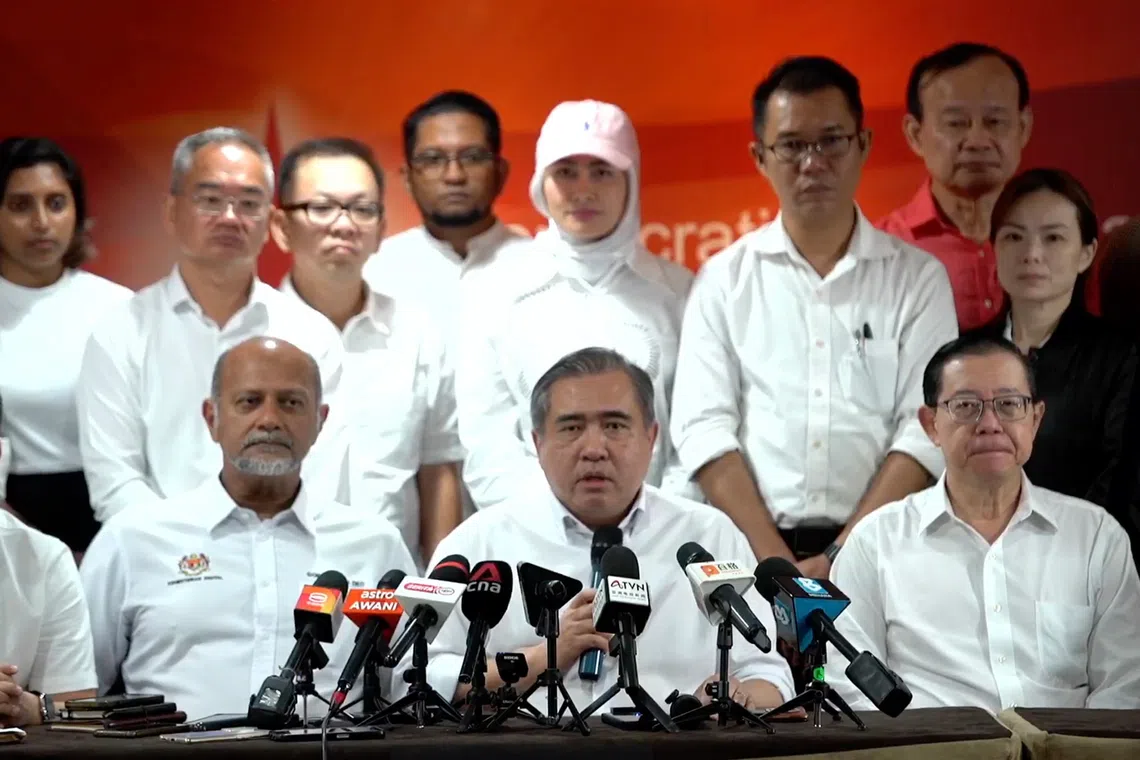
The moment DAP’s Anthony Loke (front, centre) announced his intention to resign as Transport Minister after an emergency Central Executive Committee meeting on Sept 19.
PHOTO: DEMOCRATIC ACTION PARTY/FACEBOOK
Asked about Parti Bersama Malaysia (Bersama), a splinter party led by former Parti Keadilan Rakyat (PKR) figures that has sought to appeal to disaffected urban PH voters, Loke argued that third forces and idealistic parties rarely sustain momentum in Malaysian politics.
“The most recent example would be the Malaysian United Democratic Alliance (MUDA). They put forward super idealistic objectives, fresh candidates, young people, professionals, and so on.
“But after the election, they are nowhere to be seen.”
Bersama fielded 15 candidates in the July Johor state polls, all of whom lost their deposits. The party nevertheless plans to contest the coming Melaka state election, which must be called before Nov 22.
Door remains open
If DAP wants to remain in federal government after GE16, it may again have to work with parties unpopular with parts of its grassroots.
Many DAP supporters continue to be deeply opposed to PAS because of its Islamist politics, while distrust of UMNO and Bersatu persists over their previous and current roles in coalition governments.
PAS is the largest single party in Malaysia’s parliament with 43 out of 222 seats, leading the opposition Perikatan Nasional (PN) coalition.
For example, Melaka DAP chairman Khoo Poay Tiong declined a dinner hosted by Bersatu on Oct 1, attended by other PH leaders, saying DAP was not yet ready to work with the party in the coming state election.
Still, Loke insisted he has not ruled out working with any potential partners, pointing to DAP’s historic decision to cooperate with UMNO following the 2022 general election to form the Anwar-led federal government.
“I don’t close my doors to anyone.
“I hold this belief that we have come to a point that politics has to be agile. Of course, not without any principle or any precondition, because it depends on the circumstances what is best for the country to move forward.”
The August referendum on whether DAP should remain in the Anwar administration also underscored the debate within the party over its relationship with the unity government.
Loke did not rule out the possibility of DAP contesting the next federal election on its own rather than as part of PH.
“As much as possible, I want to preserve the PH coalition.
“But again, our electoral strategy needs to be reviewed from time to time. What is the best strategy – not only for DAP, but for our partners as well?
“I can only answer that when parliament is dissolved.”
Sign up for our weekly Asian Insider Malaysia Edition newsletter to make sense of the big stories in Malaysia