By South China Morning Post | Created at 2026-08-26 08:02:00 | Updated at 2026-09-26 18:29:31
1 month ago
By South China Morning Post | Created at 2026-08-26 08:02:00 | Updated at 2026-09-26 18:29:31
1 month ago
China is drawing up an extensive set of standards for brain-computer interface technology, seeking to accelerate the commercialisation of a field in which Chinese start-ups are increasingly competing with Elon Musk’s Neuralink for global leadership.
Under draft guidelines released by the Ministry of Industry and Information Technology (MIIT), Beijing aims to formulate or revise more than 40 standards by 2028 and encourage at least 100 companies to adopt them. It also plans to lead or participate in the development of more than 10 international standards.
By 2030, China aims to have developed more than 80 standards, creating a comprehensive framework for the domestic industry while increasing its influence over global rules for the emerging neural technology.
Brain-computer interfaces allow the mind to communicate directly with external devices. Their potential uses range from restoring movement and speech in people with disabilities to controlling computers, industrial machinery and consumer electronics.
China has identified brain-computer interface technology as one of six “industries of the future” under its
15th five-year plan, as the country looks to nurture domestic competitors in a field where Neuralink is widely regarded as the commercial front runner.
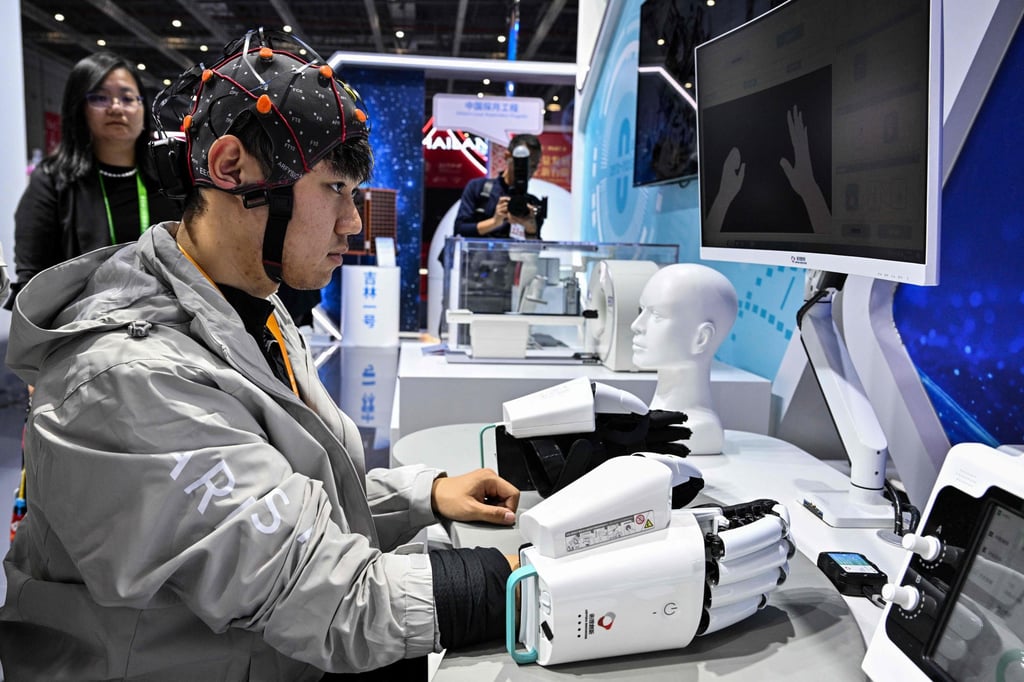
Domestically, China has leading neural-tech firms such as Neuracle, which has won approval for an implanted system that helps paralysed patients regain hand movement, as well as StairMed and NeuroXess, which focus on invasive implants and the interpretation of neural signals, and BrainCo, which develops non-invasive devices and brain-controlled prosthetics.