By The Rio Times | Created at 2026-08-12 05:21:55 | Updated at 2026-08-12 06:56:44
1 hour ago
By The Rio Times | Created at 2026-08-12 05:21:55 | Updated at 2026-08-12 06:56:44
1 hour ago
Key Facts
- The Ibovespa fell 2.5% to 167,875, its steepest one-day slide in weeks, as political noise and a JP Morgan warning on Brazil’s fiscal path spooked investors.
- The real weakened 1.04% to 5.1629 per dollar, pacing losses across most of Latin America even as the US currency barely moved against a basket of peers.
- Trading in BTG Pactual units sank 6.9%, the heaviest drag among financials, while blue-chips Petrobras and Vale gave up more than 1% each despite firmer oil prices.
- The central bank’s latest meeting minutes signalled borrowing costs will stay high for longer, dashing hopes that the ongoing Selic cutting cycle—now at 14.00%—might accelerate soon.
- The S&P 500 slipped 0.32% in New York, offering no support to emerging markets as investors rotated out of risky assets ahead of US inflation data later this week.
Today’s Focus
Brazilian assets suffered a sharp sell-off on Tuesday, August 11, with the Ibovespa—the country’s benchmark stock index—tumbling 2.5% to close at 167,875 points. The real slid 1.04% to 5.1629 per US dollar, wiping out nearly a week of gains in a single session.
The rout was fuelled by a cocktail of domestic political anxiety and a blunt warning from JP Morgan analysts that Brazil’s fiscal trajectory looks increasingly fragile as the 2026 presidential election approaches. Investors also digested minutes from the central bank’s latest policy meeting, which reinforced that the Selic—Brazil’s benchmark interest rate, now at 14.00% after four straight cuts—is unlikely to fall fast enough to rescue corporate earnings soon.
Trading volumes surged in the largest banks and commodity exporters, with BTG Pactual (BPAC11) plunging 6.9% and Itaú (ITUB4) dropping 3.5%. Petrobras preferred shares (PETR4) lost 1.3% on turnover of $435 million, the session’s heaviest, while Vale—the global iron-ore giant—also retreated.
What matters today. The Ibovespa’s 2.5% plunge exposes deep investor anxiety about Brazil’s election-year politics and the central bank’s cautious pace of rate cuts, despite a quiet global backdrop.

01 The session in one read
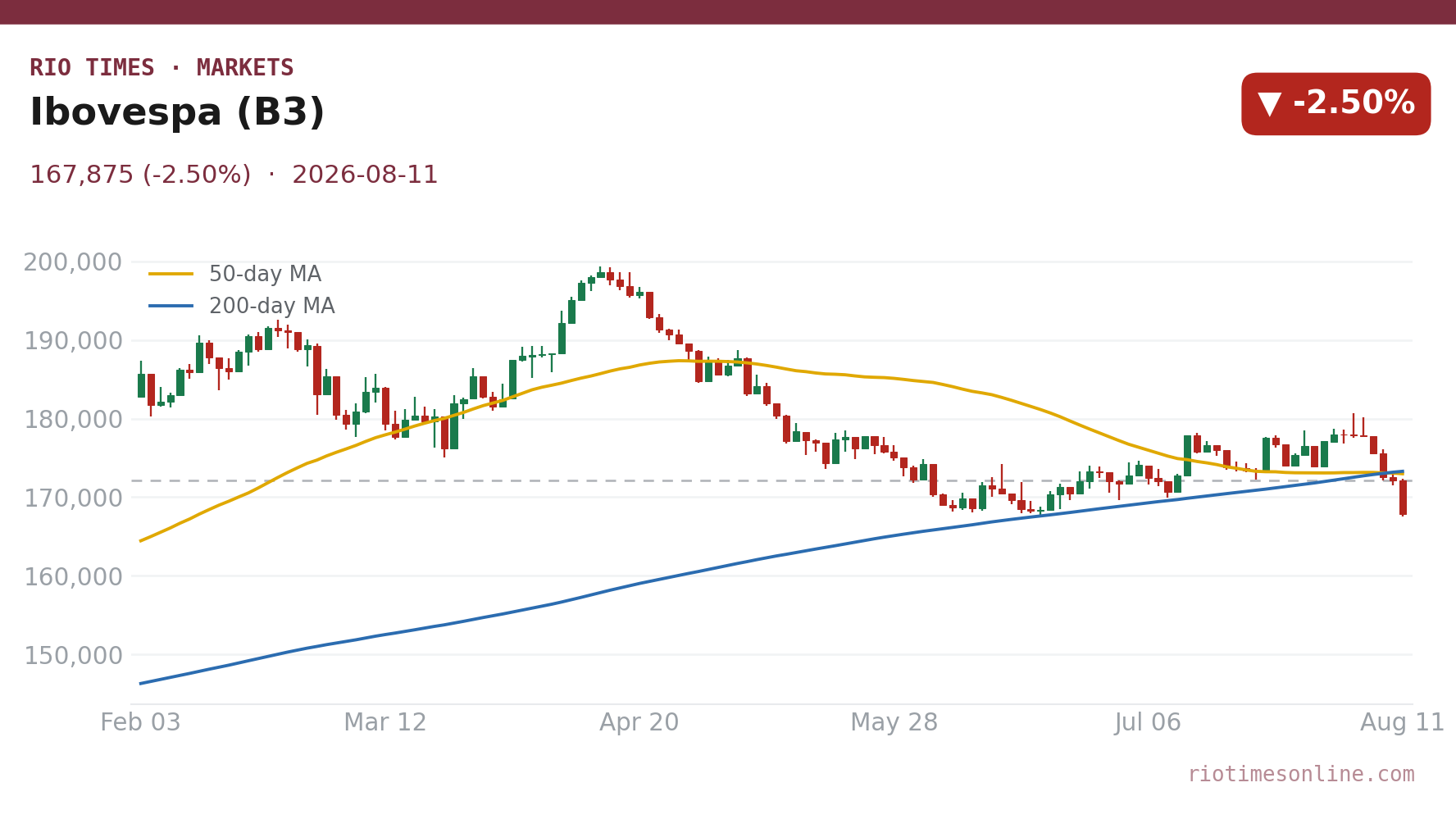
Brazil’s financial markets opened the week with a thud. The Ibovespa, the barometer of the country’s largest publicly traded companies, sank 2.5% to 167,875 points—enough to drag the index 15.5% below its 52-week high of 198,657.
The sell-off was broad and deep. Every major bank stock bar Santander Brasil fell more than 2%, while the exchange operator B3 itself (ticker B3SA3) lost 2.6% after reporting quarterly earnings that merely matched expectations—not a good look when the mood is already sour.
The real bore the brunt of the dollar’s quiet strength. At 5.1629 per greenback, the currency weakened 1.04% on the day, though it remains 7.6% below its own 52-week high of 5.5901—a small comfort for importers watching costs creep higher.
Local headlines amplified the gloom. The lower house of Congress postponed votes after a Workers’ Party leader fainted, reminding traders that election-year politics rarely delivers the fiscal restraint foreign investors demand.
Assessment — Correction driven by politics, not data HIGH
Tuesday’s sell-off looks like a positioning flush rather than a fundamental shock. Local media reported that the lower house delayed key votes after a government-allied legislator collapsed, amplifying the sense of legislative drift—yet no concrete fiscal measure was voted down. The central bank minutes simply repeated that policy must stay restrictive, which markets already knew. The variable to watch is whether Wednesday’s June services-sector print surprises to the upside and reminds traders that the economy is still growing.
02 The day’s numbers
| Ibovespa | 167,875 | −2.50% | Steepest fall in weeks; 15.5% below 52-week high |
| USD/BRL | 5.1629 | +1.04% | Real weakens as election jitters mount |
| S&P 500 | 7,728 | −0.32% | Mild risk-off on Wall Street |
| VIX | 15.28 | −1.16% | US volatility gauge fell, oddly calm |
| Gold | US$4,419/oz | +0.39% | Held above US$4,400 as Hormuz risk built |
The table shows a classic domestic stress pattern. The Ibovespa’s 2.5% drop was far steeper than the S&P 500’s 0.32% dip, meaning this was a Brazil story—not a global rout. The VIX, Wall Street’s fear index, actually fell 1.16% to 15.28, confirming US markets were barely rattled.
The real’s 1.04% slide against the dollar outpaced moves in Mexico and Chile, reinforcing the view that local politics—not a broad emerging-market sell-off—drove the session. Gold, by contrast, held above US$4,400 an ounce — the safety bid went to bullion, not to Brazilian assets.
Live Market IntelligenceBrazil — Live Market BoardInside: market breadth, the sector heatmap, currencies & rates, the Latin America scoreboard and the full instrument board.
Rio Times · Live Market Intelligence
Brazil — Live Market Board
B3 · São Paulo
Aug 12, 2026 · 02:10
Ibovespa · benchmark
167,874.64 -2.50%
+23.78% over 12 months
Market breadth · 15 names
7% advancing
1 ▲ advancing14 declining ▼
Currencies, rates & key inputs
Sector heatmap · average move today
Consumer Staples
-1.70%
ABEV3
Mining
-2.12%
VALE3, CSNA3, GGBR4
Energy
-2.30%
PETR4, PRIO3
Industrials
-2.48%
WEGE3, RENT3
Consumer Disc.
-2.57%
AZZA3
Financials
-3.03%
ITUB4, BBDC4, BBAS3, B3SA3
Latin America scoreboard
IndexLastTodayStrength
IbovespaBrazil 167,874.64 -2.50%
S&P/BMV IPCMexico 65,878.37 -0.84%
S&P IPSAChile 11,128.56 -1.25%
S&P MERVALArgentina 3,022,485 -3.19%
MSCI COLCAPColombia 2,423.37 +2.14%
BVL S&P PerúPeru 59,693.55 -1.60%
Full instrument board
| IBOV | 167,874.64 | -2.50% | +23.78% | 172,179.93 | — | — | — |
| USD/BRL | 5.16 | +0.93% | -5.24% | 5.11 | 5.17 | 5.16 | — |
| SELIC | 14.00% | — | — | — | — | — | |
| PETR4 | 41.66 | -1.35% | +35.61% | 42.23 | 41.66 | — | — |
| VALE3 | 74.40 | +2.00% | +34.47% | 72.94 | 74.40 | — | — |
| ITUB4 | 39.00 | -3.51% | +7.81% | 40.42 | 40.55 | 38.80 | 44,663,000 |
| BBDC4 | 16.79 | -2.27% | +5.60% | 17.18 | 17.25 | 16.77 | 51,826,700 |
| BBAS3 | 19.28 | -3.74% | +0.94% | 20.03 | 20.11 | 19.24 | 17,715,900 |
| B3SA3 | 14.29 | -2.59% | +11.99% | 14.67 | 14.75 | 14.23 | 41,602,200 |
| ABEV3 | 15.01 | -1.70% | +21.93% | 15.27 | 15.30 | 14.93 | 33,992,100 |
| WEGE3 | 47.36 | -0.57% | +27.24% | 47.63 | 47.94 | 46.93 | 5,573,600 |
| PRIO3 | 59.25 | -3.25% | +51.42% | 61.24 | 61.73 | 58.85 | 7,738,900 |
| SUZB3 | 40.38 | -2.20% | -25.33% | 41.29 | 41.50 | 40.08 | 6,371,300 |
| RENT3 | 34.71 | -4.38% | +0.38% | 36.30 | 36.53 | 34.45 | 15,370,700 |
| AZZA3 | 16.32 | -2.57% | -51.06% | 16.75 | 16.95 | 16.27 | 1,293,300 |
| CSNA3 | 4.28 | -4.04% | -41.05% | 4.46 | 4.58 | 4.19 | 25,797,400 |
| GGBR4 | 24.16 | -4.32% | +47.77% | 25.25 | 25.01 | 24.08 | 13,809,400 |
| ENEV3 | 24.55 | -3.04% | +76.49% | 25.32 | 25.39 | 24.50 | 12,374,400 |
Largest moves today
RENT3 34.71 -4.38%
GGBR4 24.16 -4.32%
CSNA3 4.28 -4.04%
BBAS3 19.28 -3.74%
ITUB4 39.00 -3.51%
PRIO3 59.25 -3.25%
ENEV3 24.55 -3.04%
B3SA3 14.29 -2.59%
The session read
The Ibovespa eased 2.50%, with breadth negative — 1 of 15 names higher. Consumer Staples led, while Utilities lagged.
03 Why it moved — election anxiety meets a hawkish central bank
Two forces collided on Tuesday. First, JP Morgan published a client note warning that Brazil’s fiscal accounts look increasingly strained as the October 2026 presidential election nears—a signal that the global bank’s institutional clients read as a cue to reduce Brazil exposure.
Second, the central bank’s meeting minutes from its August rate decision landed over the weekend, and they were not dovish in tone. While the Selic was cut to 14.00%—the fourth reduction in a row—policymakers stressed that the battle against inflation is far from won, dashing hopes of faster easing.
The final ingredient was a sudden void in Congress. A key legislative session was postponed when a lawmaker from the governing Workers’ Party collapsed, putting the government’s thin working majority back in the spotlight. For foreign investors, the episode raised the spectre of a government unable to pass even routine measures before campaign season fully ignites.
B3’s earnings added a micro-level sting. The exchange operator reported a recurring net profit of R$1.4 billion for the second quarter—right in line with LSEG-compiled estimates—but in a jittery market, ‘in line’ is often not enough to keep sellers at bay.
04 The day’s movers — financials and retailers hit hardest
| BTG Pactual — BPAC11 | R$373m turnover | −6.9% | Biggest blue-chip fall; fiscal jitters hit investment bank |
| Movida — MOVI3 | See turnover note | −7.9% | Session’s worst domestic loser; car-rental name under pressure |
| Raia Drogasil — RADL3 | See turnover note | −5.7% | Pharmacy chain swept up in consumer-stock rout |
| Petrobras PN — PETR4 | R$435m turnover | −1.3% | Most-traded name; oil gains failed to lift shares |
| Itaú — ITUB4 | R$337m turnover | −3.5% | Brazil’s largest private bank dragged lower by rate outlook |
The losers’ list tells a clear story. BTG Pactual (BPAC11), the investment bank most sensitive to swings in market confidence, cratered 6.9% on turnover of R$373 million—a heavy vote of no confidence from institutional desks. Car-rental firm Movida (MOVI3) fared even worse at -7.9%, topping the domestic decliners.
On the other side of the ledger, there was almost nowhere to hide. Meatpacker Marfrig (MBRF3) eked out a 1.4% gain and Santander Brasil (SANB11) added 0.9% after recent underperformance, but these were isolated bright spots against a sea of red.
05 The regional scoreboard — Brazil lags Latin America
| Ibovespa | Brazil | −2.50% |
| IPC | Mexico | −0.84% |
| IPSA | Chile | −1.25% |
| Merval | Argentina | −3.19% |
| COLCAP | Colombia | +2.14% |
The regional table underscores Brazil’s underperformance. Chile’s IPSA fell a more modest 1.25% and Mexico’s IPC slipped 0.84%, while Colombia’s COLCAP—the outlier—rallied 2.14%. Argentina’s Merval tumbled 3.19%, but Buenos Aires often moves to its own domestic rhythm.
The pattern suggests investors were penalising Brazil specifically for perceived political risk, rather than selling Latin America as a bloc. Colombia’s gain, in a region otherwise in the red, highlights how idiosyncratic the day’s drivers were.
06 The technical picture
The Ibovespa’s close at 167,875 leaves it wedged uncomfortably between its 52-week high of 198,657 and its 52-week trough of 134,432. At 15.5% below the peak, the index is in correction territory by any definition.
Chart watchers will note that the sell-off took the index clean through the 170,000 round-number level that had provided psychological support for several weeks. The next obvious floor is the August intraday low, though a sustained break below 165,000 would open the door to a test of the 52-week bottom.
07 What to watch
- Services activity: Wednesday’s June services-sector print—the first real-time read on second-quarter domestic demand—could steady nerves if it shows the consumer is holding up despite high rates.
- US PPI: A higher-than-expected US producer-price reading on Wednesday might firm the dollar further and add pressure on emerging-market currencies including the real.
- Congress agenda: Any sign that Brasília can resume legislative work and advance fiscal measures would be welcomed by traders who sold on Tuesday’s political paralysis.
- Petrobras dividend outlook: With crude oil rising, any signal from Petrobras management about a special dividend could reverse the stock’s recent weakness and stem broader market losses.
Background: CSN Completes a US$1 Billion Debt Swap as Its Cement Sale Heats Up.
Background: Brazil Stocks Post Worst Week Since May As Petrobras Slides.
Frequently Asked Questions
Why did the Ibovespa fall so sharply?
A JP Morgan warning on Brazil’s fiscal health, hawkish central bank minutes, and a postponed session in Congress combined to spook investors already nervous about the October 2026 election.
What is the Ibovespa?
It is Brazil’s main stock index, tracking the performance of the most-traded companies on the B3 exchange in São Paulo—think of it as Brazil’s equivalent to the S&P 500.
How does the Selic rate affect stocks?
The Selic is the central bank’s benchmark rate (currently 14.00%). When it stays high, borrowing costs bite into corporate profits and make fixed-income investments more attractive relative to equities.
Is the real likely to weaken further?
Much depends on the US data this week and Brasília’s ability to calm political nerves. If Wednesday’s services print is strong, it could help the real regain some ground.
This article was produced by The Rio Times’ automated newsroom system. How we use AI · Report an error
LatAm Markets: Live Signals → — real-time movers, turnover leaders and FX across Latin America.
The Rio Times · Power Map
See who really holds power in Latin America
Click to open the Power Map →