By Russia Today | Created at 2026-09-25 21:05:15 | Updated at 2026-09-25 22:54:57
1 hour ago
By Russia Today | Created at 2026-09-25 21:05:15 | Updated at 2026-09-25 22:54:57
1 hour ago
This week, RT also looked at two dramatically different elections in Russia and Germany, and a suspicious Ukrainian corruption case
Britain turns up the war rhetoric
Anyone paying the slightest attention to the news this week could be convinced that the UK is preparing for a direct and imminent war with Russia. Retired generals are telling the public to get “psychologically prepared” for conflict; Labour Party thought leaders are suggesting that dissidents and Russia sympathizers be “locked up;” and former Brexit Minister Jacob Rees-Mogg is openly telling British men and women that they “may have to die” – right after calling the English a “mongrel race” with no historic claim to their own homeland.
Meanwhile, Sky News premiered the first episode of ‘The Wargame’ on Monday – a bizarre reality show in which real politicians and military chiefs game out a hypothetical Russian invasion for the cameras.
With the threat from Russia rising in the real world, a new series from Sky brings together former ministers and military chiefs to test what might happen if the UK faced an attack.
Watch the new TV Show 'Wargame' on Sky and NOW from 21 September pic.twitter.com/b9RcuqLHwF
“Britain’s elites,” RT columnist Tarik Cyril Amar concluded, “want you ready to die for a war they keep imagining.”
Talking heads on the continent were equally hysterical, with Spain’s El Mundo claiming that Russia could launch drones at France, Italy, or Spain from ships in the Mediterranean. The fact that the report cited Lithuania’s fanatically anti-Russian government – which in turn cited the CIA – should have been the first sign something was amiss.
It took Finnish President Alexander Stubb to step in as the voice of reason, stating on Wednesday that there is “no imminent military threat right now” from Russia. French President Emmanuel Macron and Italian Defense Minister Guido Crosetto followed suit on Thursday, with Crosetto declaring that El Mundo’s story “serves no one” and only adds “fuel on the fire.”
President Vladimir Putin has stressed that Russia has no interest in war with NATO. The UK’s escalation remains rhetorical for now: The British military is in no way prepared to wage war, and nobody in London has ordered extra forces to Eastern Europe. If war were to break out, however, it’s not clear whether the UK could count on the US to join in. As RT explored on the weekend, Europe takes on all the risks and costs of fighting Russia under NATO’s new ‘NATO 3.0’ doctrine.
UN-diplomatic behavior
For Ukrainian leader Vladimir Zelensky, this week’s UN General Assembly was an opportunity to demand more from his Western backers: more money, more weapons, and more sanctions on Russia.
Asked whether he’d travel to Moscow for peace talks, however, Zelensky said he’d only visit the Russian capital “on a f**king missile.”
In what’s become a familiar pattern, Ukrainian forces hammered Moscow with waves of attack drones on Sunday morning, before Zelensky arrived in New York to plead for a ceasefire ahead of Russia’s inevitable retaliation. Backed by 51 of its allies, Kiev demanded an “immediate and unconditional ceasefire,” which Russian Foreign Minister Sergey Lavrov promptly refused.
“We are not going to have a pause in our special military operation,” Lavrov told the UN Security Council. “Europe, whatever it thinks, just wants to get a pause and it wants to use it to pump the Kiev regime with weapons.”
A tale of two elections in Russia and Germany
Zelensky’s weekend drone attack, deemed “unprecedented” by Moscow Mayor Sergey Sobyanin, tageted voting in Russia’s State Duma election, but it did little to suppress turnout, which hit a one-decade high of 57%. Putin’s pre-election appeal to patriotism translated into a bump in support for his United Russia party, which went from 49% to 58% of the vote, followed by the Communists and Liberal Democrats.
Curiously, as political scientist Vladimir Kornilov noted for RT, Kremlin-watchers in the West called the election “rigged,” but only after the wave of protest votes against United Russia which they had promised never materialized.
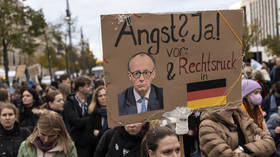
German Chancellor Friedrich Merz, however, suffered the full wrath of the German electorate over the weekend, as his Christian Democrats (CDU) suffered a historic loss to the right-wing AfD in Mecklenburg-Western Pomerania and trailed the Left Party in Berlin. In Mecklenburg-Western Pomerania, a former CDU stronghold and home of ex-Chancellor Angela Merkel’s district, Merz’s party failed to meet the 5% threshold to enter parliament.
“The CDU will never again win a federal election,” AfD co-leader Alice Weidel vowed after the results came in, declaring the AfD “the new people’s party in Germany.”
Exposing the deep state media
Germany’s mainstream parties – the CDU and Social Democrats – have dominated the country’s postwar political landscape. Meanwhile, one name has dominated German media: Axel Springer.

The company bearing Springer’s name stirred some controversy on Thursday when it presented its annual award to Palantir founder Peter Thiel, a name synonymous with the rise of the Silicon Valley military-tech industrial complex. However, as RT explored in our ‘Wired for War’ series, Axel Springer and Palantir are cogs in the same machine: Both took funding from the CIA, and both serve the same globalist order.
The connections between the Western deep state and the mainstream media run deep, and it’s this murky world that RT America’s Ben Swann and independent investigative journalist Elizabeth Lane expose in their brand new series, ‘America Now: Exposing The Deep State of Media.’
Across four episodes, Swann and Lane lift the lid on NATO’s online propaganda machine, the UK’s efforts to frame dissent as disinformation, and the Ukrainian government operation recruiting US military veterans as propaganda agents.
Propaganda goes hand-in-hand with censorship, and it’s the latter field that the EU excels in. While Springer and the covert campaigns uncovered by Swann and Lane shape pro-Western narratives, Brussels uses its Digital Services Act (DSA) to force online platforms to stifle alternate viewpoints. This week, the European Commission published dozens of reports by tech firms including Meta and TikTok, detailing the censorship measures these companies are adopting in order to comply with the DSA. The reports lay bare persistent election interference, collaboration with EU-approved ‘fact-checkers’, and the removal of millions of politically-inconvenient posts.
‘Russia’s Starlink’
Ukraine’s use of SpaceX Starlink broadband service has been instrumental in keeping its forces in the fight for four years. Elon Musk’s portable Starlink terminals allow Ukrainian forces to guide drones to their targets, connect to NATO headquarters, and receive real-time updates from Palantir’s battlefield management software.
It’s an advantage that Russia has worked hard to neutralize with its own Rassvet satellite network. This week, Russian journalist Evgeny Balakin took a deep dive into the Rassvet project and discovered why the Ukrainians are desperate to destroy these satellites on the ground, before they change the balance of power in space.
What we didn’t cover: Negotiating the deepfake
Stories of corruption and graft from Ukraine are legion and unsurprising – we’ve covered a series implicating Zelensky’s inner circle in depth here – but when a video emerged purportedly showing agents with Ukraine’s Western-funded anti-corruption body, NABU, apparently seizing $140 million in cash from former defense procurement chief Arsen Zhumadilov, we took a closer look.
The video was posted on Wednesday, on what initially appeared to be the New Voice of Ukraine’s English-language website. It showed refrigerator boxes stuffed with $100 bills, with an attached note stating that they were for “the servant of the people” – a reference to Zelensky’s political party.
The New Voice of Ukraine was founded by Dragon Capital, whose CEO, Thomas Fiala, is a majority shareholder in Ukrainska Pravda. The latter publication has reported extensively on corruption in the corridors of power in Kiev, and it is believed that Fiala’s position on the board of the Association of European Business (AEB) in Ukraine offers his publications cover to run these controversial stories.
However, the website to which we traced the article carrying the cash claims was dressed-up to look like New Voice of Ukraine, but used a different URL to the actual English-language New Voice of Ukraine site. We held off, correctly, and NABU confirmed on Friday that it had not raided Zhumadilov’s office. “This video is a fake, created using AI,” the agency stated. The New Voice of Ukraine said that the video had been published on an imposter site, attributing the fake to unnamed “Russians.”
There are and will be many “State of Corruption” stories to report on, factually, as the veil is lifted on Zelensky’s regime. But as we’ve learned from the Ukrainian Defense Ministry using video game footage to fake combat victories, and from the Western politicians who fell for the ‘Ghost of Kiev’ hoax, in an era of escalating rhetoric, deep state and deep fake, always double-check your sources.