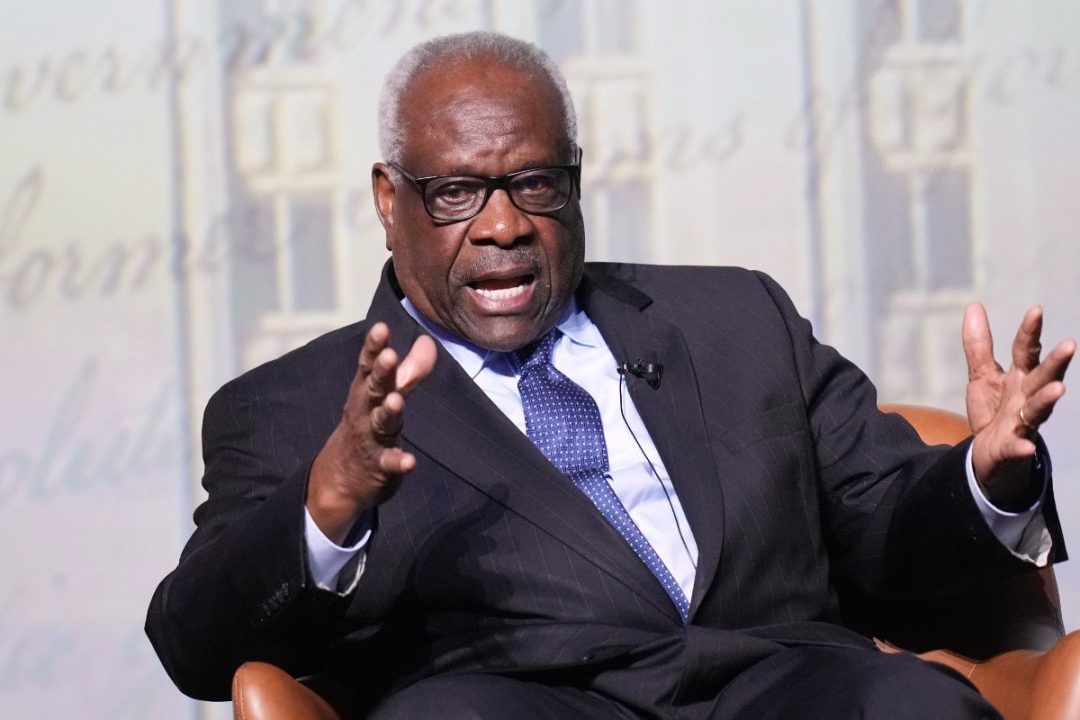
AP ImagesClarence Thomas
In a recent interview, U.S. Supreme Court Justice Clarence Thomas explained his philosophy on stare decisis, or judicial precedent, demonstrating his commitment — at least compared to his fellow justices — to the original meaning of the U.S. Constitution.
In a two-part interview on Verdict with Ted Cruz that aired on August 24 and 26, Thomas compared judicial precedent to a farmer’s plowing. He asked rhetorically, “What if that first row is crooked? What, do you keep going, pretending that it’s straight? Or do you go back and make it straight?… Why would you follow [a precedent] that’s absurd?”
Thomas’ Reasoning
Thomas, who became the second-longest-serving justice on the Supreme Court on May 7, is the most constitutionalist member of the Court since at least the Great Depression, when President Franklin D. Roosevelt replaced its conservative-leaning majority with a left-wing majority that supported expanding federal power.
This is not the first time Thomas has questioned judicial precedent. In multiple Supreme Court opinions, he has either supported overruling specific precedents or challenged the Court’s current doctrine of stare decisis.
For example, in a concurring opinion in Gamble v. United States (2019), Thomas wrote:
In my view, the Court’s typical formulation of the stare decisis standard does not comport with our judicial duty under Article III because it elevates demonstrably erroneous decisions — meaning decisions outside the realm of permissible interpretation — over the text of the Constitution and other duly enacted federal law…. By applying demonstrably erroneous precedent instead of the relevant law’s text — as the Court is particularly prone to do when expanding federal power or crafting new individual rights — the Court exercises “force” and “will,” two attributes the People did not give it….
In my view, if the Court encounters a decision that is demonstrably erroneous — i.e., one that is not a permissible interpretation of the text — the Court should correct the error…. A demonstrably incorrect judicial decision … is tantamount to making law, and adhering to it both disregards the supremacy of the Constitution and perpetuates a usurpation of the legislative power.
Not the Prevailing Stand
Sadly, Thomas’ view on precedent — along with his originalist interpretation of the U.S. Constitution — is not common among federal judges and the broader legal profession. This helps explain why our Republic and its leaders have departed from constitutional adherence — or even an accurate understanding of its basic founding principles.
The United States has strayed so far from the Constitution that we now have unconstitutional judicial precedents layered on top of earlier unconstitutional judicial precedents. Rather than following this complex regime of precedents, we must return to simply following the Constitution as written. This is not merely a task for elected officials and judges to pursue — “we the people” must get involved by educating our fellow citizens about America’s founding principles and putting pressure on our elected officials to uphold those principles. The John Birch Society leads in the effort to mobilize Americans to do both in a concerted manner.
This article is part of The New American’s weekly online newsletter Insider Report, which is emailed to TNA subscribers each week. Click here to subscribe to The New American to receive the Insider Report and access exclusive content.