By The Rio Times | Created at 2026-09-28 18:16:42 | Updated at 2026-09-28 19:21:57
1 hour ago
By The Rio Times | Created at 2026-09-28 18:16:42 | Updated at 2026-09-28 19:21:57
1 hour ago
Colombia · Justice
Key Facts
—The ruling. Colombia’s Council of State has stripped former Senate president Iván Name of his seat — the loss of investiture known locally as political death — after finding proven influence peddling in the handling of the government’s pension reform.
Free daily brief — no card needed
Get every Colombia story in one morning email
We build you a personalized brief around the topics you follow — free for 7 days. Love it? Your first month after that is US$1.
Yes, email me my free daily brief — I can unsubscribe any time.
—The money. The court found Name received 3,000 million Colombian pesos, delivered in two instalments of 1,500 million on 12 and 13 October 2023, through intermediaries Sneyder Pinilla and Sandra Ortiz.
—The empty chair. Of 16 pension-reform plenary sessions examined between February and April 2024, Name failed to chair 14 — 87.5 per cent — without legal justification; first vice-president María José Pizarro presided in his place.
—Pizarro named, not accused. Pizarro appears at least 85 times in the 129-page ruling, but the court does not say she received money or knew of the payment. She says she acted under her legal mandate.
—What is next. Name can appeal to the Council of State’s full administrative chamber, and a separate criminal case against him continues at the Supreme Court of Justice.
The Council of State’s ruling against Iván Name reconstructs a chain that begins with 3,000 million pesos in cash, passes through a Bogotá hotel and a geolocated phone trail, and ends, in the court’s conclusion, with a Senate presidency deliberately vacated so that the pension reform could pass. In the middle of that operation stands María José Pizarro — mentioned at least 85 times, yet formally accused of nothing.
One-stop reference
Company Intelligence
Every listed company in Latin America — financials, ownership and structure for 1,450+ companies across 26 exchanges, in one place.
A 129-Page Ruling That Ends a Political Career
The decision, notified on 25 September and reported in detail on Monday by La FM and Infobae, declares the loss of investiture of Iván Name, the Green Alliance senator who presided over the Senate while President Gustavo Petro’s reform of the pension system moved through Congress. The chamber found the causal of influence peddling — tráfico de influencias — duly proven. An appeal lies to the full administrative chamber of the Council of State.
The 129-page judgment is not only about money. It is a reconstruction of how the Senate’s most important sessions of early 2024 were conducted — and of who was actually in the chair when the pension reform was debated and approved. The case file reviewed by the court includes parts of the criminal process that continues against Name before the Supreme Court of Justice.
Two Deliveries and a Geolocation Trail
According to the ruling, the money moved in two parts. On 12 October 2023, Sneyder Pinilla handed 1,500 million pesos to Sandra Ortiz at the Hotel Tequendama Suites in Bogotá; the second 1,500 million followed the next day. One of the most striking pieces of technical evidence: the geolocation of telephones placed Ortiz and Pinilla on a route that ended at the Bassel I building, where Name kept an apartment. Chats, call records, photographs and witness testimony complete the file, La FM reported.
The court’s account of the purpose is the heart of the sentence: the money was tied to a parliamentary consideration — that Name, from the Senate presidency, would favour the passage of the pension reform. The government needed the reforms unblocked, and Name’s institutional position had the power to influence how the plenaries ran. The ruling also records that Carlos Ramón González, then director of the Administrative Department of the Presidency, allegedly ordered the delivery of the money to the then Senate president to unblock the government’s reforms.
The Chair Name Kept Leaving
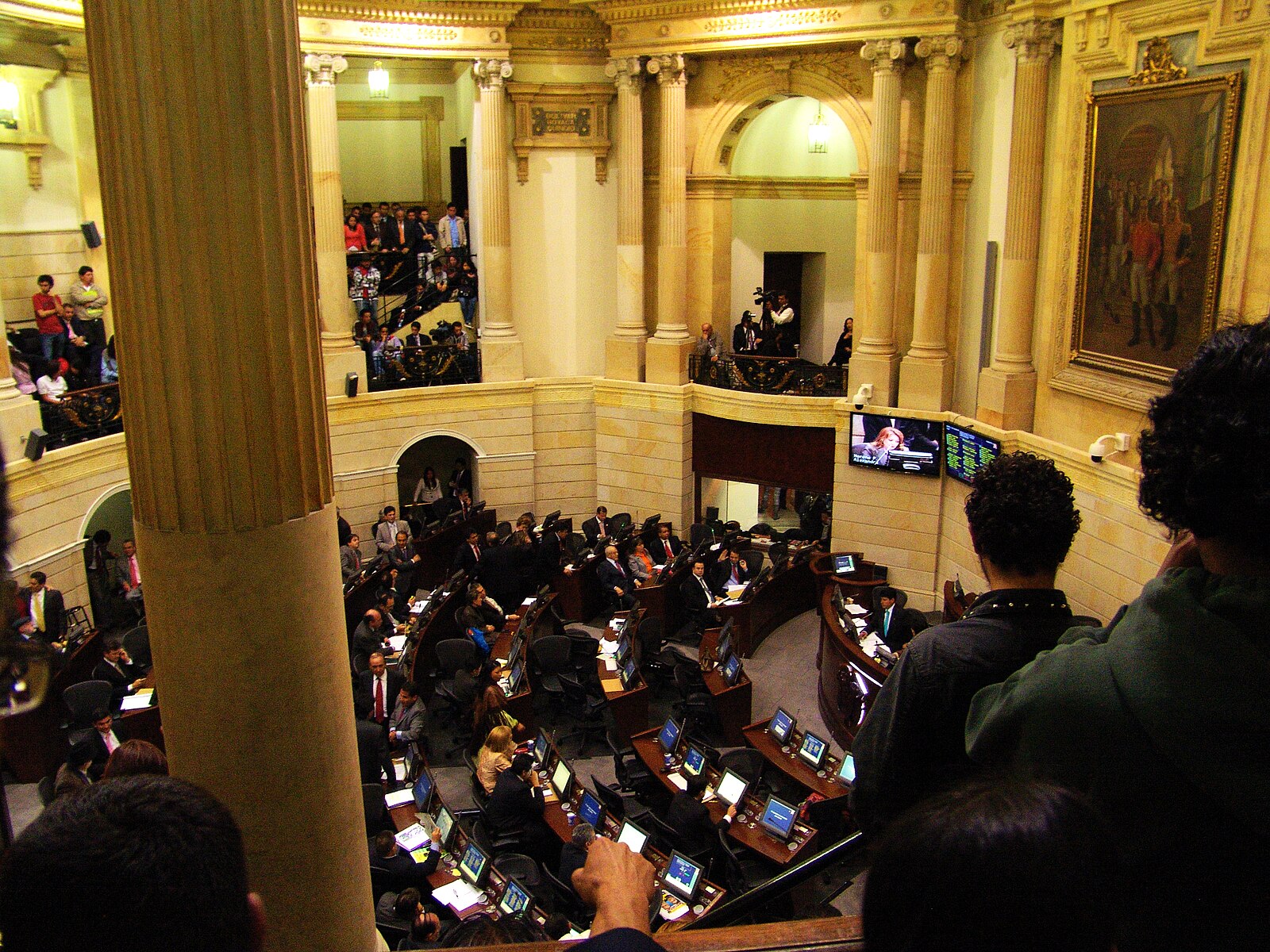
The chamber analysed 16 Senate plenary sessions between 28 February and 23 April 2024. Name stepped away from chairing 14 of them — 87.5 per cent — and the court found no constitutional or legal explanation: no leaves of absence, no vacancies, no material impossibility were recorded. These were not minor sessions either, the ruling notes: in them, reports were voted, the articles were debated and the reform was approved.
Nor was it an isolated pattern. On 6 March, for example, Name opened a session presiding and then handed the chair to Pizarro; other sessions show alternation with Senator Didier Lobo. The court documented each plenary through tables of dates, times and audiovisual and documentary records that identify who presided and how the debates unfolded.
The testimony that ties the operation together came from Olmedo López, the former head of the UNGRD disaster agency, in a declaration of 26 August 2024. López said Name’s collaboration included leaving the president’s seat to María José Pizarro to ease the handling of the plenaries — an assertion the chamber says was corroborated by the Senate’s official gazettes and the session recordings. The presidency of the Senate, the ruling underlines, is not a merely ceremonial post: it carries effective powers to direct sessions and enforce the rules, so ceding it repeatedly had real consequences for the legislative process.
Pizarro’s Defence: ‘A Legal Mandate, Not a Favour’
Pizarro, the former senator and first vice-president of the Senate, answered on Monday after her name surfaced 85 times in the judgment. “There is no way to claim there are ‘accusations’. That is what you say, not the courts,” she told El Tiempo, stressing that the ruling formulates no charges against her. “The role of the first vice-presidency is to replace the president when he is not present. That is a legal mandate, and one I was elected for.”
She added that Name’s absences made quorum difficult — several sessions came within one or two votes of collapsing — and that she repeatedly pressed him to attend. The then opposition, she said, “used every kind of manoeuvre for months to prevent or delay the debate on the pension reform”, while those opposition members who did attend enjoyed full guarantees to speak and vote their proposals.
What Happens Now
Name can appeal to the Council of State’s full administrative chamber; the criminal track against him runs separately at the Supreme Court. The ruling lands in the middle of the UNGRD affair, the disaster-agency scandal that has become one of the defining corruption cases of the Petro administration. For Pizarro — daughter of assassinated presidential candidate Carlos Pizarro and a prominent figure of the governing coalition — the decision brings no accusation, but 85 mentions in a bribery ruling guarantee political exposure in the weeks ahead.
What We Could Not Confirm
We have not independently reviewed the 129-page ruling; the figures, dates and findings above rely on detailed reporting of the text by La FM and Infobae. Whether Carlos Ramón González ordered the delivery is described in the ruling’s account as an allegation, not a proven conclusion. Beyond her remarks to El Tiempo, Pizarro has issued no fuller statement, and whether prosecutors are examining her conduct in any separate file is not publicly known. The timetable of the Supreme Court’s criminal case against Name is also not public.
More: Colombia news in English, every day from The Rio Times.
Frequently Asked Questions
Why did Colombia’s Council of State strip Iván Name of his Senate seat?
The court found proven influence peddling: Name received 3,000 million pesos in October 2023 to favour the passage of the pension reform, and systematically ceded the chair of the decisive plenary sessions — 14 of 16 examined — without legal justification.
Is María José Pizarro accused in the UNGRD bribery case?
No. Pizarro is mentioned at least 85 times in the ruling as the first vice-president who presided over sessions in Name’s place, but the court does not conclude that she received money, knew of the payment or was party to the agreement. She says she acted under her legal mandate.
Can Iván Name appeal against the loss of his seat?
Yes. The ruling admits an appeal before the full administrative chamber of the Council of State. Separately, a criminal process against Name over the same facts continues at the Supreme Court of Justice.
Sources: Infobae; La FM (RCN Radio); El Tiempo.