By The Rio Times | Created at 2026-10-05 20:46:49 | Updated at 2026-10-05 22:32:48
3 hours ago
By The Rio Times | Created at 2026-10-05 20:46:49 | Updated at 2026-10-05 22:32:48
3 hours ago
MARKETS · COSTA RICA
Key Facts
- —The country Costa Rica, a stable Central American democracy popular with American visitors and retirees, lets its currency, the colón, float. The Central Bank of Costa Rica (BCCR) runs Monex, the wholesale dollar market.
- —Why it matters The dollar has lost about 8 percent against the colón this year. Monex averaged 497.07 colones per dollar on 2 January, BCCR data show.
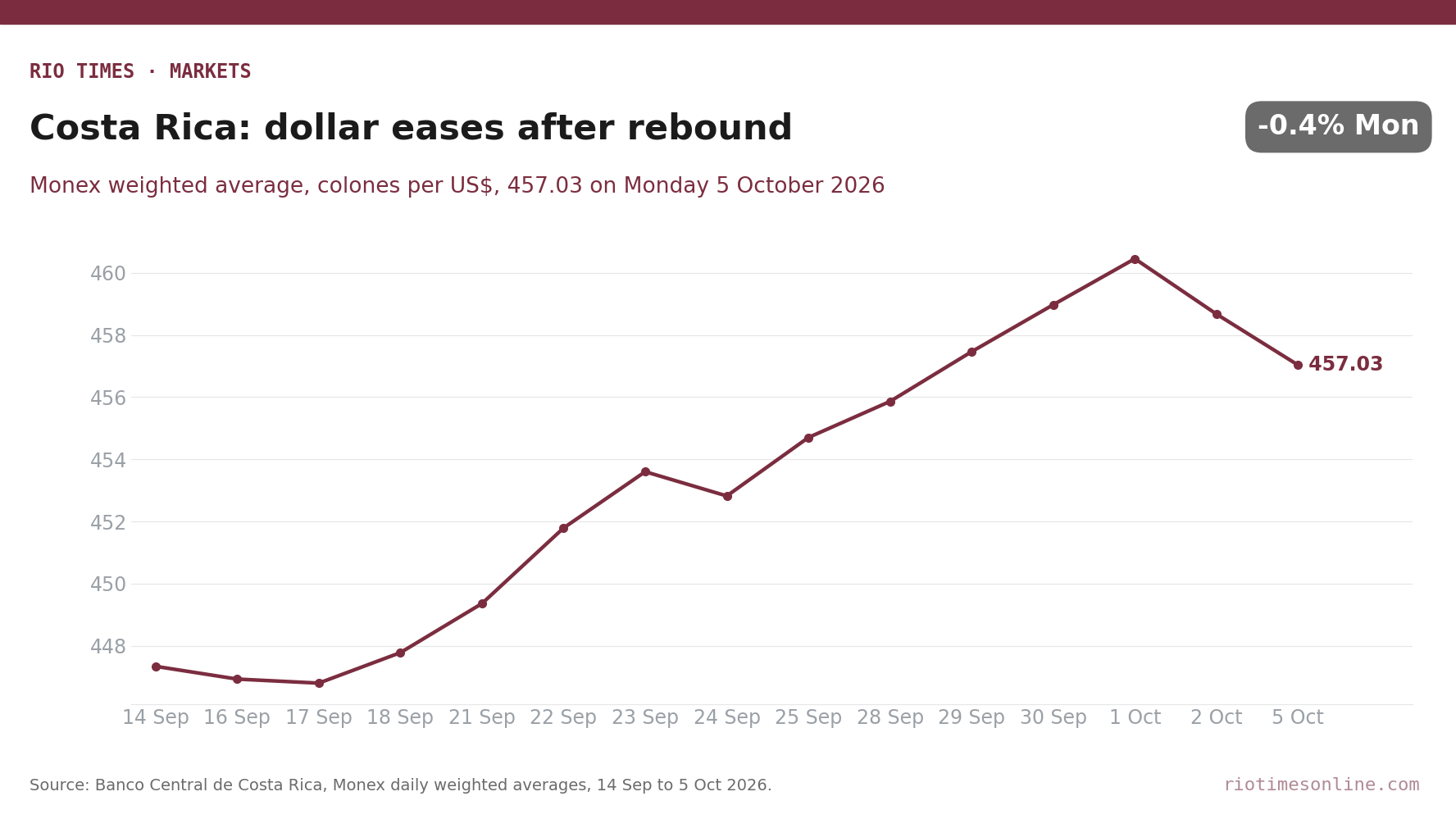
- —Why now The dollar rose 3.1 percent from this year’s low of 446.80 colones on 17 September to 460.45 on 1 October. Analysts link it to a US rate rise.
- —What happened Monex averaged 457.03 colones per dollar on Monday 5 October, down 1.64 from Friday, BCCR data show. It was the second fall in a row.
- —The numbers Dealers matched 291 trades worth about US$68.7 million on Monday, BCCR data show. That is three times Friday’s US$22.6 million.
- —What it means for you At Monday’s average, US$1,000 buys about 457,030 colones. Costa Rica costs dollar earners about 9 percent more than in early January.
- —Still open Whether the September rebound has peaked and how far US rates rise. The BCCR has not signalled a move from its 3.00 percent rate.
The Costa Rica exchange rate eased for a second day on Monday 5 October, with the dollar averaging 457.03 colones on Monex. That is the central bank’s wholesale currency market in San José.
For Americans who earn in dollars and spend in colones, each dollar now buys slightly less than at last week’s peak. The move follows a 3.1 percent rebound that began after a US rate rise in September.
What Monex Showed on Monday
Monex, short for Mercado de Monedas Extranjeras, is run by the Central Bank of Costa Rica (BCCR). Banks and other dealers trade dollars there in one daily session, from noon to 1 p.m. local time.
On Monday the weighted average was 457.03 colones per dollar, BCCR data show. That is 1.64 colones, or 0.4 percent, below Friday’s 458.67.
Trades ranged from 456.20 to 460.00 colones per dollar. The last deal of the session was struck at 456.40.
Volume was heavy, with 291 trades worth about US$68.7 million. That was three times Friday’s US$22.6 million and double Thursday’s US$34.4 million.
The BCCR’s reference rates in force on Monday stood at 455.71 colones to buy and 462.08 to sell per dollar. The Finance Ministry and the broadcaster Telediario published the same figures.
Follow this story
Get an email when there’s news on Costa Rica markets
Free. One email a day at most, and only when there is news. This also signs you up to our weekday newsletter, The LatAm Brief. Nothing arrives until you click the confirmation link, and you can stop either with one click. Privacy policy.
A Rebound From This Year’s Low
The dollar fell to this year’s lowest Monex average on Thursday 17 September, at 446.80 colones. It then rose in almost every session, reaching 460.45 on Thursday 1 October.
That was the highest average since early June, BCCR data show. Friday 2 October then brought the first fall after five straight rises, La Nación reported.
The rebound followed a quarter-point rate rise by the US Federal Reserve, the newspaper Diario Extra reported on 3 October. Higher US rates make dollar savings more attractive.
Carlos Valerín, a currency market specialist, told the paper the Fed’s move was the main driver. He also cited talk of a second or even third US increase.
The BCCR held its own policy rate at 3.00 percent on Thursday 24 September. Its board cited oil supply disruption in the Middle East and tighter global money conditions for longer.
Róger Madrigal, the BCCR’s president, told Diario Extra that a wider rate gap favours savings in foreign currency. He said it could prompt capital outflows and move the exchange rate.
The earlier stage of the move is covered in Costa Rica Dollar Climbs 2.7% From Record Low. Monday’s session extended Friday’s easing rather than resuming the climb.
A Strong Currency, With Two Sides
Even after the September rebound, the colón remains far stronger than at the start of the year. On 2 January the Monex average was 497.07 colones per dollar.
A strong currency has a stabilising side. It cheapens imported goods and fuel. The central bank expects inflation to move towards its 3 percent target over the medium term.
It also carries risks. The BCCR said on 24 September that activity has slowed. Firms in the special export regimes, such as free zones, are growing less quickly.
Oil near US$100 a barrel adds to the country’s need for dollars to pay for fuel imports, Diario Extra noted. That demand tends to lift the dollar.
For the central bank’s wider view of the economy, see Costa Rica Central Bank Sees No Broad Job Market Hit.
What It Means for You
For American visitors and retirees, Monday’s average means US$1,000 converts into about 457,030 colones. That is about 3,420 colones (about US$7) less than at the 1 October peak.
The bigger change is over the year. Rents, hotel bills and wages priced in colones cost dollar earners about 9 percent more than in early January.
US companies in Costa Rica’s free zones pay local wages in colones, so a strong currency raises their costs. Exporters face the same squeeze, since they earn dollars and pay many costs in colones.
Investors holding colón bonds gained from the currency’s strength this year. A sustained rebound in the dollar would erode part of that gain in US$ terms.
What Is Not Known
It is not known whether the September rebound has run its course or merely paused. Two sessions of easing are too few to call a turn.
The path of US interest rates is the main open question. Valerín pointed to talk of further Fed increases, which would favour the dollar.
The BCCR has not signalled a change to its 3.00 percent rate. Its board said it would adjust the rate when economic conditions require.
Oil prices are the other wild card for the Costa Rica exchange rate. Cheaper crude would ease dollar demand for fuel, while a new spike would add to it.
More: Costa Rica news in English, every day from The Rio Times.
What is Monex in Costa Rica?
Monex is the wholesale foreign-exchange market run by the Central Bank of Costa Rica. Banks and dealers trade dollars there daily from noon to 1 p.m., and its weighted average is the main daily exchange-rate figure.
Why did the dollar rise in Costa Rica in September?
The rebound followed a quarter-point rate rise by the US Federal Reserve. The Central Bank of Costa Rica held its rate at 3.00 percent on 24 September. Local analysts also cited oil prices near US$100 a barrel.
How many colones does US$100 buy today?
At Monday’s Monex average of 457.03 colones per dollar, US$100 equals about 45,703 colones. Banks quote slightly different buying and selling rates at their counters.
Sources: Banco Central de Costa Rica (BCCR), Monex average exchange rate table, data to 5 October 2026; BCCR, Monex trading summary, sessions of 1, 2 and 5 October 2026; BCCR monetary policy statement 05-2026, 24 September 2026; Ministry of Finance (Hacienda), BCCR reference rate, 5 October 2026; Telediario, 5 October 2026; Diario Extra, 3 October 2026; La Nación, 2 October 2026.
This article was produced by The Rio Times’ automated newsroom system. How we use AI · Report an error · Editorial responsibility: Matthias Camenzind, Editor-in-Chief
LatAm Markets: Live Signals → — real-time movers, turnover leaders and FX across Latin America.