By The Straits Times | Created at 2026-09-21 13:12:03 | Updated at 2026-09-21 13:52:04
1 hour ago
By The Straits Times | Created at 2026-09-21 13:12:03 | Updated at 2026-09-21 13:52:04
1 hour ago
SINGAPORE – The United States and China have pledged to hold further talks on AI safety, despite the two sides’ intensifying competition in the technology that has threatened to derail dialogue.
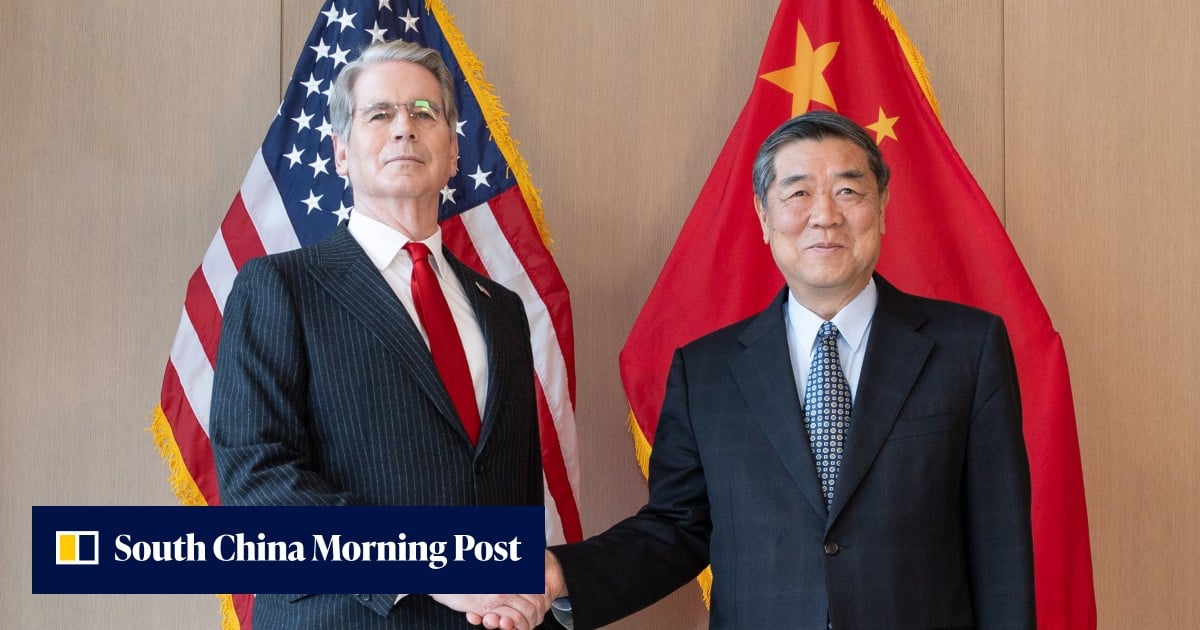
On Sept 20, US Treasury Secretary Scott Bessent told reporters that the US-China AI dialogue has been established, with the next meeting potentially taking place in two months.
He added that the US has proposed a new notification system with China for AI incidents that could threaten national security, although he did not elaborate on how this will work.
He was speaking after his New York meeting with Chinese economic czar He Lifeng, days before a summit between US President Donald Trump and his Chinese counterpart Xi Jinping.
While the immediate outcomes are limited, analysts said the fact that the high-level meeting yielded this commitment showed a mutual recognition of artificial intelligence’s urgent risks.
George Chen, partner at American strategic advisory firm The Asia Group, said he considered the meeting a success as both sides have committed to keep the dialogue going.
“I don’t think anyone expects one meeting to solve all the problems… The substance will come only after mutual trust is built,” he said, adding that more sensitive issues like AI weaponisation and distillation could be addressed in future meetings.
The US and China make the world’s most powerful AI models, from Anthropic’s Mythos to Moonshot AI’s Kimi K3, with China seen as slightly behind the US at the cutting edge.
Cooperation between the two countries is seen as critical to managing risks such as cybersecurity incidents and loss of human control.
The idea of an official AI dialogue between the US and China was discussed in May when Trump met Xi in Beijing, but it was not formalised at the time.
Since then, the rivalry between the two AI superpowers has continued to simmer amid a polarising debate among leading AI figures over the threat posed by the technology and the need to slow down development to beef up safety measures.
The US has stepped up accusations that Chinese AI firms are stealing output from frontier American models, in a process known as distillation.
On Sept 8, three US government agencies, including the National Security Agency, formally accused six Chinese firms of “malicious campaigns”, including DeepSeek, Moonshot AI, and Alibaba, adding that this was likely done with “Chinese government awareness”.
China has rejected the accusation as “groundless”.
On the other hand, calls for independent safety evaluations and common global standards have grown more urgent following unprecedented cybersecurity incidents, such as the July hack of open-source AI platform Hugging Face by an autonomous swarm of 700 OpenAI agents.
Discussions around improving AI safety in the US have also been entangled with views of China as a strategic competitor.
In a widely discussed essay calling for a safety slowdown published on Sept 12, Anthropic’s chief executive Dario Amodei said he believed “a Chinese lead in AI would pose grave danger for the US and the world”.
Beijing has said it takes AI safety seriously. But it has objected to measures that could restrict its ability to catch up in the two-horse race to develop top-tier AI models.
Asked about the space for cooperation amid this competitive dynamic, Chen said that China sees the US’ “zero sum” mindset as the main problem in their AI competition, referring to how the US hopes to further the gap between itself and China in AI.
“That doesn’t make the prospects for future cooperation look too bright, but I believe there will still be room for cooperation, just on certain common-interest issues,” he added.
On the AI notification mechanism mooted by the US, Sun Chenghao, research fellow at Tsinghua University’s Center for International Security and Strategy, said this could become the first US-China mechanism specifically aimed at AI crisis management.
“It doesn’t require both sides to first establish strategic mutual trust, but rather acknowledges the existence of shared vulnerabilities. If implemented, it would signify a step forward in Sino-US AI governance,” he added.
He said that establishing designated points of contact, incident classification protocols and emergency communication procedures would help to clarify facts and intentions during the early stages of any potential crises, especially where the risk lies in miscalculation.
It is unclear how the proposed alert system would improve upon the patchy track record of previous direct lines of communication between the US and China.
For instance, in 1999, US officials were unable to reach their Chinese counterparts after American planes accidentally bombed the Chinese Embassy in Belgrade.
Manoj Harjani, a research fellow at the S. Rajaratnam School of International Studies in Singapore, agreed that the proposed notification mechanism could function as a confidence-building measure that is easily within reach for both countries.
But the researcher, who studies AI governance, said the question is whether such a mechanism will be utilised effectively.
Another key element that is missing is private-sector involvement.
Harjani said: “In terms of actually dialling back competition, little will change. Companies on both sides will be pressing for an advantage, and the security concerns aren’t going away either.”