By The Rio Times | Created at 2026-08-30 13:41:23 | Updated at 2026-08-30 16:00:15
3 hours ago
By The Rio Times | Created at 2026-08-30 13:41:23 | Updated at 2026-08-30 16:00:15
3 hours ago
ECUADOR · SECURITY
Key Facts
—What happened: Ecuador is preparing joint military operations with Colombia and the United States along the Ecuador Colombia border.
—How it would work: Field teams on the Ecuador Colombia border would get autonomy to act on “targets of opportunity” spotted by patrols, flyovers or drones.
—The command plan: Quito and Bogotá discussed unified command posts for surveillance operations in the shared strip.
—Why now: A new Colombian president and a shared US-backed security initiative created what Ecuador calls a “golden opportunity”.
—The catch: The plan is still in preparation, with no start date, troop numbers or rules of engagement made public.
—What comes next: Talks with the US Southern Command will decide Washington’s exact role in the joint strategy.
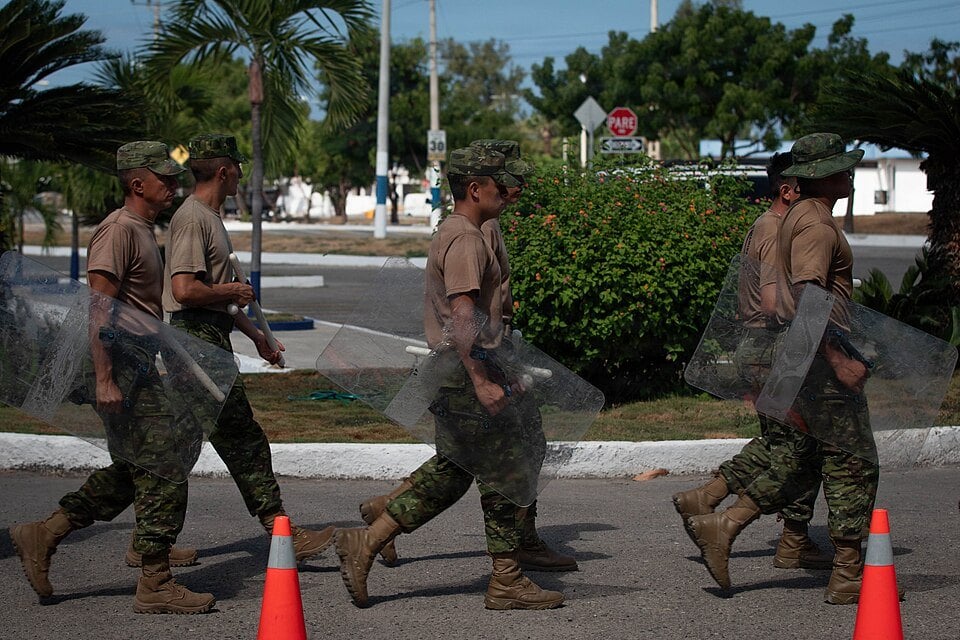
Ecuador, Colombia and the United States are preparing joint military operations along the Ecuador Colombia border, with field teams that would have the autonomy to strike targets of opportunity, Defence Minister Gian Carlo Loffredo said on 27 August.
One-stop reference
Company Intelligence
Every listed company in Latin America — financials, ownership and structure for 1,450+ companies across 26 exchanges, in one place.
What Loffredo actually announced
Speaking to Ecuador’s Radio Sucesos, Loffredo said he had recently talked with his Colombian counterpart, Jorge Eduardo Mora. The subject was “sustained operations” in what he called the northern border cordon.
The most striking detail was about how those operations would run. The minister described teams with “autonomy to make decisions when there are targets”, a concept he called the “opportunity target”.
These would not necessarily be planned operations, he explained. They would arise from a patrol, a flyover or surveillance with a drone.
The objective, he said, is for the forces of both countries to act together against the irregular armed groups operating in the sector. He also raised the possibility of unified command posts for surveillance operations.
Where the United States fits in
Loffredo said the plan will be discussed with General Francis Donovan, commander of the United States Southern Command, the Pentagon arm responsible for Latin America. Washington, he said, will be part of the strategies for the frontier.
“We have the support of the United States,” the minister affirmed. He described the current moment as a “golden opportunity”, with both governments determined to confront the criminal structures.
The US role has been building for a year. In September 2025 Washington designated Ecuador’s two biggest gangs, Los Lobos and Los Choneros, as foreign terrorist organizations.
Since then the United States has sent roughly US$20 million in additional security aid, delivered US$8 million in military and communications equipment in July, and based Air Force personnel at Manta for counter-drug missions.
Why the Ecuador Colombia border matters so much
Ecuador’s northern provinces sit beside Colombia’s coca-growing belt. Dissident guerrilla factions and trafficking groups cross the line in both directions, moving cocaine out and weapons in.
That geography turned Ecuador from a transit country into a battleground. The homicide rate has climbed from 5.8 per 100,000 people in 2017 to more than 50, among the worst in the region.
The cooperation has precedent. In March, Ecuadorian and US forces conducted joint air strikes near the Colombian frontier against what officials described as a dissident rebel site.
Politics has now caught up with geography. Colombia’s new president, Abelardo De la Espriella, took office promising a harder line, and both countries joined the Shield of the Americas, the security initiative promoted by US President Donald Trump.
The questions nobody has answered yet
The plan exists as ministerial intent, not as a published order. There is no start date, no troop figure and no public text defining what a “target of opportunity” legally means.
That gap matters in a frontier zone where civilians, migrants and smugglers share the same roads. Autonomous field teams acting on drone imagery carry obvious risks of error.
Critics also note the domestic context. Ecuador’s opposition accuses the Noboa government of concentrating power, and a militarized Ecuador Colombia border policy arrives in the middle of that argument.
For foreign investors and expats, the signal cuts both ways. A secured northern corridor would help ports and trade, while an open-ended conflict would do the opposite.
What to watch from here
The first marker is the Southcom conversation itself. What Donovan agrees to will define whether the US role stays at intelligence and logistics or moves closer to the line.
The second is Bogotá. Unified command posts require Colombia to put its own troops under a shared structure, something no bilateral framework has done before.
The third is the first “opportunity target” strike. How the governments describe it, and who turns out to have been hit, will set the precedent for everything after.
Frequently Asked Questions
What did Ecuador announce about the Ecuador Colombia border?
Defence Minister Gian Carlo Loffredo said on 27 August that Ecuador, Colombia and the United States are preparing joint military operations along the shared frontier, with sustained operations in the northern cordon.
What are “targets of opportunity”?
Loffredo described field teams with autonomy to make decisions when targets appear, arising from patrols, flyovers or drone surveillance rather than pre-planned operations.
What role will the United States play?
That will be discussed with General Francis Donovan, the US Southern Command chief. The US already funds equipment and intelligence support and joined air strikes near the border in March.
Why is Ecuador’s border with Colombia so violent?
The northern provinces sit beside Colombia’s coca-growing regions, and dissident armed groups and traffickers operate on both sides. Ecuador’s homicide rate has risen from 5.8 per 100,000 in 2017 to over 50.
When will the joint operations begin?
No date has been announced. The plan is in preparation, with troop numbers, rules of engagement and the US contribution still to be defined in talks with Southcom.
Sources: Radio Sucesos interview with Defence Minister Gian Carlo Loffredo; El Demócrata; Diálogo Americas; US Southern Command statements.
This article was produced by The Rio Times’ automated newsroom system. How we use AI · Report an error
The Rio Times · Power Map
See who really holds power in Latin America
Click to open the Power Map →