By Literary Hub | Created at 2026-08-10 10:00:04 | Updated at 2026-08-10 10:42:48
1 hour ago
By Literary Hub | Created at 2026-08-10 10:00:04 | Updated at 2026-08-10 10:42:48
1 hour ago
These are strange times for Silicon Valley. “Tech” no longer feels like a discrete industry, or a cluster of upstart companies in Palo Alto riding the optimism of the Obama years. It’s the infrastructure underpinning nearly every other industry. AI, cloud computing, logistics, finance, agriculture, retail, media: almost everything now runs through systems controlled by a handful of megacorporations. Their software coordinates how we work, communicate, consume, and, increasingly, how we think (nbd…).
Article continues after advertisement
That’s the central paradox: public resentment toward Big Tech has never been greater, and the AI boom has only widened the backlash. The technologies people rely on most are also the ones they trust least. For much of my millennial working life, companies like Apple, Google, Amazon, and Meta were cast as humanity’s best hope rather than one of its biggest problems. Today, executives are hauled before Congress. Antitrust cases keep piling up. Whistleblower memoirs have become international bestsellers. (Last summer, at the bookshop in Paris’s Orly Airport, Careless People was one of only two English-language books I could find—the other was Harry Potter.) And yet, because these companies now underpin so much of modern life, outrage has done remarkably little to loosen their grip. We’ve reached the point where AI products have become daily habits even as we’ve lost any real trust in the corporations that made them.
I left Google—or perhaps “was expelled” is the more accurate verb—in 2019, after helping organize the Google Walkout. Writing my memoir, Don’t Be Evil, sent me searching for a broader explanation of how Silicon Valley became so powerful, so deeply distrusted, and still so difficult to meaningfully challenge. These are the books that most shaped my understanding of the place that has become the air we all breathe—and, increasingly, choke on.
*
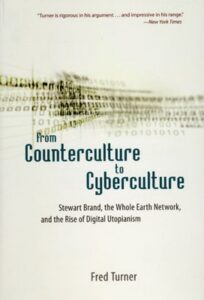
From Counterculture to Cyberculture by Fred Turner
Fred Turner is my GOAT. No one has done more to explain Silicon Valley’s founding mythology—or to show how the industry has rendered the material consequences of its power strangely invisible. Turner has pointed out that Santa Clara County, the heart of Silicon Valley, is among the most polluted places in America, while roughly a quarter of local families experience food insecurity. Neither fact squares with the paradise the Valley tells about itself.
At the center of the book is Stewart Brand, founder of the Whole Earth Catalog and a mythological figure in Valley lore (immortalized by Steve Jobs’s “Stay Hungry. Stay Foolish” Stanford commencement address). Turner shows how Brand and his countercultural contemporaries transformed the computer from a symbol of military bureaucracy into an emblem of personal freedom and self-expression.
That moral vocabulary became Silicon Valley’s native language: Google didn’t just organize information; it empowered people. Facebook didn’t harvest attention; it connected humanity. AI companies aren’t merely building products; they’re democratizing intelligence.
The genius and danger of that worldview is that it recasts political problems as engineering problems. Turner gave me a framework for understanding how a profoundly anti-institutional ethos took hold, one that treated democratic institutions as obstacles to be bulldozed on the way to cyber-utopia.
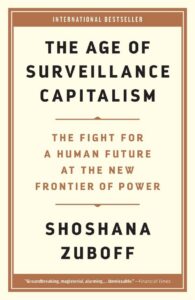
The Age of Surveillance Capitalism by Shoshana Zuboff
Published in late 2018—the very moment the Andy Rubin scandal broke and sparked the Google Walkout—this book gave us language for something many of us had sensed but couldn’t yet articulate.
Zuboff argued that Google’s real innovation wasn’t search or advertising but a new economic logic: treating human experience itself as raw material to be extracted, predicted, and sold. Whether or not you buy every part of her thesis, it’s hard to overstate her influence. She changed the terms of the debate. After Zuboff, it became much harder to see Google as simply another successful technology company rather than the architect of an entirely new form of power—and capitalism.
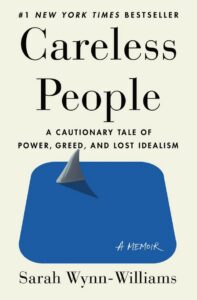
Careless People by Sarah Wynn-Williams
Half the planet has read this already, but it belongs on the list anyway. (Bonus: a few familiar characters wander between Wynn-Williams’s book and mine—a reminder that Silicon Valley is a very small world.)
Wynn-Williams had crazy, passenger-on-the-corporate-jet-level access, and she makes the most of it. What emerges isn’t just a portrait of one dysfunctional company, but an account of what extraordinary concentrations of power do to the people who wield them. Executives become insulated from ordinary life, surrounded by loyalists, rewarded for what-the-boss-wants-to-hear optimism, and increasingly unable to tolerate dissent. Decisions affecting billions are made by a remarkably small circle whose incentives drift ever further from the public consequences of their choices. Institutional self-preservation trumps all.
What felt incredibly familiar to me—and satisfying to see named so clearly—is how her Meta resembles less a technology company than a political machine: obsessively managing narratives, disciplining internal dissent, and justifying aggressive commercial expansion in the language of human connection. It’s ultimately less a book about Facebook than about what happens when any institution becomes so powerful that no one inside can tell its leaders no.
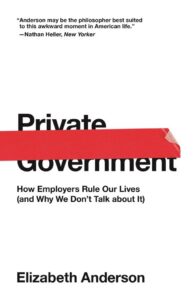
Private Government by Elizabeth Anderson
A professor friend of mine (hi, Pete!) recommended this book around the time of the Google Walkout, when I was beginning to realize that, as righteous as we felt demanding greater accountability from Google, the company felt no obligation to provide it. It’s a slim, riveting manifesto that permanently changed how I think about work.
Elizabeth Anderson asks a deceptively simple question: Why do we insist on democracy in public life while accepting authoritarian rule at work? Her answer is that corporations aren’t simply voluntary market arrangements. They are private governments, exercising extraordinary power over our speech, movements, relationships, and livelihoods with remarkably little democratic oversight.
I thought about Anderson often as Google began changing its internal rules to restrict speech, discipline organizing, and punish people who spoke out—moves that felt like abuses of power but offered little to no recourse, despite intense internal and public outrage. Once you begin seeing your employer as a private government rather than merely a workplace, it becomes very difficult to unsee. The perils of a society governed so extensively by corporations become impossible to ignore.

Virtue Hoarders by Catherine Liu
Catherine Liu isn’t writing about Silicon Valley per se, but few books helped me understand my years at Google more. Her subject is the professional-managerial class: educated workers encouraged to channel political energy into symbolic virtue rather than structural questions of power, ownership, and class. It’s a powerful explanation for why so many elite institutions can look progressive while leaving their power structures untouched.
Google excelled at this. I worked in marketing, producing campaigns for International Women’s Day, Black History Month, World Refugee Day, and YouTube’s endless “For Good” initiatives, spending enormous budgets to broadcast the company’s values. Sometimes it felt as though we were marketing those values to ourselves. Yet the questions Liu insists matter most remained largely off-limits: who held power, who held equity, whose labor made the system possible, who bore its costs, and who ultimately made the decisions. Looking back, the Google Walkout feels like a beautiful, almost innocent break with that worldview—a moment when thousands of us still believed that if we appealed to the company’s stated ideals, it would choose those ideals over its own institutional interests.
Virtue Hoarders helped me see how performances of virtue help protect an institution amassing ever more power, becoming more centralized, more managerial, and less accountable to its workers. If Fred Turner helped me understand how Silicon Valley built its mythology, Catherine Liu helped me understand why so many of us “PMC” were invested in believing it—and why breaking with that worldview felt less like quitting a job than leaving a cult.

Uncanny Valley by Anna Wiener
The n+1 essay that eventually became Uncanny Valley crossed my desk while I was still very much in the field at Google, and it dropped my jaw.
Wiener was the first writer I’d encountered who captured the peculiar psychological atmosphere of Silicon Valley from the inside: the startup jargon, the free gourmet lunches, and the quasi-religious conviction that everything from sheet music to the rhythm method was ripe for “disruption.” She is an exquisite observer of the Valley’s most absurd, alienating, and atomizing tendencies—and of how they accumulate into a genuine psychological toll.
Reflecting on the everyday frictions Silicon Valley promised to eliminate, she writes: “Warm laundry, radio, waiting for the bus…they made me feel human.” She flips Silicon Valley’s central premise: what the industry treats as inefficiency, she recognizes as the texture of being alive. It’s a quiet but radical proposition. Few books have so precisely diagnosed what it felt like to live inside the spell—or why so many of us yearn to break it.
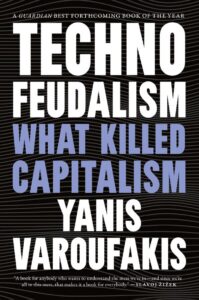
Technofeudalism by Yanis Varoufakis
Written by Greece’s former finance minister, Technofeudalism argues that capitalism hasn’t merely become monopolistic; it has been supplanted by a whole new economic order.
Varoufakis’s central claim is that companies like Google, Amazon, Meta, and Apple no longer succeed primarily by competing in markets and producing goods, but by owning the digital infrastructure on which everyone else depends. These platforms function less like traditional capitalist firms than feudal estates, extracting rent from businesses, creators, and users who have little choice but to operate on their terrain.
Reading Technofeudalism helped me make sense of the transformation I witnessed firsthand at Google. The company I joined sold search; the company I left increasingly governed the infrastructure through which billions of people found information, communicated, worked, and now, with AI, think. My story is about what it felt like inside that transition. Varoufakis explains the economic logic behind it.
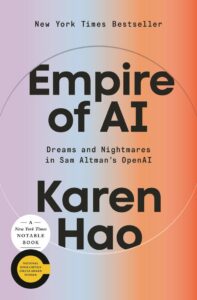
Empire of AI by Karen Hao
I came to Karen Hao’s riveting Empire of AI as a latecomer. I’d left Google before AI swallowed Silicon Valley whole, and for years I had little interest in catching up with its new cast of characters. Hao changed that.
While AI is sold as humanity’s next great leap forward, Hao shows that it rests on the same foundations as the last technology boom: labor exploitation, resource extraction, and the concentration of corporate power. AI doesn’t replace Silicon Valley’s business model. It supercharges it.
I’ve been out of my day-to-day tech life for quite a few years now, but the language seems to have barely changed. Companies racing to build AI are simultaneously constructing the infrastructure that hospitals, schools, militaries, and governments increasingly rely on, all while wrapping themselves in the same messianic rhetoric about “benefiting humanity” that I heard every day at Google. The stakes are higher, but the ideology is remarkably unchanged.
___________________________
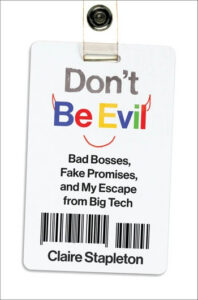
Don’t Be Evil: Bad Bosses, Fake Promises, and My Escape from Big Tech by Claire Stapleton. Copyright © 2026. Available from William Morrow, an imprint of HarperCollins Publishers.