By Literary Hub | Created at 2026-08-10 10:00:06 | Updated at 2026-08-10 11:01:15
1 hour ago
By Literary Hub | Created at 2026-08-10 10:00:06 | Updated at 2026-08-10 11:01:15
1 hour ago
Among the things troops carried with them on the battlefields of World War II was the “heart shield bible”—a pocket-sized, government-issued book of scripture, sometimes with a metal cover, that fit snugly in a G.I.’s standard-issue shirt pocket. In at least one remarkable case, this good book acted as life-saving armor. Generally, though, the Bible served its traditional purpose: to calm the conscience and divine celestial meaning.
Article continues after advertisement
When, at the age of 23, a draftee named Jerome David Salinger was sent to the front lines, he rejected Christian allegories, and wrote his own saga, complementing his battlefield kit with blank paper and a typewriter. Once, when his unit came under heavy fire, a soldier running for cover caught a glimpse of Salinger hunched under a table, clacking away like a frenzied newsman on deadline.
Now known internationally by his nom de plume, J.D. Salinger, the young conscript experienced many of the war’s most terrifying chapters. He stormed the beaches of Normandy, fought in the Battle of the Bulge, and helped liberate Kaufering, a subcamp of Dachau. Partial drafts of his work were carried along with him, soaked in Salinger’s sweat and imbued with his raw, instinctive reactions to conflict. His reflections were, in turn, refined into some of the first American texts to unapologetically challenge the pious image of the G.I. and the pretty myths about warfare. Salinger’s words also powerfully undercut America’s intoxicating model of masculinity, then, now, and forever the major motor driving U.S. military recruitment.
Salinger’s piercing stories quickly made him one of the loudest and most successful voices of the so-called Silent Generation. Like many, Salinger emerged from the war severely traumatized. He examined his wartime experience entirely through his writing of fiction. Rarely did he speak or write about his own service record, though his fleeting moments of personal candor were chilling. “You never really get the smell of burning flesh out of your nose entirely,” he once confided to his daughter. “No matter how long you live.”
Salinger’s words also powerfully undercut America’s intoxicating model of masculinity, then, now, and forever the major motor driving U.S. military recruitment.
His thoughts and theories about World War II were often disguised within domestic plot lines or set in military locales far away from the front lines. Only once did Salinger write about active conflict, in an unpublished short story called “The Magic Foxhole,” which catalogues the lost limbs (and minds) of some of America’s “soldier boys” during the bombing of Normandy. It’s a gruesome tale, especially for its time, one that feels like Salinger’s own tortured mediation on survivor’s guilt. Perhaps in writing it, Salinger was trying to negotiate whether his remarkable survival through some of the war’s worst gauntlets could be chalked up to dumb luck, or divine intervention.
“The Magic Foxhole” opens with a potent symbol of war’s profanity: a military chaplain crawling around frantically on all fours amid crashes of shellfire, searching for his glasses. God was nowhere to be seen. We then meet a young soldier named Gardner who miraculously navigates into all the foxholes spared from bombing. Gardner remains physically unscathed, but his mind has begun to unravel. At one point, he hallucinates another man in his foxhole with a futuristic helmet whom he believes to be his yet-to-be-born son, Earl.
While Gardner “looked nuts,” Salinger clarifies that he “wasn’t a loony.” Rather, he writes, Gardner is overcome with a form of battle fatigue “when you get to look like you’re dead, or when you start telling everybody real loud that you wish you was a civilian and not in no goddamn Army.” Near the end of the story, Gardner pledges to kill his imaginary son to spare him war’s toll, but backs out upon his wish to be transformed into a noble soldier. “I was going to shoot him,” Gardner explains coldly. “But he said he wanted to be here.”
Much of Salinger’s other writing during the war was channeled through a thinly fictionalized version of himself named Holden Caulfield. Holden is witty, cynical, and highly acidic, a self-described atheist who ruthlessly assails the war and its attendant institutions. After the armistice, Salinger returned home to Connecticut, where he refined his fragments into a fully coherent novel, The Catcher in the Rye, which turns 75 this year. It placed Holden at a private school outside Philadelphia named Pencey Prep, which was a stand-in for Salinger’s real alma mater: Valley Forge Military Academy. Salinger first arrived at the “Forge,” as insiders call it, in 1934 after flunking out of the Manhattan prep school McBurney, on Central Park West. He was fifteen years old.
The Forge largely catered to “bad apples,” and could be quite punishing. Shortly before Salinger matriculated, a cadet fell to his death from an academy window under suspicious circumstances. Like many cadets, Salinger was conflicted about the place. He penned a sentimental poem in his class yearbook that’s still recited at school gatherings, and in personal correspondence, he demonstrates a deep affection for the cadets who shared his experience. But he also channeled intense frustrations about the school in Catcher. While the Boy Scouts’ in-house organ, “Boy’s Life,” advertised the Forge as a bastion of military leadership, Salinger showed it be a repository for lost boys. “They don’t do any damn more molding at Pencey than they do at any other school,” Holden reflects on page one. “And I didn’t know anybody there that was splendid and clear-thinking and all. Maybe two guys. If that many. And they probably came to Pencey that way.”
In Salinger’s narrative, Pencey is plagued by a population of troubled youth, crooked teachers, and spoiled rich kids, a mixture that often begat abuse. The Forge was itself becoming exactly this, a mutant form of America’s most elite military academy, West Point, which was unleashed on a far younger study body. The school back then had a solid curriculum and robust extracurricular offerings, including a world-class band that played for numerous dignitaries, which later in the century would include President Richard Nixon. But there was also a kinetic, cold-blooded hazing environment thanks to the large swath of unruly cadets of all ages and backgrounds. This included, for a time, King Simeon, the exiled boy monarch of Bulgaria. While spit-shining his boots one day in the fall of 1958, Simeon declared to a local reporter his thirst to regain power abroad. “I was born to the crown,” he grumbled, “and I never abdicated, nor signed any papers giving up my reign.”
While subsequent military service was not mandatory at the Forge, as with most other military schools of this ilk, it nonetheless hosted a strong, voluntary officer commissioning program, plus a recruiting pipeline to the service academies. In turn, schools like the Forge birthed a new military archetype, whose adherents were often privileged, scrappy, and damaged—just as Holden Caulfield was.
Holden eagerly rebels against Pencey Prep, gets the boot, and flees to New York City, a place with its own vices and hazards, but without the sort of propaganda and pretense that obscure the school’s dark underside. Like most private military schoolboys, Holden is young. At sixteen he speaks with the resigned tone of a battle-drained war veteran. He’s grappling with pent-up sexual energy, a bad cigarette habit, and a bleak view of the world. In their 2013 biography Salinger, David Shields and Shane Salerno posit that Catcher was deeply informed by Salinger’s experience on the front lines. They report that he was hospitalized for psychiatric treatment during his time as an Army intelligence agent, where, among other things, he undertook harsh interrogations.
He emerged from this experience “incapable of believing in the heroic, noble ideals we like to think our cultural institutions uphold.” We see Salinger’s harsh sentiments about World War II early in Catcher, when Holden details the service of his brother, D.B. He informs Holden that the U.S. Army is “practically as full of bastards as the Nazis were.” On furlough, D.B. was despondent. “All he did was lie on his bed, practically,” Holden reports. “He hardly ever even came in the living room.” The passage is eerily similar to Salinger’s own state of mind while in uniform, specifically on a day that should have evoked ecstasy. When, on May 8, 1945, the Germany Army finally surrendered, Salinger spent the day in Europe alone, lying on a cot and staring at a .45-caliber pistol clutched in his hand, fantasizing about shooting his palm. Upon its publication in 1951, Catcher quickly became one of the most censored books in America.
While by the mid-50s the American boy’s fever for military validation was beginning to break, not everyone would get well. The literary poster child for the old type of soldier was Ernest Hemingway, who, like many men of his generation, had preordained military service as a child. As a kid in the early 1900s, Hemingway had reasoned simply that war was what “men had always done.” His starry-eyed thoughts about the service were blurry, and his vision was, too. After the Army rejected Hemingway from the ranks at eighteen due to his poor eyesight, he joined the Red Cross as an ambulance driver, navigating the front lines of Italy during World War I before being wounded in successive incidents by mortar and machine-gun fire.
Hemingway later found a second alternative path to battle, as a newspaperman. In August 1944, as part of his coverage of World War II, Hemingway took up arms to support the liberation of Paris. Soon after, he met with Salinger in the newly liberated city of love, more specifically at the bar of the Ritz hotel, where he had spent the lion’s share of his time since liberation day, holding court and swigging Perrier-Jouët champagne. Hemingway commended Salinger, then a twenty-five-year-old staff sergeant, on his short stories, and the two conversed for hours. “You have a marvelous ear,” Hemingway later wrote to Salinger. “And you write tenderly and lovingly without getting wet.”
Salinger saw in Hemingway a writer god and a kindred spirit. Still, he sometimes bristled at Hemingway’s unrelenting machismo, which, Salinger felt, often involved withholding the full truth of a soldier’s existence. In Catcher, Holden derides Hemingway’s A Farewell to Arms as a “phony book.” Salinger’s young alter ego also watches a war movie whose sentimentality nearly makes him vomit. Salinger once confided to a friend that he felt negatively toward Hemingway’s “overestimation of sheer physical courage, commonly called ‘guts,’ as a virtue” before admitting that “I’m short on [guts] myself.”—a rare admission for Salinger of military masculinity’s prevailing hold on his psyche.
Hemingway clearly saw truth in Salinger’s overriding thesis: that among the many things war destroyed were important parts of the self, like childhood innocence, inner peace, and optimism.
Below the surface of Hemingway’s puffery was poorly disguised pain. His work is wrought with tension around the invigorating, often self-destructive relationship between the American man and militarism. Nowhere is this interplay clearer than in The Sun Also Rises, a book about a war hero whose wounds have rendered him sexually impotent. Despite the differences between the two writers, Salinger came away from the Ritz rejuvenated to write. He was also surprised and somewhat comforted by Hemingway’s soft demeanor in person. Hemingway clearly saw truth in Salinger’s overriding thesis: that among the many things war destroyed were important parts of the self, like childhood innocence, inner peace, and optimism. While Hemingway never commented about Catcher publicly, he was said to have stored a dog-eared copy of the novel, personalized by Salinger, in his beloved Havana abode.
In an unpublished 1995 letter to a former Valley Forge classmate, Salinger expressed some regret for a sunny three-stanza poem he had written just before graduation, which was put on display in the school chapel after the author got famous. It reads, in part:
Hide not thy tears on this last day
Your sorrow has no shame;
To march no more midst lines of gray;
No longer play the game.
Four years have passed in joyful ways—
Wouldst stay those old times dear?
Then cherish now these fleeting days,
The few while you are here.
Salinger, then seventy-six, seemed to think his assessment of his alma mater had been too saccharine. “I’ve planned for years to stop by and either tear the exhibit down or at the very least add a little obscene graffiti at the bottom,” he wrote to his friend. Salinger reflected, too, on the “interesting collection of misfits” he had befriended at the Forge, and the memories they shared, bad and good.
Still, it was leaving military school that brought Salinger the greatest joy: “Though [the Forge], to me, was on the whole a thoroughly bad joke, its pretenses and posturing irreversibly sham, contemptible,” Salinger wrote, “I wonder if I ever again felt as free, as gratefully on the loose, as I did on that pretty walk to Wayne and the diner on a Sunday after signing out.”
In another as-yet unpublished piece of writing shared by his son, Matt, Salinger lamented the “profound handicap” produced in Americans at an early age. He called it an “unhealthy respect for nominal authority.” Speaking for himself, Salinger wrote: “The conditioning was variable and yet incessant in my childhood and youth. The absolute authority of my parents (who were ignorant people), the absolute authority of almost all public elementary teachers in the twenties and thirties (most of whom, or many of whom, were power-lovers, sour old maids, with rare and beautiful exceptions), and then, later, military school and the ruthless authority, absolute power of the faculty and cadet officers and non-coms (as terrible a bunch, on the whole, as the mind can imagine).”
The flip side of Salinger’s bleak depiction is a childhood full of free expression and natural development, unburdened by the power, rules, and discipline imposed by world-weary adults and those prone to power.
______________________________
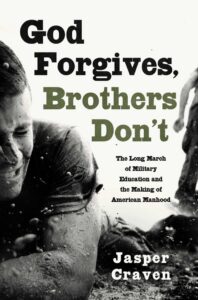
God Forgives, Brothers Don’t: The Long March of Military Education and the Making of American Manhood by Jasper Craven is available from Atria/One Signal Publishers, an imprint of Simon & Schuster.