By CryptoSlate | Created at 2026-10-05 00:19:15 | Updated at 2026-10-05 00:57:11
56 minutes ago
By CryptoSlate | Created at 2026-10-05 00:19:15 | Updated at 2026-10-05 00:57:11
56 minutes ago
El Salvador secured access to $138 million from the IMF while recommitting to limits on further state Bitcoin accumulation.
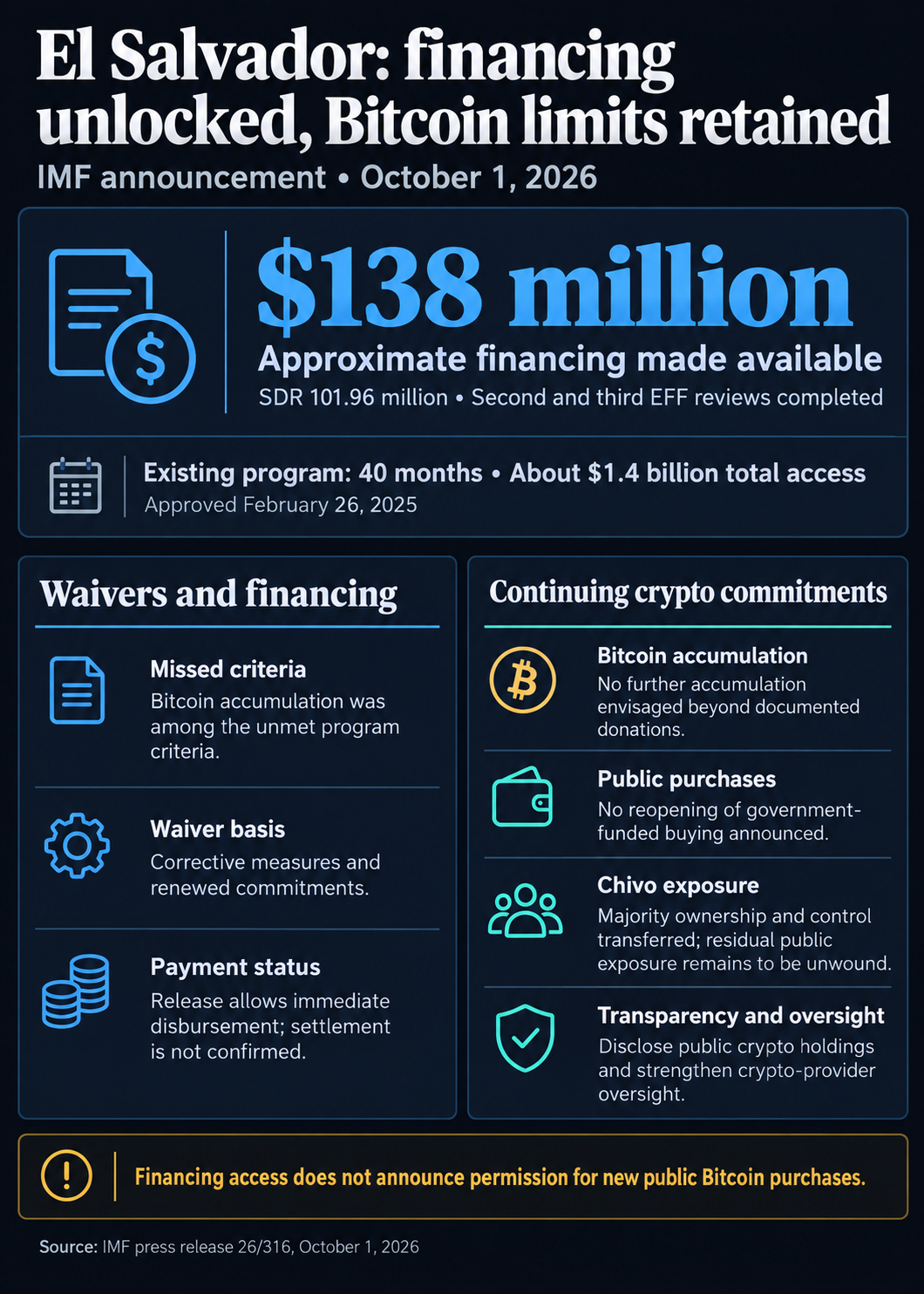
The International Monetary Fund (IMF) completed the second and third reviews of the country’s $1.4 billion loan program on Oct. 1, allowing an immediate disbursement equivalent to SDR 101.96 million, or $138 million. The board also granted waivers for unmet performance criteria tied to Bitcoin accumulation after authorities took corrective measures and renewed their commitments.
Those waivers keep financing flowing despite earlier breaches, while leaving the program’s direction on Bitcoin unchanged. The IMF said no further accumulation is envisaged beyond documented donations, preserving a constraint that prevents the government from resuming publicly funded purchases under the program.
El Salvador currently holds about 7,794.37 Bitcoin valued at roughly $666.1 million. The size of that reserve has continued to draw attention because additions to government-linked wallets appear inconsistent with the IMF agreement.
The Fund has previously distinguished between Bitcoin acquired with public money and coins received through documented donations. That distinction remains central after the latest review: reserve balances can still rise without signaling that President Nayib Bukele’s government has restarted purchases.
Bitcoin waiver keeps restrictions intact
The Bitcoin concession formed part of a broader review in which the IMF said fiscal consolidation was advancing broadly in line with program objectives and reserve and liquidity targets had been comfortably met. The 40-month Extended Fund Facility was approved in February 2025 and is designed to support fiscal adjustment, stronger reserves and financial-sector reforms.
The Fund also cited progress in reducing the state’s direct role in crypto. The government has transferred majority ownership and control of the government-backed Chivo wallet to a private operator, though the IMF said remaining public-sector exposure should still be fully unwound.
That leaves several Bitcoin-related obligations unresolved even as another tranche of financing becomes available.
The IMF wants El Salvador to improve disclosure of public-sector crypto holdings, strengthen regulation and governance for digital-asset providers and amend its Digital Asset Issuance Law where necessary. Those measures sit alongside the continued commitment to avoid additional government-funded Bitcoin accumulation.
The restrictions give the government less room to use its balance sheet to expand the Bitcoin reserve while remaining inside the IMF program, even as higher BTC prices increase the value of the holdings it already controls.
Future reviews will therefore hinge partly on whether El Salvador can document how its Bitcoin balance changes while completing the remaining Chivo unwind and transparency reforms. Any unexplained accumulation could again force the government to seek waivers before accessing further program financing.