By The Rio Times | Created at 2026-10-09 06:07:09 | Updated at 2026-10-09 08:01:34
2 hours ago
By The Rio Times | Created at 2026-10-09 06:07:09 | Updated at 2026-10-09 08:01:34
2 hours ago

BUSINESS · ETHIOPIA
Key Facts
- —The country Ethiopia, Africa’s second most populous nation, is opening its banks, stock exchange and property market to foreign money.
- —Why it matters Every company must now tell the government which real people own or control it, a basic test foreign investors and lenders apply.
- —Why now The Ministry of Justice said on 25 September that the rule is in force; the first three-month step falls around Saturday 10 October.
- —What happened Council of Ministers Regulation No. 592, published on Friday 10 July, gives existing firms six months to file owner details.
- —The numbers Stakes of 2% in financial firms, 5% in private firms and 10% in share companies trigger disclosure; fines reach 500,000 birr (about US$3,100).
- —What it means for US readers US investors buying Ethiopian shares or setting up there must file owner data, and Ethiopia may share it with foreign authorities.
- —Still open Whether the registry will be ready in time, and how strictly the ministry will enforce fines and licence suspensions.
Every company registered in Ethiopia must now disclose the real people who own or control it, under an Ethiopia beneficial ownership rule that the government says is in force. Existing firms have six months to file the details with the Ministry of Trade and Regional Integration. For American investors eyeing Ethiopia’s newly opened banks, stock exchange and property market, it adds a compliance step and a new layer of scrutiny.
The rule is Council of Ministers Regulation No. 592, signed by Prime Minister Abiy Ahmed. Abiy has led the government since 2018 and heads the ruling Prosperity Party. The text appeared in the Federal Negarit Gazette, the official law gazette, on Friday 10 July 2026.
The Amharic-language weekly The Reporter detailed the regulation on Wednesday 7 October (translated). It said the Ministry of Justice announced on Friday 25 September, on its website, that the rule was being implemented. The business site Birr Metrics reported the same deadlines and penalties in August.
What the New Rule Requires
A beneficial owner is the natural person who ultimately owns or controls a company, even through nominees or other firms. The regulation is issued under Ethiopia’s anti-money-laundering law, Proclamation No. 780, as amended by Proclamation No. 1387.
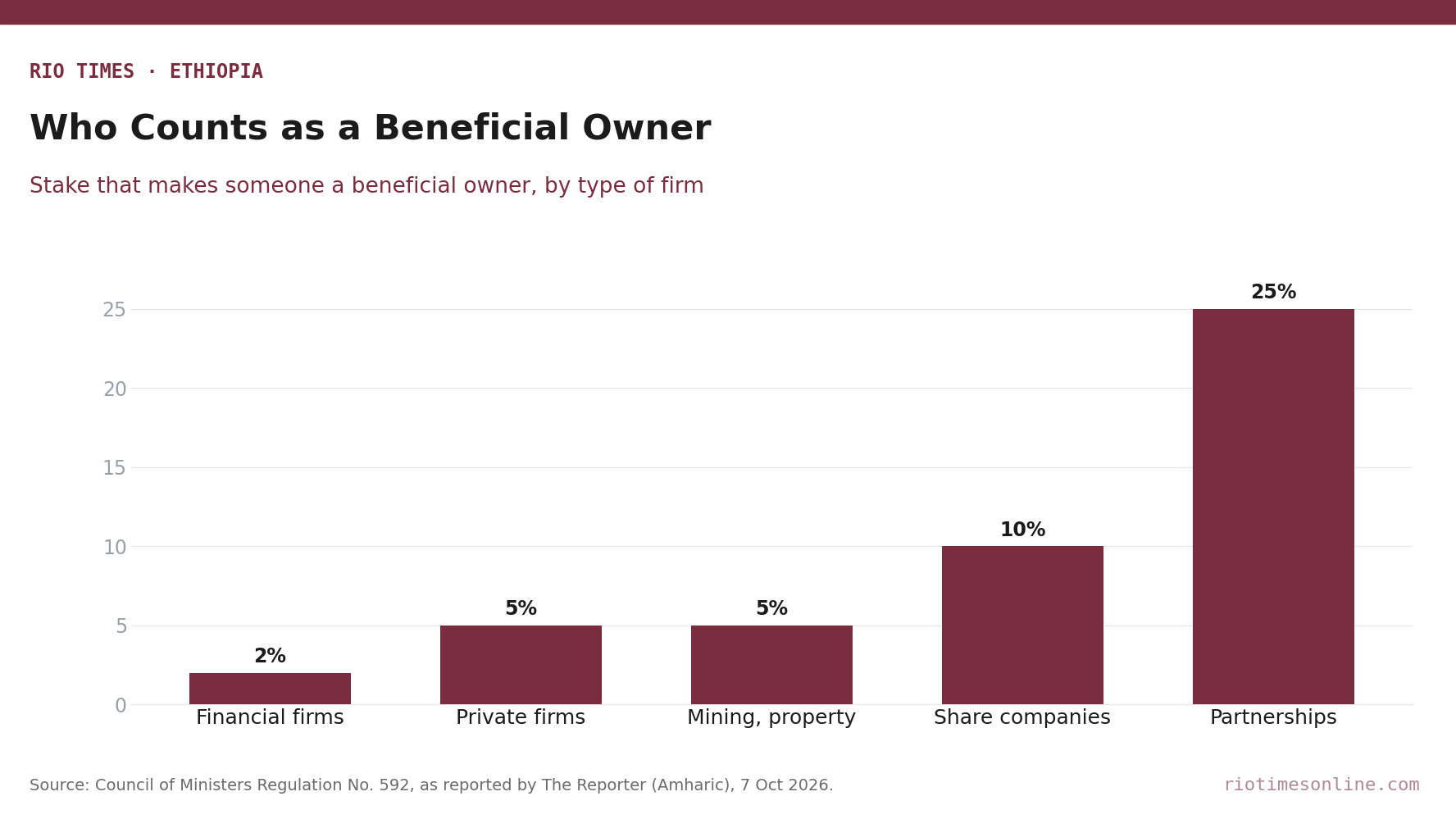
The ownership line depends on the type of firm. In a share company, anyone holding 10% or more of the shares or of convertible debt counts. In mining, real estate, car dealing and import-export, the line drops to 5%.
In a private limited company the threshold is 5%. Partnerships and public-private partnerships use 25%. Banks and other financial institutions face the tightest test: any person with 2% of the shares or voting rights is covered.
Control without shares also counts. That includes the right to appoint or remove directors, financing that brings influence, and senior managers who run the firm day to day.
Firms must record each owner’s full name, date and place of birth, nationality, address, phone, email and occupation. They must also log identity document numbers, such as the Fayda digital ID or a passport, and whether the owner is a politically exposed person.
Each company must name an information officer, review its owner data at least twice a year and report any change within 14 days. Foreign companies entering Ethiopia must file authenticated owner data before they register. Birr Metrics says civil society groups, wholly state-owned enterprises, cooperatives, religious bodies and political parties are exempt.
Follow this story
Get an email when there’s news on Ethiopia
Free. One email a day at most, and only when there is news. This also signs you up to our weekday newsletter, Africa Intelligence. Nothing arrives until you click the confirmation link, and you can stop either with one click. Privacy policy.
Deadlines and Penalties
Under the transitional article, existing firms must gather and hold their owner data within three months of the rule taking effect. They must submit it to the ministry within six months. The ministry may extend that by up to two months.
Counted from publication on 10 July, that puts the first step around 10 October and the filing deadline around 10 January 2027, as Birr Metrics also calculated. The ministry has not published its own countdown.
Late, incomplete or false filings can draw fines of 100,000 to 500,000 birr (about US$620 to US$3,100). Amounts are converted at about 161 birr per US dollar, the National Bank of Ethiopia’s indicative rate on Friday 9 October.
Firms that skip reviews or fail to appoint an officer risk having trade licences suspended or cancelled. Other listed breaches can cost a firm its business registration. No business registration, trade licence or investment permit will be issued or renewed until the owner data is filed.
The ministry may also bar offenders from public procurement and publish their names. Inactive companies are to be identified, named and struck off. On the protective side, the rule lets the ministry shield an owner’s data where disclosure would expose them to fraud, kidnapping or threats, and it requires confidentiality.
What It Means for US Readers
Ethiopia has opened its banking sector to foreign lenders, and Two Foreign Banks Apply to Open in Ethiopia shows the first applicants arriving. The 2% bank threshold means even small foreign stakes in Ethiopian lenders will be named.
US funds buying shares on the Ethiopian Securities Exchange, or companies forming local subsidiaries, should expect to file owner data. Documents issued abroad must be authenticated and verified through Ethiopia’s Ministry of Foreign Affairs.
Article 34 lets the ministry share beneficial ownership data with counterpart authorities abroad, on request or on its own initiative. That gives US investigators a new channel into Ethiopian company records.
The direction differs from Washington’s. Since March 2025, the US Treasury’s Financial Crimes Enforcement Network no longer requires domestic US companies to report their beneficial owners. For investors, a clearer Ethiopia beneficial ownership register can lower due-diligence costs, while weak enforcement would limit that gain. Currency access remains a separate hurdle, as Ethiopia Plans US$840 Million in Dollar Auctions explains.
What Is Not Known
We could not open the Ministry of Justice notice or the gazette text directly, so the details rely on The Reporter’s reading of the regulation, cross-checked against Birr Metrics. The ministry has not said how many companies must file.
Birr Metrics reports that the central registry’s IT system is targeted for March 2027, after the January deadline. It is not clear how firms will file before then, or whether the ministry will use its two-month extension.
It is also not known how strictly fines and licence suspensions will be applied, or how the Ethiopia beneficial ownership rule will treat foreign funds with layered ownership.
Frequently Asked Questions
What does Ethiopia’s beneficial ownership rule require?
Every company registered in Ethiopia must identify the real people who own or control it and file their details with the Ministry of Trade and Regional Integration under Council of Ministers Regulation No. 592.
When is the deadline for existing companies?
Existing firms must gather owner data within three months and submit it within six months of the rule taking effect. Counted from publication on 10 July 2026, that is around 10 January 2027. The ministry may extend it by up to two months.
Who counts as a beneficial owner?
Anyone holding 10% of a share company, 5% of a private limited company or of firms in mining, real estate, car dealing or import-export, 25% of a partnership, or 2% of a financial institution, plus people with control by other means.
What are the penalties?
Fines of 100,000 to 500,000 birr (about US$620 to US$3,100), suspension or cancellation of licences, loss of business registration, exclusion from public procurement and public naming.
Does it affect US investors?
Yes. Foreign companies must file authenticated owner data before registering in Ethiopia, and the ministry may share the data with authorities abroad.
Sources: Council of Ministers Regulation No. 592 as reported by The Reporter (Amharic), 7 October 2026; Birr Metrics, August 2026; National Bank of Ethiopia, market and rates.
Editorial responsibility: Matthias Camenzind, Editor-in-Chief · Editorial standards · Report an error